by Liz Levin
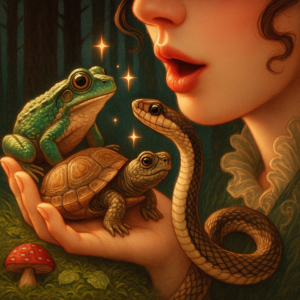
I get the alert about Corinne’s death while Terrible and I are fighting about words. Namely, which ones I should say next time I’m around other humans. He’s lying in the river beside the cottage. Each time he speaks, he heaves his head out of the water. When he’s done, he lets his 300-pound noggin crash below the surface, splashing everything. I’m standing on the muddy riverbank, soaked.
He’s named for terrible crocodile, the English translation of Deinosuchus, his most likely genus. Generally, I don’t speak reptiles or amphibians into existence that died out before we humans spoke English (or existed). Terrible is an exception. He’s demanding I read Chaucer around humans. I remind him I’ve barely begun reciting the Oxford English Dictionary’s nearly 50,000 obsolete words. At a rate of two dozen a day, I’ll finish in five years.
Terrible isn’t convinced.
“But I was alive during the Cretaceous! You think my mate hides in a list of barely dead words?”
“Why not?” I ask. “A common word created you.” He drops beneath the water, soaking me to my neck. “Merde. Keep your head above water while we’re talking. You’re over 30 feet long. You’ll empty the river.” Terrible was designed to eat dinosaurs, and it shows.
“Common word,” grumbles Terrible. “There’s nothing common about me.”
I couldn’t agree more, but we both know I wasn’t capable of linguistic feats on my curse day, five years ago this Saturday. Terrible was born on that day, before I found the cottage and before I started recording what I say within earshot of humans so I can replay it to determine which species belongs to each word. I’ve tried to recreate those first impassioned sentences I said in front of Mama and Corinne, but as much as I try, I’ve never birthed another Deinosuchus. And though I’ve uttered the curse that made Serpent, that word has never birthed another.
You may wonder why I say birth or born. After all, lizards and amphibians drop from my lips when I speak English within earshot of humans, not from my womb (thankfully). I ask you, are there better words? I’ve tried vomit. None of the creatures born speaking like that.
“Is he still complaining, Vivienne?” asks Serpent, gliding across the mud to coil up my leg and around my waist, like an ornate belt. He’s pretty enough to seduce Eve. His skin bears a geometric pattern of emerald, sapphire, and gold. “Living gems,” he likes to say, “much better than your sister’s dead rocks and flowers.” He’s not wrong. “You haven’t made a girl for me, and you don’t hear me complaining.”
“Another of you?” I cross my arms and shiver, even though it’s 86 and humid. “Terrifying. Last thing we need is you reproducing.”
“Impossible to improve perfection,” Serpent says. “Too true. But I came to tell you your light-up machine interrupted my sunbath.”
I glance at my phone on the picnic table, a safe distance from the river. Electronics and brackish water don’t mix.
“I’m working on it, Terrible.” He’s moved his head below water again. I talk to his bulbous eyes. “I know you’re lonely.” I am too. I don’t say it aloud. I don’t want to offend anyone.
“Putain de merde.” Corinne Barreau, Wife of Phoenix’s Golf Course King, Dies at 22.
The service is Saturday, on the fifth anniversary of our curse.
* * *
I ride my mountain bike along deer trails until I reach the Phoenix exit. Turning back toward the woods, I see an electrified fence topped by razor wire. Signs caution: Toxic dumping site. Stay out. Behind the fence lies desert. If I turned back with the intent of entering, I would find an unlocked door. Behind it is a primeval forest with sequoia-sized trees.
That’s the ecosystem outside Phoenix, but the woods are a patchwork of habitats, from deciduous forests to tundra, from peat bogs to estuaries, like the one by our cottage. I’ve wondered whether our cottage is beside an estuary because it’s where women with our curse always live (if we survive) or did the cottage move to the biome Terrible would need?
I’ll leave it to you to answer that question.
I like to think that this wild place contains all the famous cottages, even Baba Yaga’s chicken leg house. So far, I’ve found it disappointingly empty of humans and witches.
And fairies, thankfully.
Serpent is cozy in the granny basket as I ride six miles to the Golf Course King’s estate, a.k.a. Hugo Von Brandt, my ex-fiancé. It’s dawn and Phoenix is unbearable. I arrive early to wash up in the pool house. Unscrewing the pineapple-shaped finial from the iron railing beside the door, I retrieve the key. I change from dusty cutoffs to the requisite black dress, and an opaque black veil looped to catch anything that drops from my mouth. I don’t plan on speaking English. Mama spoke French in our home. I’m fluent enough to pass as a native, a ruse I’ve played before, but it’s dangerous here. After all, Mama thinks I’m dead.
I shoulder my backpack, leaving it open at the top and cautioning Serpent not to stick his head out. He’s a curious snake.
The service is in the greenhouse. My veil sticks to my face in the humidity. My sister is the only one here, lying in a sapphire-colored casket beside the podium. I walk down the center aisle, past empty chairs. Before I revealed Mama’s lies and poisoned our engagement, Hugo and I were to be married here.
Oh, Corinne. In death, she looks like porcelain. Fragile. Like someone who would shatter under an ambition like Mama’s.
As the favored child, I had years to build defenses against Mama’s avarice disguised as affection. People say I looked like Mama from birth, and so, like a good little narcissist, she loved me at first sight. Corinne, my junior by a year, looked like the lover who left her. Accordingly, Mama handed her a broom when she was in kindergarten.
Classmates thought it better to be me than her, even though they adored Corinne. They saw Mama lavish me with unmerited praise; they saw the patches on Corinne’s hand-me-downs. They were right enough. I helped when Mama wasn’t watching, but after Mama caught me chopping fennel for Mama’s favorite bouillabaisse — my recipe perfected over years — she punished Corinne.
Mama ordered her to draw water from the new wishing well that had appeared the day after the mayor admonished the media for implying Phoenix was running out of water. Corinne returned and Mama emptied the pitcher on the cacti while scolding her youngest. Corinne’s apology yielded a tiger lily, uncut emerald, and thorned rose that dripped blood. Mama sent me to the now blessed well.
“You can still save this engagement, mon bijou. If your pathetic sister can win a blessing, so can you.” I suggested she go in my stead. She rubbed her neck, swallowed, and gestured toward the door. Oh Mama, I understood you well. Even then. You knew the price.
When a fairy disguised as a princess requested water, she looked as though she stood behind a screen of bloody thorns. I refused and she cursed me. Or so the story goes. The well disappeared. Mama said we needed to talk, drove me to an empty patch of desert, and left me. If I hadn’t uttered that curse after she left, birthing Serpent who led me to our cottage, I would have died. Even with his help, I nearly did.
Someone moves beside me and the casket. Trim in a custom suit, blond hair freshly cut, skin leathered from the links: the Golf Course King of Phoenix, Hugo Von Brandt, the golden chariot to wealth Mama raised me to catch.
Hugo doesn’t recognize me in my veil. “Gorgeous, isn’t she?” He nods to Corinne’s heart-shaped face and soft brown hair. “You knew her? We all miss her more than words can express. She had so much left to offer.”
I choke back a curse before it becomes a word. It sounds like a sob. To offer? Like diamonds for the price of a word? How would Hugo pay to water his expanding empire now? I bow my head before I walk away. He doesn’t comment on my silence.
During the ceremony, I lean against a shadowed pillar and listen to Spanish-speaking servants praise the late Mrs. Von Brandt who always spoke to them in their language. The chef tells a humorous story about her notorious hatred for smart phones, and how she tricked him into giving his phone to her for the day to help him overcome his addiction. I straighten at that. What were you planning, Corinne? Hugo or Mama manufactured her hatred of phones, for certain. If her curse worked as mine does, she could type English words without activating her blessing. My movement wakes Serpent. He drapes himself across my shoulders, hidden by the veil, whispering questions in my ear while I shush him.
The group in front of me gossips through the last speeches.
“Did you hear how she went?”
“Choked.”
“My ex performed the Heimlich on a guy at a steakhouse.”
“She wasn’t eating when she died.”
“They say they found her—”
I squeeze through the crowds until I’m in the main house, on my way to the room Hugo said would belong to me after we wed. Serpent and I search for anything that will tell the story of Corinne’s death, or life. He slithers under and behind while I scrutinize photographs of carnivorous flowers hanging from clothespins. She had an artist’s eye, even if photography was never her specialty.
After moving a three-shelf bookcase, at Serpent’s suggestion, I find a safe built into the wall. Or magicked there; it resembles the one in my cottage. Just like mine, I find no obvious lock. There is an iron sculpture of a carnivorous pitcher plant. “Do you think it works like mine?”
“Only one way to tell.”
With trepidation, I lift a finger to the bulbous flower, preparing to plunge it into the dark opening. My safe features a cobra’s open mouth. I survived my first attempt to open that safe. Unlike this one, it was designed for someone with my cursed blessing. “Wish me luck!”
“You already have me.”
I’m not surprised when the flower’s cylinder constricts around my finger. I feel a sharp jab before the pressure releases and the door pops opened. My finger numbs, then my hand. Already it’s spread more than my safe’s toxin does. I’m immune to reptiles’ and amphibians’ toxins and venom. Here’s hoping flower toxins are similar enough. Only my immunity is magical, not biological, and there’s no promise I’d be protected even if the safes’ toxins were chemical twins. The numbness creeps above my wrist before I panic.
“Serpent, help!” I whimper. He strikes, biting the inside of my elbow, right above the line of numbness. The sharp pain of Serpent’s venom chases back the numbing effect of the safe’s toxin. It’s like the blasting away of cobwebs, followed by the clarity of knowledge.
After wiggling my fingers to shake away the pain, I open the door to the small safe and slide her journals into my backpack. I hesitate before adding the pouches of gemstones. I’ll make better use of them than Hugo or Mama would. In the attached bathroom, I wash my face and change back. I wrap a floral scarf over my hair and around my face to hide my identity (it’s too lightweight to support births) and leave this gilded cage.
* * *
I’m pushing up my kickstand, congratulating myself on my smooth exit, when Mama finds me. “Vivienne! I thought that was you, my sweetest daughter!” she cries in French. She’s wearing white, elbow-length gloves with shiny black buttons and a black sundress with a scattering of white roses trailing down the belled skirt. Her chestnut hair is gathered in a soft roll. She looks chic, just as I remember her. “I thought I’d lost you, but here you are, like a miracle on the day of my greatest sadness.” I don’t respond as she smooths away my veil and kisses my cheeks. She misunderstands my silence. “Oh, sweetest girl, you can speak to me in French. Your… gift. It only happens when you speak English. Use our mother tongue and you will have no worries.”
Gift? I wonder, tensing. Why does she think I have a gift? She was first to call it a curse. It is never good when Mama changes her mind. I sit forward on my bike. She stands in front of the wheel, grasping the handlebars. Trapping me in her false affection. I shift forward slightly, testing her hold. She gives a nervous laugh and takes a step back on her red-bottomed heels. “Careful, sweetest! You only have one Mama. Best not to run her over.”
I shrug. “You didn’t lose me, Mama,” I finally respond, in French. “You kicked me out. I almost died.”
She tilts her head and smiles. “But you aren’t dead. You left the car when I was distraught, incoherent, unable to give chase, and you survived. You thrived. You are still so beautiful, my sweetest Vivienne, even like this.” She caresses my head, masking her sneer. My hair is long, like hers, but the chestnut waves are dull and snarled. I ran out of conditioner last month and haven’t gotten a chance to buy more. I’ve been selling rare breeds of reptiles and amphibians to the San Diego Zoo. I like their conservation programs and my contact. We speak in Spanish, his first language. He believes that French is mine. Sometimes he tries to teach me a few English words. I decline. His hair is black, shoulder-length, glossy. I’m sure he uses conditioner.
“I need to go, Mama.” I turn the wheel and rock forward on my bike. Just a bit more and I’ll be able to roll by her. We’re far from the parking lot and I know this area. I’ll lose her, easily.
“No, don’t you leave.” She’s replaced sugar with steel. This is her Corinne tone. Is it any wonder my younger sister acquiesced when Mama finally coated her words with sweetness and acted as though she’d always loved her? But that won’t be me. “I figured out your sister’s gift,” she says, drawing a gold notebook from her clutch. She opens it, revealing a handwritten lexicon so like the one I left in the cottage, it makes my eyes smart. These moments are the most devastating. When Mama does something that demonstrates that she was right. We are the same. Even our handwriting is almost identical. “See, at first the gift seems random. You speak, and out fall hideous toads and frogs, of no value to anyone. But all we need to do is what I did with your sister. We just need to find the words that make the valuable things, like alligators that can make beautiful bags. She caresses her clutch. The pattern is subtle, just like the smooth skin of an alligator’s belly.
“Can I see?” I ask, reaching for the notebook. She steps to the side to hand it to me and I’m off, wheels spinning over the pavement, past split-levels with hardscaped yards and alleys until I’m out of the city and on my way home.
* * *
I stop a few times to hydrate and make frogs outside gas stations. I duck my chin into my open backpack, pretending to search for something. I speak the words as customers enter and leave convenience stores, just loudly enough to register without inviting a response. I know the words that create males and females of all six species of leopard frog endangered in Arizona. I choose a species and make two dozen males and two dozen females. Serpent grumbles from his spot beneath the frogs.
I stop at a sheltered spot on the way to the Phoenix entrance and acquaint them with their new habitat. None of them talk to me. It isn’t surprising. I’ve created a lot of leopard frogs over the years. Mostly, they only speak when they are the first of their species.
“Home?” asks Serpent. I nod. “Finally.” He falls back to sleep on top of my funeral veil and dress.
I study Corinne’s journals before bed. Most are pre-curse, filled with charcoal drawings of high school friends drawn with scales and tails, fawning over a sad doe wearing Corinne’s face. They offer her small things — pencils and dandelions — while gossiping about her helplessness. Small breasts, small bones, small dreams. Mama is absent. When I appear, I am human and alone, clenched jaw and furrowed brow. If she saw me now, I’d look the same.
I open the last journal. The top two-thirds of each page is filled with colorful scenes of monstrous people, interspersed with words, each composed of a particular flower or gem. The words drip in blood that dries beneath the too-bright sun. The bottom third of each page depicts charcoal caves beneath the earth’s surface where humans lie on hammocks, dreaming.
This is Corinne’s lexicon, I realize. Not the tidy gold journal filled with Mama’s even loops.
* * *
Sharp knocking wakes me the next morning. I’m lying on my side, a wedge pillow at my back and a body pillow between my legs to keep me in position. Serpent lies coiled beside my face, ready to bite me if I roll over onto my back. These are just precautions. Even if I talk in my sleep, my words shouldn’t matter because I’m the only human around.
“That we’ve seen,” Serpent would caution. If I believed his horror stories, I’d think there are hordes of humans outside this cottage, with their ears pressed to the thin walls, just waiting for me to mumble something in my sleep.
The knocking. There are people and I’m not dreaming. I rub my face and crawl over pillows, tripping my way to the bathroom. It’s small, with a corner shower and a pedestal sink, but it’s plenty of space for me. I wash my face and gather my knotted hair into a bun. I’m wearing sleep shorts and a camisole, but anyone who is at my door at the tender hour of… noon… can deal with it. This is my first visitor so it’s on me to set low expectations.
I walk through the family room, past an overstuffed sofa, and gecko-print-covered recliners. (No, I didn’t buy it. The cottage knew I was coming, just as it will know when you’re on your way.) The artwork changes each time I sleep. Today, a black and white photo of Terrible spans the sofa’s width. His mouth is open, showcasing his teeth. I open the door, and Mama drops the bronze salamander-shaped knocker. She’s incongruous in her pleated black slacks and cream blouse. Behind her, an Escalade sits on a freshly paved driveway that connects to a road. Last night, there was a dirt trail barely wide enough for my bike’s tires. My gaze skitters between the new features. Finally, I say, “There’s a road?” I barely catch the American toad, common garter snake, and snapping turtle that fall from my lips.
“In French,” Mama reminds me, shouldering past me into the cramped family room. “Really, sweetest, did you just wake up? You’ve wasted half the day.” She sets her alligator-skin purse on the coffee table, shifting aside my dogeared copy of Amphibians of North America, and directs a blinding smile my way. “Are you ready to get to work? I’ve made a list of all the best ones.”
Maybe she’ll leave if I ignore her. I walk into the dining room and open three of the empty terrariums sitting on the long table. I place an animal in each, add water and dried food, and return to the family room.
Mama is still there, now holding a green notebook. Her smile is gone. “Is this any way to treat your mama? You offer food to those pests before you offer me a glass of wine? What happened to the manners I taught you, Vivienne?”
“I don’t have wine,” I say in French.
“No matter,” she says, gesturing as though to wipe away the last ten minutes. “As I was saying, I know how to make us rich.”
“Aren’t you already rich?” I ask. “Don’t tell me you didn’t profit off Corinne’s gift.”
Mama glances away, widens her eyes at Terrible’s photo, before meeting my gaze. She takes a deep, yoga breath, exhales, and sits on the edge of the couch with her back to the photo. Hoop earrings shimmer like pearls. Nacre, or mother-of-pearl, the luminescent secretion mollusks use to coat errant grains of sand. Pearls are rare. Mother-of-pearl coats the inside of every mollusk shell. The earrings are cheap, considering.
She sighs, rests her face in her hands, rubs it gently. When she looks up, lipstick, liner, foundation, and powder are unmarred. “I made a mistake, mon ange. I went straight to your ex-fiancé and shared the news of Corinne’s gift. He married her, of course. He was no fool. After that day, he never left me alone with Corinne. Not until he left town for business. And then we barely got started before…”
She pauses, shakes her head as though to redirect her thoughts.
“But with you, I’ve learned. You were always the better daughter, sweet Vivienne. I’m so sorry I didn’t see your potential at once.” She opens the green notebook. There, in slender loops like mine, she has written a plan to monetize my curse, because if I used it the way she suggests, it would curse all who breathed life through my words. “Some of them aren’t pests, see? Some have purpose.”
I take the book, her earrings swaying as I pull it from her grasp. I glance away before she notices my tears. In French, I say, “Mama, why don’t you get yourself a glass of water while I read.”
I open the door, muttering “mother-fucking nacre” before I’m out of earshot. I catch a warty toad for the compound adjective and an unknown crocodilian. I set them on the picnic table, rubbing my finger across the crocodilian’s back. I’d forgotten nacre was identical in English and French. I’d research its species later. On the muddy banks of the river, I draw my knees to my chest and wait.
It isn’t long before Serpent joins me. “You heard?” I ask.
“I was under the couch. Slid out the snake door when your mother was in the kitchen.”
Terrible splashes up from the river, hoisting his front legs onto muddy land. I glance at my drenched sleep shorts and camisole, thankful I’d chosen black. The sun is at its zenith, drying the beads of water off my arm. I rest my head on my knees. “I don’t know what to do about her,” I say.
No one speaks. Terrible wasn’t there to hear Mama, but he knows the stories. They both do. Five years together. Worth more than my twenty with Mama.
“Did you hear what she said about Corinne?” Serpent finally says.
“What did that witch say?” Terrible asks. I’m surprised. He likes the witches in the stories I read to them. He says they have the best parts.
Serpent’s voice shifts to a high-pitched whine that sounds nothing like Mama. “’After that day, he never left me alone with Corinne. Not until he left town for business. And then we barely got started before…’” It takes me a moment to ignore the voice and process the words.
“You think…”
“I do.”
“What do you think?” I ask. I don’t even know what I think.
“That the witch killed your sister,” Terrible says. “That’s how it always goes.”
“I don’t know,” I say.
“Ask her,” Serpent says.
“And then?” I ask.
* * *
I move the picnic table closer to the water. I set the green notebook on top. Terrible’s bulbous eyes watch me. Serpent slithers across my shoulders, silent. I say, “Our plan is horrible.” I touch the green notebook, thinking of Mama, the crimes she’s proposed, and the one she may already have committed. “Maybe she didn’t do it.”
I return to the cottage to gather Mama. “Let’s sit in the sun to talk.”
She follows, grimacing at the muddy ground and weathered bench. She sits and disturbs the air with talk of alligator hides and import laws. “But don’t fret. I’ll handle logistics. You study your gift. Do you know which words link to each species? So often it’s nonsensical. You know what Corinne said for opal?” She whispers a crude word. I laugh, surprising us both.
“Mama, what happened to Corinne when Hugo left? I know something happened.” I pause, rest my hand on top of hers. “I won’t blame you.”
Her eyes glisten. She cried in just this way — a few tears that didn’t smudge her eyeliner — when she drove me to the desert five years ago. “Oh, Vivienne, mon bijou, it was tragic. We finally had time alone, our first since the wedding, and your sister refused to help. She just wanted to talk. In French! I gave her wine and a few pills, just to relax. She was so tense! I tucked her into bed like when you were girls.” She never did that. For either of us. “Left for a moment — to grab a glass of merlot and our notebook — and when I returned, she was still.”
“Why, Mama? Why was she still?”
“Her mouth, her throat.” She looked up at me and her face was wet, eyes smudged. “Filled with pearls.” She looked around, probably wishing for her purse and its tissues, before she rubbed her hands across her face and dried them on her pleated black slacks. “But that’s all in the past. Now I, we, can start over.”
“You’re right,” I say. “Stay here a moment, Mama. I’ll get your tissues for you.” I look to Terrible as I leave, all but his eyes beneath the water, invisible if you don’t know where to look.
I wrap myself in a robe before sitting on the gecko-patterned recliner. Even after an hour in the sun, my clothes are damp. I lean back and study Terrible’s photo. After the third sniff, I open Mama’s clutch and dig out the package of tissues.
I think about pearls. A common grain of sand inspires its creation; common words produce them. Before Mama left me in the desert, she punished Corinne for my curse. “You ruined your sister,” she said, as she held the painting Corinne had gifted her on Mothers’ Day over the kitchen sink and set it on fire. Corinne cried, “Mama, stop, mama, stop, mama, stop,” and black and white pearls bounced across the floor.
When I left my childhood house, I still believed Corinne was gifted. She’d leave, I thought, Mama would have nothing, and Corinne would have everything.
I almost died in the desert. Serpent saved me, led me to the cottage. Years later, when I made it out of the woods, I learned of her marriage. Hugo is an ass, I thought. But at least she’s away from Mama.
I should have known how much a person will do for a bit of sweetness, after a lifetime without. Delirious from a mix of alcohol and sedatives, Corinne pleaded with the woman who cried only crocodile tears. And she died, choking on pearls.
* * *
I shower and change into clean clothes before I go outside. Mama is gone. A hybrid pickup sits in the Escalade’s place on a drive that now curves toward the San Diego entrance. I lift the cover on the truck bed to find it filled with premium habitats. I sigh, not happy, exactly, but relieved that the cottage agrees with my choice.
Terrible lies beside the river, bulbous eyes closed. His back looks like a mountain range, burnished copper in the sun. Like Serpent, he is a living treasure. “Well?” I ask because I probably should.
He grunts.
“Indigestion,” Serpent says. The unknown crocodilian lies beside Serpent, sunbathing.
“Do you know the species?” I ask because I’ve given up predicting what Serpent knows.
“She hasn’t said.”
Terrible raises his head from the water and lets out a nauseating belch. I pinch my nose until the odor clears. I wipe the tears from my eyes and rest my palm on the ground beside the baby crocodilian. “You speak?” I stroke her baby-soft skin. Someday the nubs on her back will be craggy mountain ranges. Today, they look like strings of burnished pearls.
“I’m not mother-fucking nacre,” she snorts. “I’m mother-fucking Necrosis. Pleased to meet you. And especially you,” she says, turning her snout toward Terrible.
My laugh, when it comes, is more than a little hysterical. “Cell death? Terrible, her name means cell death.”
“She’s perfect,” he says, gently resting his snout on the riverbank so that the mate who just traversed my narrow esophagus can touch her nose to his.
I leave them to it. Inside, I gather Corinne’s journals and add them to our safe. They join the lexicons and diaries written by the women who have made it to our cottage. (There are gaps. Sometimes we do burn in the desert or freeze in the woods.) They belonged to ages when everyone witnessed the power of magic, or prayer, or science. None witnessed the power of dinosaurs. Perhaps you will.
* * *
 About the Author
Liz Levin lives near Chicago with one vociferous cat and the three other humans who cater to his needs. An alum of the Stonecoast MFA program and Clarion Science Fiction and Fantasy Workshop, her work is published or forthcoming at MetaStellar, Flash Fiction Online, and Metaphorosis.
This was lovely!
So much world-building in such a small package! I really enjoyed it.