by Liam Hogan
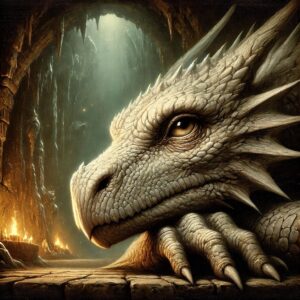
You don’t get to the age of two hundred and seventy-eight by being stupid. Or careless. Or, worst of all, trusting. Yet there I was, trapped and shackled by dragon iron. The accursed chains were as ancient as I was, the skills of their forging lost in the great wars, but they were as unbreakable as ever. It was best to conserve my strength; so, thoroughly annoyed with myself, I lay on the dark cavern floor, legs stretched before me and my head resting on them, waiting for whatever came next.
Whatever came next was a flashily dressed royal-type. Hopes rose. Kings and princes were, in my experience, vain creatures, easily flattered and bargained with and most of them quite short-lived — relatively speaking. There would, I was sure, be an out, even if I had to outlive him to get to it.
He halted at the far reaches of the dreary subterranean void, a distant, insignificant figure, well out of reach of my constrained claws. Possibly not out of reach of my tail, though it would require an impressive back flip to whip it that far in his direction. Nor, I supposed, would he entirely escape the extremities of my fiery breath. I could, at the very least, singe this arrogant human’s neat beard. Though that was definitely a last resort.
“Dragon,” he said, the feeble sound lost in the vast space.
“Count the limbs,” I growled, “It’s wyvern, Prince.” Wyverns — and dragons — have deep, gravelly voices. It comes from the heavy smoking.
“And it’s King, not prince,” he said, with a degree of hauteur that he must have practised in front of a full-length mirror. “King Ulfred.”
He was young to be a king, no more than three decades. I had half a mind to ask who he’d bumped off to ascend to the throne, but like I said, royal types can be awfully short lived. Especially if they’re stupid, or careless, or trusting. I didn’t want to antagonise him too much; just enough to show I wasn’t cowed.
“You all look the same to me,” I yawned, and there was a yelp from the man-at-arms trapped beneath my claw.
The King’s eyes widened. “Is that man still alive?”
“Yes.”
“May I ask… why?”
“I thought he might be important to you. Call him a peace offering, if you will.” I smiled, all teeth. “A sign of good intentions.”
The King didn’t smile in reply. I could have warned him: it ages you, maintaining such a severe expression. Well, it ages humans.
“The men were picked to be disposable.”
“That explains the laughably thin armour.”
He shook his head. “They were nothing more than a distraction, while my elite guard approached with the restraints. He means nothing to me. Do with him as you will.”
There was a whimper from beneath me. The man had been admirably still, no trouble at all, albeit under the threat of a very messy death. It would be wrong to say I felt anything for him, any more than the King would for a chicken destined for his table. And yet…
“I don’t much like canned food,” I quipped, though the quip would fail to land for a good number of centuries. I lifted my claw and prodded the prone man into action. He stumbled to his feet and fled — away from my wickedly sharp talons, and away from his uncaring King, deeper into the cavern where less frequently glimpsed dangers lurked. You try to do a good deed…
“What is it you want from me, King Ulfred?”
“I’m at war, with King Francisco—”
“If I could stop you right there.” Like I said, we have deep voices, it’s easy to talk over someone when they’re just a leaf rustling in the wind. “You want to use me as a weapon?”
“Well, yes.”
“What makes you think I’ll let you?”
He finally smiled; I preferred the frown. “I’ll only release your chains, not the shackles. You want out of those, you do exactly as I say.”
Cunning. And dastardly. Like sharks and crocodiles, wyverns never stop growing. Imprisoned by dragon iron, my limbs would be crippled over time. A slow, painful future.
I peered down my nose. “You might make me promise, instead?”
“And that would hold you?” The frown was back.
“A wyvern’s promise is far more binding than iron, King Ulfred, even dragon iron. As I’m sure your advisors told you. Or perhaps you don’t listen to them, hmm? Anyway, you’re barking up the wrong tree.”
“Oh? Am I?”
“Yes, if you want a weapon, you want the biggest, baddest flying monster you can find. And that’s not me. What you need is an ash wyvern.”
“An ash wyvern? I’ve never heard of such a thing.”
“Oh, they’re very rare. Hardly surprising you don’t know about them in these blighted backwaters.” I watched, delighted, as he bristled. Such thin skins, humans. “Most who encounter them don’t live to tell the tale. But the tale is worth telling.
“An ash wyvern is larger than I am, and, as you might guess from the name, they’re silvery-white and appear as ghosts. But its their breath that makes them unique, and uniquely feared. They have the most destructive, fiery breath in the world. A breath that brings death, far more so than any mere dragon or lesser wyvern like me. It is a breath that melts stone, that eats through metal like a hot knife through butter. As for what it does to flesh, well, you can imagine. Most of all, it is a breath that, once unleashed, cannot be restrained. It consumes everything in its path, until all is laid to waste for leagues around, ash and dust, even the wyvern who breathed it.”
King Ulfred stroked that neat beard of his. “A mighty weapon, then. But one that can only be used once?”
“Trust me, once is too many times. You never actually want to deploy an ash wyvern! Genies out of bottles and all.” I wasn’t sure he’d get that reference either. Not an anachronism this time, more a whole other mythology. “Me, I can swoop down and kill a half dozen soldiers in each pass, though it’s the scare factor that gets enemy cavalry all riled up and sends unwashed rabble scurrying for cover. But an ash wyvern…” I shook my head ponderously. “Once it is unleashed there won’t be anything left that didn’t have the foresight to crawl under a very large rock. No crops, no forests, no livestock, no army or farmers, no castles and certainly no rival king. All wiped from the face of this Earth. Ultimate destruction from the ultimate weapon.”
It was quite horrid, how his eyes glittered as he listened. “So,” I pointed out, feeling the need to join the dots, “just the fact you have one, will guarantee you victory. The scare factor. Because against such a terrible threat, only a fool would attempt to stand.”
“And you tell me this, because?”
“Because, in return for my freedom, I can get you an ash wyvern.”
“Indeed? Very well. But the same rules apply. I won’t release your shackles, just your chains. And you must swear—”
Here it came…
And then it didn’t.
Perhaps he had heard of genies after all. Or other magical beings, whose words were like the reflections of the moon on a cold pond. Deceptive, and impossible to grasp. This was the point at which he could have done with those neglected advisors. In the end, he didn’t do too badly. Perhaps I underestimated him.
“You must promise,” he finally said with infinite care, “Not to cause me harm, directly or indirectly, to the best of your abilities. You must promise to bring me an ash wyvern. And…”
It’s always the third bite at the thorax, isn’t it?
“…you will only be freed once victory is mine!”
“I don’t see how I can promise the last part, since that is in your hands,” I said, deflating his triumph.
“Well…” He looked confused; perhaps I had overestimated him. “Then promise the first two parts, and I’ll look after the third.”
I promised, reluctantly, and the chains (but not the shackles) were released. I grinned my most evil grin and ducked my head sharply towards the king, who was now very much in range. “Say,” I said, and he squealed and fell over backwards as his royal guards scrabbled for their swords and spears. “You don’t have a history of heart problems in your family, do you?”
He shook his head, unable to speak, or even squeak.
“Well, that’s good,” I said. “It’s hard to keep my oath if I don’t have a full medical history, if I don’t know how sensitive you might be to shocks and scares and the like. To the best of my abilities, right?”
With that, I squeezed up the narrow crevice to the outside. Thankfully, it was daylight, a wan sun working away at the morning’s mist, just enough to warm my wings. There was a gathering of the King’s men watching as I stretched, shaking the water and fallen dirt from my back. I thought of snatching a few — travelling snacks for my journey — but concluded that this might indirectly harm the King. Pesky thing, promises.
It was good to be in the skies again, even though I wasn’t entirely sure where I was headed. North, was my best guess. If it hadn’t been for the shackles around my ankles and the irksome promise, I’d just keep going. Find somewhere with no dratted Kings, no dragon iron, maybe no people at all. Not that there were many places like that any more. The Earth was getting awfully crowded, and the humans I did encounter never seemed happy to see me. Can’t understand why. I preferred their cattle to their children, or their women. The older the better — richer flavour and more to chew on. And yes, I’m still talking about cows.
I stopped to ask the way from a sun-basking griffin. She couldn’t help smirking as she glanced at the bands of dragon iron, my twin badges of disgrace, and I’d have clipped her wings if she hadn’t given me such promising directions.
The way was up into the hills, low cousins to the mountains that crowded the horizon, wearing capes of snow that never melted. Well, not for the next half a millennia or so. A wyvern’s ability to glimpse the distant future meant that things that seemed constant weren’t, and things you keep expecting to change, don’t. Or not in the ways you expect. There’s a certain circular inevitability to history, to stupidity, and yes, to war.
The abyss the griffin had guided me to, at the far end of a dark lake, was suitably ominous. A cleft in the hillside, a stream trickling from its mouth, a fetid smell wafting from its depths… Even I had a shudder of apprehension as I entered the foreboding ravine, wriggling my way until I came to a pitch-black chamber, where I had the sense of being minutely inspected.
“Hello, younger brother.” A voice as ancient as the rocks sighed.
“Altran; thought I might find you here. Kin. Sister. Friend?”
“I see you got yourself captured.”
“Ah, yes. Though how can you…?”
“I can taste the iron, Shurni. Not just any old iron, either. Dragon iron. Haven’t smelled that sour stench for over a century. Chaffs, I’ll bet? Someone must really want you to do something for them.”
“Well… they did.”
“Oh?”
“And now they want you to do something for them.”
“ME?!” the voice thundered, rocks rattling from the roof, and I had a grim vision of the two of us buried forever beneath that lonely hill. In better news, the rumble let a thin sliver of light creep into the Stygian depths. In worse news, the light revealed the remains of what Altran had been surviving on while she wallowed in her misery, the discarded bones and tattered fleeces of snow-blind sheep and scraped goats that had strayed into these tunnels. It explained the crunch underfoot. Amazing she could pick out cold iron over all of that. I suppose she must have gotten used to it, though heavens knew how.
“Yes,” I said. “You, sister. I need you.”
“For what?” Her measured reply was far more dangerous than her exclamations. She was from a clutch two centuries older than mine, and that was why I’d appended the hopeful “friend?”. We might be related, but we didn’t grow up together. My plan — such that it was — relied on her willing cooperation. As did my life.
“I want you to join an army.”
You could hear solitary drips of water pinking into some pool somewhere. I held my breath. The hillside held it’s breath. Even Altran was very, very still.
“What sort of an army?”
“A… human one?”
“Have a care, brother!”
“You won’t be asked to do anything!” I protested. “Just to be seen!”
“Just, my inane little brother says. Just be seen. I should have crushed your entire clutch when I heard mother was laying again!”
“Well, that’s—”
“Look then — look, if you must!”
She reared forward and into the tendrils of light from above. Altran’s entire head was bone white. Colourless, other than the two spots of blood red that flashed in her furious eyes.
That’s the problem with fire breathing, for wyverns. Dragons have it relatively easy, employing a different technique of igniting their flames, as different as the stings of wasps are from bees. For wyverns, breathing fire changes you. Each fiery breath consumed a firestone from our crops, just as our flames consumed wood, or flesh.
You started your life, it always seemed, with plenty of stones, flaming at the drop of a hat when you were young and foolish, when you were at your most vulnerable. But wyvern lives are long, if you escape infancy. By the time I’d reached what most wyvern would consider young-middle ages, I was rationing my remaining firestones, eating my food raw, and flaming only when necessary. Each time you breathed fire, each time you lost a stone, you also lost the vibrant hue it imparted, the reds, greens, and purples with which we were streaked. Each flame leached colour until you had only one stone left, barely enough to keep your internal engines going. Just one fiery breath from extinction.
Wyverns do not, as a rule, die of old age. Once we pass through the perils of our youth — other siblings, whether the same age or, like Altran, two centuries older, the odd accident (dragon iron can make more than chains and shackles, though there are also natural hazards, like cavern roof collapses…), and the hazards of courtship flights, themselves a great consumer of firestones — there was relatively little that could harm us. Even dragons gave us a wide berth.
Instead, we die a little with each exhaled inferno, each proof of our awesome power. For wyverns, fire is a defence mechanism. Which is why we do not, on the whole, make very good weapons.
I had not known Altran was on her last breath. When I’d seen her, sixty years earlier, she’d been no rainbow, sure, but the edges of her scales had still glimmered with colour. This explained why she was skulking far from prying eyes.
“You’re perfect!” I exclaimed, covering my gasp. “I was going to suggest chalk, or some other sort of make up, but no, sister, you are absolutely perfect!”
“I am nothing,” she spat. “Waiting for such prey as falls into my lair. I’m washed up, no weapon, and certainly not one to strike fear into anyone’s heart.”
So I told her my plan. Slowly, with much shaking of her mighty head and many a weary grunt, I won her around.
“It does rather seem, little brother, that it is my life you’re putting on the line?”
It wasn’t easy, this winning her around bit.
“A myth, then. If this is to be my end, Shurni, then at least it will make for a good story.”
“No end, sister.”
“You promise?”
I held her gaze, though that was mighty hard to do. “If I could, I would. But…”
“Hah! Promise bound and shackled by dragon iron… a sorry state. It might be worth climbing out of this hole, just to watch you try and dig yourself out of yours.”
With that, I think, I knew I had her.
“With your help, Altran. If you do as I’ve suggested — with your own particular flair, of course! — If you remain aloof, and haughty, and imperious… Do you think you can do that?”
She thought long and hard. It was so gloomy down there, in Altran’s lair, that I had time enough for visions. Strange, unsettling visions. Skies criss-crossed by shiny, winged creatures whose wings never flapped. Metal-skinned monsters that flew higher than a wyvern has ever flown and left no room for us, or for dragons, or for griffins. Soulless, lifeless things built by man. Portentous omens indeed, though from the fuzzy nature I could tell it was a far distant vision of a far distant future. My concerns were very much with the present, with the here and now. I still wasn’t certain which way Altran would go.
The cavern rumbled and groaned with her laughter. “Alright, little brother. Let us go and visit this King of yours. I grow tired of mutton. If there is venison and aged beef enough for a decent meal, at least I will not die empty stomached.”
“Grand, grand!” I was delighted, for both of us. “Though before we feast, we will need to make a small detour?”
“Ah yes, that part of the plan. Risky.”
“To which end, any idea of where we should detour to?”
Altran considered, then nodded. “I think I know the place. Though… best let me do the talking, yes?”
* * *
A sight it must have been, two wyverns flying south, one as pale as the clouds, the other darker, as though its shadow. Except in mating dances, neither wyverns nor dragons tend to fly together. And though Altran hadn’t exactly been gorging herself of late, she was still four centuries old and even I was awed by her size. Big sister, indeed.
I circled the King’s castle, flashing the manacles at my ankles to show that it was me, and swooping towards the elevated courtyard in front of the keep in a clear message: clear this space, or be landed on!
Before the stir of guards and onlookers even had a chance to re-arrange themselves, Altran soared in and settled on the roof of the keep itself, skittering down slates and loose stones from the parapet, and extended her wings to look utterly regal and badass and not unlike the heraldic figure she would some day, quite soon, become.
One advantage of me being down below, and Altran being up there, other than her looking like an absolute queen, was that it was obvious that I was the one who would be doing the talking.
“King Ulfred.” I lowered my head. Not a lot, a half-bow, a mark of mutual respect that wasn’t reciprocated. I ignored the consternation of the gathered courtiers, servants, and guards, who, I guessed, hadn’t got the memo that the King had enlisted a wyvern.
“You returned,” King Ulfred said, with a glance to check his elite guard was between me and him.
“Of course. And with an ash wyvern, as promised.”
“Yes, well…” He peered up to the lofty heights of the keep.
“…to whom I promised a half dozen cows.”
“Did you now?”
“Yes. Hungry work, being the most dangerous weapon in existence. But not to worry–they don’t have to be productive cows.”
Ulfred tutted, but fluttered a hand towards one of his flunkies, an implicit see to it.
“So,” I asked, all casual. “When do we go to war?”
He stared for a moment, as if able to see through the walls of his castle and towards his not-so-distant enemy.
“Tomorrow.”
“That soon?”
“No time to waste. My army is ready, and, for now, I have the element of surprise. And you, wyvern, will be by my side on the glorious day.”
I may have groaned. I should have expected this. “I have done as you asked–”
“You brought me an ash wyvern, yes. And I am a man of my word. But my word was that you will only be freed once victory is mine. And it is not mine yet.”
There was hope for him, advisors or not, though it’d be better if he seriously toned down the smug. He also wrongly assumed I was bound to protect him. But my promise had been that my actions wouldn’t cause him harm, it didn’t say I had to put my body between him and arrows and the like. Not as long as I choose to interpret it that way.
“You know, I think you should own the moment,” I whispered. Naturally, everyone within the grounds of the castle heard me. “It being the eve of war and all.”
“How so?”
“Here you are, with two wyverns not ripping you and your army apart. Given our arrival probably sent a few of your less brave conscripts scurrying for the nearest ditch, a display of your mastery is called for, to settle nerves. You should tell your men what you intend, in battle tomorrow. It would do wonders for morale.”
“Well, yes.” He looked surprised. Unasked for, helpful advice. “That does make sense…”
“And don’t forget the cattle.”
He scowled. “Just see to it that your ash wyvern stays on the roof. And extends his wings again?”
Her, I could have corrected him. But I didn’t want to spoil the entertainment.
“Gather my commanders and have the army prepare for my orders. Promise them a cask of ale or two. That’ll still their impatience.” Off the King and his flunkies stalked to advise his generals and to dress in over-polished armour, before addressing his troops. Meanwhile, I caught the distinctive whiff of very nervous cattle. They were scrawny things, I should have asked for two more, and they were doing their best to escape the men dragging their unwilling carcasses into the upper courtyard.
“Where should we…?” a man said, arms bulging as he pulled at the rope. There was something familiar about him… Ah! Our man-at-arms from the cavern had managed to find his way out. Good for him. Now demoted to wrangling supper for wyverns, but that was a better fate than I would have predicted for him.
“Oh, leave them here and close the gates behind you,” I said, gesturing to the roof where Altran waited. “I’ll take them up.”
I probably shouldn’t play with my food, but a wyvern likes to hunt. I caught them, one by one, and carried them to the roof, still struggling in my claws. That way, no-one could see how many Altran ate and how many I snaffled. Not that I felt any remorse about taking my due. I’d flown twice the distance she had, even if I was only half the size.
As we ate we listened to the King’s speech, offering our critique, in wyvern-ese of course. We picked at our meal as the King took my possibly not entirely accurate description of an ash wyvern, and exaggerated it further still. A little light spraying of half-crunched bones happened despite our efforts not to laugh.
But the speech had a rousing effect, as the terrified, skyward gaze of conscripted soldiers gave way to a look of awe, and of possible hope.
“That’ll do it, you think?” Altran asked, after I’d made her stand tall and spread her wings as both King and wyvern basked in rapturous applause.
“We’ll see. Tomorrow. There’s half a cow here, if you…?”
“You have it, little brother. It’s been a while since I’ve eaten so much. Though I think I could get used to it again.”
* * *
We marched out at dawn. An immense throng of men, the steady clank of arms and armour, a painfully slow shuffle forward with Altran and I to the sides so that we didn’t accidentally crush half the army. The horse that the king rode, though blinkered, could sense we were there and wasn’t happy about it. It can’t have been a comfortable ride.
We ascended a low rise, beyond which stretched the open plain where tradition dictated battles between these two nations were fought, much to the ire of those who traditionally lived there. King Francisco’s army was arriving just as we were, and above the bristling tips of spears and pennants, there was—
“The enemy! The enemy have an ash wyvern as well!” King Ulfred exclaimed. “I am betrayed!”
“You are fortunate,” I told him. “That you got one when you did, otherwise you would be at a serious disadvantage right now.”
The King frowned, but returned his attention to the battlefield, as the opposing forces closed the gap between them, while the respective Kings and their respective wyverns kept their respectful distances.
And then… nothing seemed to happen.
For quite a while.
The King’s frown alternated with an expression I can only describe as startled.
“Why are their armies not engaging?” he demanded.
“Probably because you have an ash wyvern, your majesty. A wyvern of mass destruction. Or W.M.D., for short.”
“Well… why aren’t my armies engaging, then? Why do our archers not fire?”
“Because they have a WMD, too. And you did so wonderfully describe what one could do, in your rousing speech yesterday.”
He groaned. “So they’re both just sitting there?”
“I guess.”
“Make them fight!”
“That would be unwise.”
“Why, for hell’s sake?! That’s what they’re here to do.”
Evidentially, his stalemated-pawns had reached the necessary conclusion faster than the King. Perhaps if he’d been a little closer to the sharp edge of the action? I explained, for his benefit.
“If it looks like you’re winning, then the enemy will lose nothing by unleashing their wyvern. And if it looks like they are winning, then you might do the same. A king, at the point of losing his kingdom, does not make entirely rational decisions. As soon as one side unleashes their wyvern, so will the other. Both kingdoms laid to waste. Mutually assured destruction, your majesty. Neither side can afford to deploy their most fearsome weapon, because to do so would guarantee the enemy would use theirs. I’d say the safest thing to do… Hmm. Is to not engage?”
The king stared at me, aghast. He shook his head. “What about you?”
“Me?” I said.
“I have two wyvern on my side. Doesn’t that give me the advantage?”
I’d almost forgotten this is how it all began, with King Ulfred wanting to use me as his weapon. I shrugged. “Sure, but compared to an ash wyvern, I’m neither here nor there. I’m not immune to an ash wyvern’s breath. Nothing is, not stone, not iron, and certainly not flesh. I change nothing. Nor would an army twice as large. Against a WMD, these are lesser matters. On the apocalyptic scale, two Kingdoms each armed with an ash wyvern are evenly matched, regardless of any other forces involved.”
The king scowled. “So what do we do?”
“Isn’t that obvious?” I peered over the vast battle plain, where two armies stood ready and unwilling to hack and maim and kill. “You should try not fighting.”
“Not fight?”
“Yes. I believe it’s called diplomacy. Whatever your quarrel with King Francisco, have you considered talking it out? A negotiated peace? Of course, since you each have an ash wyvern, you’re on equal footing, so there won’t be a lot of concessions made by either side. You’re probably going to have to forgo and forget a lot of historic insults and aggression. Bygones, yes?”
His face was like thunder. There was a snicking noise as Altran restrained her mirth.
“But think on the bright side!” I offered, loudly, to cover them. “Consider the advantages of a strategic partnership, bound perhaps by a royal wedding? Just think; two mighty kingdoms, working together, each armed by the ultimate weapon. Who could stand against you?”
“No-one,” he said, rather sourly. “Unless they had an ash wyvern as well.”
I did my best to act surprised. “They are rare beasts, King Ulfred. They are not given out free with breakfast cereals.” Another allusion that would not make sense until a very long time from now.
He groaned. “I’m worse off than before I captured you!”
“I don’t see how,” I said. “Though of course, if you really think so, I could send your ash wyvern away, tell them you don’t need one any more.”
“But then my enemy would have one, and I wouldn’t!”
“Ah… True. Best look after yours then, hey?”
“What do you mean?”
“Your ash wyvern isn’t a captive, like I am, your majesty. You have no chains or shackles on it — and before you get any ideas, don’t even try, unless you want her flames turned on you and your kingdom. She’s here because she chooses to be, yes? Best treat her well, encourage her to stay. Look after her, feed her, and respect her. Don’t worry, maintaining an ash wyvern is far cheaper than sustaining a standing army. And in good news, nobody died today! I count that as a victory, yes?”
I held out my shackles, to be unlocked.
* * *
Back on the roof of the castle keep, as the army celebrated the — um, draw? Not dying? — feasting on cooked cuts of what we ate whole and raw, (though it would be cooked, before it hit our second stomachs), Altran turned lazily to me, picking between her teeth with a discarded halberd.
“You know Shurni, the whole mutual assured thing doesn’t stand up to scrutiny.”
I grinned. “I am aware.”
“Did you do all of this just for the pun? Wyverns of mass destruction?”
My grin grew wider. That was the problem with anachronisms. You either had to have another wyvern or dragon as an audience, or wait a few centuries for the pun to land. Since humans didn’t live anything like that long, most of our best jokes were mistaken for particularly obscure oracular prophecies. Ho hum.
“Not entirely…”
“Never mind the hyperbole, the blatant exaggeration; able to destroy an entire kingdom, indeed! What does anyone think they could actually do, to convince me to expel my last breath, knowing it spells my certain doom?”
“Quite.” I yawned. It had been a long day. Plus, I’m always sleepy after a good meal, and the King’s men had been even more generous than the King.
“Let alone convince me to use that breath in a specific, towards-the-enemy direction? One wonders why anyone fell for any of it.”
“Because it’s better than the alternative?” I suggested.
“But how long can it last?”
“Stalemates have a tendency to persist, until something radically changes the playing field. As long as both you and—?”
“Bartok.”
“As long as you and Bartok play your parts, I can’t see any reason why we can’t spin this out at least for a generation — of Kings, that is. Ulfred and Francisco are both relatively young.”
Altran drummed her claws on the masonry, leaving deep grooves. “Twenty, thirty years, perhaps? And during that time… do you condemn me to a senescence of silence?”
“Only with humans,” I protested. “You’re not missing much there. I’ll visit as often as I can and there’s nothing stopping you going on the occasional trip. In fact, the worry that you might not come back will do wonders for how attentive they are when you do. I’ve told them what you like to eat and that you enjoy being read to.” I shrugged. “It’s better than spending your remaining days festering in a dank hole, I hope?”
There was silence, as we watched the baleful glow of the setting sun, softened by the smoke of hundreds of campfires around the castle. Tomorrow, most of those soldiers would go back to their villages, to farming and patching up their hovels and whatever else they did when not forced to bear arms.
“Why didn’t King Ulfred remove your manacles?” Altran asked. “I thought I saw the man who carried the keys?”
“You did. But I asked him not to.”
“Why?”
“Altran, how many wyverns are on their last breath, would you say?”
“A few,” she admitted.
“And how many kingdoms are there, on this continent?”
She laughed. “A recruitment mission? With manacles as your calling card? W-M-Ds for all? Well. You’re nothing if not ambitious. Though don’t leave those shackles on for too long, brother, or eat too heartily. They constrict, do bands of dragon iron.”
For the first time I noticed the darker marks on my sister’s ankles. Probably wouldn’t have seen them, if she hadn’t been the colour of ash. The moment hung heavy.
“You know, you may not be doing us a favour, in the long run,” Altran said.
“Oh?”
“This… cold war between humans. It is not quite the same as peace. I know you mean well, Shurni, but it is all under false pretences. It might stop the bloodshed for a while, might give us ash wyverns a temporary home and respite in our old age, but less bloodshed does inevitably mean more humans.”
“Yes… I suppose.” The thought hadn’t struck me.
“Ones who will undoubtedly seek other outlets for their irrational hostility.”
“You think I should make their wars hot, again?” I asked.
Altran sighed. “It probably doesn’t matter in the long run. Our time is nearing an end, little brother. Surely you’ve had the visions?”
I was silent again, for a while. “What happens to us, sis?”
“Who knows? Nothing good, perhaps. If we went elsewhere, you might think our visions would be from there, instead of a dragonless land. Perhaps there is no elsewhere. Or perhaps our visions do not pierce that veil. But that is for the future. Today, at least, we are safe, and I am well fed!”
Altran beat her mighty wings, and lifted into the air, circling King Ulfred’s castle, warning anyone watching from beyond the walls that an ash wyvern was in attendance, (and taking the opportunity to void her bowels over the moat at the same time). Then she settled in the upper courtyard, to listen to bards tell tales of heroes and gods and monsters, accompanied by lilting harp music, while the spot between her ears was scratched by a halbard wielding, very grateful and still somewhat bruised former man-at-arms.
* * *
 About the Author
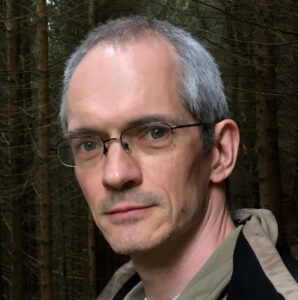
Liam Hogan is an award-winning short story writer, with stories in Best of British Science Fiction and in Best of British Fantasy (NewCon Press). He volunteers at the creative writing charities Ministry of Stories, and Spark Young Writers. Sci-Fi collection: A Short History of the Future (Northodox Press). Fantasy: Happy Ending Not Guaranteed (Arachne Press). More details at http://