by Leo Oliveira
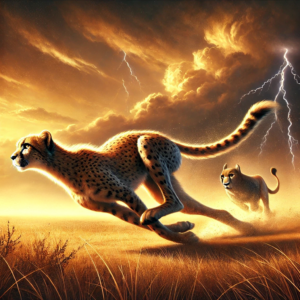
Before the lions came and ate our mother, she filled our nursling ears with tales of The One Who Races the World.
“Races the World was as quick on her feet as she was in her mind.
“She was a queen among cheetahs. A legend across the savanna.
“Impala frightened their cubs with invocations of her name. Hyenas did not steal her kills, for she was strong as well as fast, and she could drag the carcass of a water buffalo up a tree like a leopard, so that only the boldest of baboons would dare challenge her for it.”
Races the World was like a goddess to me. Countless silver nights curled up together in the long grass sheltering under a fallen acacia, begging our mother to tell us another, and another, and another. Of Races the World’s adventures, I could never get enough. I used to wish my mother had given me a proud name like hers, a bold name like hers, but I am only The One With Tiny Spots.
My brother is The One With A Dancing Tail and my sister is The One Who Sheds Black Tears. We had seen the rains come but once and we were three days and nights alone. Three days and nights as orphans. Several times that spent hungry, near starved. Our mother could not feed us anymore; not while she fed the fly-bitten bellies of lions.
Dancing Tail complained first of his empty stomach and how weary he’d grown of running, so I stopped him in the brush to chase down the fresh scent of a hare.
“I appreciate you,” Dancing Tail said, stretching out his long limbs beneath him. I considered giving him a warning not to grow too comfortable, but we’d not rested since before, and we were all tired and hungry. I didn’t have the heart to push him. Not even if our mother’s stories had taught us to be stronger.
Black Tears said nothing. She was the better hunter of us, what little practice we’d been given. But her eyes — measured, focused, and still — told me not to make a mistake. They said that she would not help me if I did.
* * *
I stalked the hare like our mother had taught us to stalk, patient and slow. “We are cheetahs, and we are not given second chances.” If I did not understand it before, I understood it then.
The hare was young and reeking of milk-scent. I followed her trail between brush stalks and golden swaying grass reeds until I spotted her ears. Somewhere out there was a litter of hare cubs, squirming and blind and useless. Possibly fur-less. All they had was their mother, and they would die quickly without her.
The first impala we ever ate was a young female our mother had brought down at the edge of the plains. She’d taught us between heaving breaths how to pull the skin free, how to split open the belly, how to fill our stomachs with the best parts of a carcass quickly, before hyenas or lions or painted wolves came to steal it.
I had never seen a dead impala before. I did not know the moist-slick mass, still blue with its fetal sack, was an unborn cub until our mother told us. I’d crunched through its soft skull, and I did not feel any guilt. I felt none for the hare now, but I twinged ever-so-slightly imagining her litter, tiny and helpless and so much like me and my siblings — my chest clenched with hurt.
Then I ran.
The One Who Raced First was born from a bolt of lightning that’d lanced down and struck the first of the First Cats. We are bolts from the black. We are energy incarnate. We burst to top speed from standing in three heartbeats flat.
Young and underdeveloped as my bones and muscles were, I closed in on the hare. It had not one hope of outstripping me. The ground became a blur. I stopped moving my legs for it was them that moved me. Inertia and instinct.
“If you think, you fall,” my mother had said to us. But that was why Black Tears caught more prey than I ever did.
A scent hit my nostrils through my next gulp of air, and I could not help myself. I slid to a halt. The hare’s fleeing footsteps faded in my ears, but I was not watching. I did not care.
We were born from lightning; lions came from the thunderclap after.
* * *
“The lions! The lions are here!” My fur trembled, feverish with race-rot — that sinking, heady feeling that follows a sprint to the edge, when the world swims before the eyes and the sun glares inside the skull.
Dancing Tail sprang to his feet. “What, where? Did you see them?”
Black Tears remained sitting. “I thought you left to catch a hare.”
“I called off the hunt because I smelled them. They’re close. I don’t know how close, but we must leave before they find us.”
“You smelled them, but you did not see them, and so you abandoned the hare.”
I have never wanted to kill my sister, but at that moment I came close. Her callousness dug into me like her tongue was tipped with poisoned spines. I hissed and spat in frustrated circles. I held my own tongue, but I held it barely.
“We don’t have to fight each other,” Dancing Tail said. “We’ve tricked them before.”
And indeed, he was right. The lions had not been content with our mother. This was not the first time their scents had drifted down to us on the breeze — they weren’t even hiding, that’s how we knew how little we meant to them — and we made use of the environment every time they came near. Switchbacks through the brush, false trails, looping paths that intersected with one another and shot out in different directions.
These had also been tricks our mother had taught us through the old tales of The One That Moves Shadows. If Races the World was like a goddess to me, Moves Shadows was like a goddess to Black Tears.
Black Tears gaped her jaws wide in a tongue-curling yawn. I forced my twitching tail to lie still.
“Let’s get it over with,” Black Tears said. “Hopefully you didn’t scare all the prey off with your yowling.”
“Only the ones slow enough to be caught by you,” I said.
“All of them, I see.”
I glared at my sister. She gave me a blank glance back. Then she turned away from us.
I sighed and pawed at the parched orange dirt. I wished she didn’t follow so closely to Moves Shadows’ favourite lessons, the ones our mother had so often repeated:
“The strong cheetah she is; she hunts alone.”
* * *
It took us until the first high heat of the day to finish our rounds. By then we had no appetite for hunting. Fear is one of the great constrictors, and we had spent so very long afraid. But we couldn’t risk standing still, either. While cheetahs sleep at night, lions are wide awake. To stop was to die. We needed to take every opportunity we had to make distance.
So, we started off and did not stop until tingling exhaustion forced us to. I sank onto my side, soaking in the cool dry earth. Dancing Tail curled up beside me. I shed heat through my open mouth, and each inhalation raked in great lungfuls of evening scent.
The musky tang of distant zebras and wildebeest skipped across the breeze to me. Dust, pressure, and the coming rains. Beetles and bugs and moisture in the air. My sister, my brother, and—
Lions.
I scrabbled upright, huffing, filtering through the scents for new and old, strong and weak, predator and prey. I had not been mistaken.
The lion scent had not gone away. If anything, it had grown stronger.
“Wake up,” I said, nudging Dancing Tail and Black Tears in the ribs. “The lions are coming.”
I could tell right away that they did not want to believe me. But the chance of ignoring a serious threat for a few fleeting moments of ignorance was not worth the trade, so they parted their jaws and confirmed my findings for truth.
“That’s impossible. How did they find us so fast?” Dancing Tail shivered. He was already the smallest of us, and he seemed to shrink further.
“They learned what we were doing.” Black Tears’ tail tip flicked up as if batting off flies. “That’s what we get for doing the same things over and over again. And whose idea was that?”
“Don’t hiss at him,” I said.
“Then you better hope you have a plan.”
I hesitated. This was not for lack of an idea, but for the nature of the idea I had. But both my littermates were staring at me, waiting, and I lowered my eyes as I said, “There’s always the Wall.”
The Wall was a dangerous place. A deadly place. Our mother had warned us in thrice as many words: humans with loud sticks and dogs, rock beasts on baking black paths, fields upon fields where nothing grows. The whole world changed on the other side of the Wall, but what other choice did we have?
“Maybe the lions won’t follow us past,” I continued. “Nobody crosses the Wall. And we can’t be far from it by now. See the baobab splitting the rocks? It’s the vulture skull stones.”
Our mother had brought us to the edge of that baobab once to tell us it was the edge of her territory. When we’d asked her why she didn’t go further, that’s when she told us about the Wall.
Neither of them liked my plan; I could tell this too. But nor did they see any other option.
“All right,” said Black Tears. “To the Wall.”
* * *
The lions stalked us throughout the night.
Several times we swerved off to the side and attempted to bed down, but the lion scent strengthened in half a cooling cycle or less without fail. They kept on coming. We had no recourse but to forget about sleep. Forget about resting. Move and move and move some more.
Cheetahs were not made for the night. We were born of lightning and nursed by daylight. Divots and grooves appeared beneath our paws, and any misstep into darkness could lead down gulleys or dry streams or crocodile-infested rivers. We had no way of knowing. We’d never been there before, and we could barely see.
At the point when the moon had begun to arch its descent, Dancing Tail took the lead. It was his turn to sweep the earth and guide us through the treacherous landscape. I kept my nose to his tail-tip, ignoring how it made me itch and sneeze. It was about the only way to keep together, our scents mingled and muddied as they were.
Then my brother disappeared.
“Dancing Tail?” I called out as he yelped — a sound that grew dimmer beneath a shatter of small stones down below.
Black Tears crouched beside me. Her ears flattened. “He must’ve fallen.”
Wordlessly, cautiously, we picked our way down the slope. It stretched near vertical from where Dancing Tail had stepped right off, and I had more than a couple close calls tempting a similar fate.
When we reached the bottom, Dancing Tail was hissing in pain, but alive.
I let relief brush through me before I saw his front right paw. It was twisted. Almost backwards. Broken.
“It hurts,” he said.
“Tiny Spots….”
“I know it hurts, but we must keep moving. Do you need help up?”
“Tiny Spots….”
“Come on, just lean on my shoulder. You can stand.”
“Tiny Spots!”
“I know what you want,” I hissed back at Black Tears. “It isn’t happening.”
Black Tears was no more than a pale outline in the deep grey gloom behind me. Still, I thought I could see the disapproval in her twitching whiskers. But by some miracle, she protested no more — not when we lifted Dancing Tail up on either side, not when we slowed our pace to a creep carrying him between us, and not when the lion scent began to overpower the scents of strange rock and dead wood closing in from the distance. Not one of us said anything as dawn came overhead. Not until we saw the Wall.
Black Tears stopped first, her eyes open wide.
I could not help but do the same.
The Wall stood as tall as a full-grown cheetah on her hind legs. Impenetrable. Thin bones of glittering rock crisscrossed each other, all strung together so as not to allow even a mouse to slip through the cracks. The very top was tipped in thorns.
“We’re trapped,” Dancing Tail wailed.
Neither Black Tears nor I responded, because we both saw it to be true.
“There must be a way around,” Black Tears said after a moment. “How else would stories get in?”
And then I glimpsed it: a break in the glimmering mass, a hole farther down the Wall the size one of us might squeeze through. “There, quickly!”
We pushed ahead as swift as we were able. It wasn’t fast enough.
The grasses behind us crunched under confident paws. Growls understood without a word to accompany them. The markers of killing intent. It wasn’t long before we saw their golden fur, too, along with their golden eyes.
The lions.
“We won’t make it,” Dancing Tail cried.
He was right. The lions spread out around us, carving the shape of a crescent moon. They would spot the gap; they would run us down. This I knew as I knew my own spots. So, I did what only someone as brave and brilliant as Races the World would do.
“Keep moving to the gap in the Wall,” I said. “I’ll lead them away.”
“Don’t you dare!” Black Tears said, but I was already running.
Lions are no easier to fool than anyone else, but they were built to chase lightning wherever it strikes. That’s what thunder does.
Where my littermates went to one side, I veered to the other. Taunting, close, like prey bolting out of instinct. Fear. The lions caught on like flame, and suddenly the grasses burst alive with giants.
This is also true about lions: they are much larger than even a full-grown cheetah. Our heads fit right in their mouths. I have seen this with my own eyes. My mother’s shoulders fit, too.
My courage wilted in a blink.
There were a dozen lions now — all leaping and lunging out at me, their paws bigger than my head, their claws thicker than my spine. They could kill me in a moment. I tensed my tired limbs and ran.
What started as a distraction turned on a fang-tip to survival. I raced without a thought for where my littermates were, or why I was running, or where I was leading the lions to. I didn’t think about why, or how to slow down to ensure the lions kept up, or what I would do once Black Tears and Dancing Tail escaped. I felt hot breath against my fur. I felt death closing in. I felt my heart beat faster, faster, faster, until I was sure it stood moments from giving out of race-rot.
Then Black Tears caterwauled. Loud and insistent. It was a dying wail, a fear wail, and it drew the lions up short to stare.
I am ashamed to admit it, but it’s true: I did not look twice. I did not glance around. I did not take in what had happened or where my brother and sister were. I flung myself through the gap in the Wall and I did not slow down until I tripped and rolled under a dry bush beyond.
It was only afterwards that I searched the grass for my littermates. Black Tears padded to my side, head bowed.
Alone.
“Where is Dancing Tail?” I asked. I already knew. I had to have known.
Black Tears lifted her eyes to mine. There was a defiant gleam in them. Defensive. “He wouldn’t have survived.”
I don’t remember if I did or said anything right after this. I only remember moving, and then Black Tears saying, “You don’t want to see.”
I didn’t listen.
When the lions ate our mother, we could not bear to watch. I could not bear this time any better, but just as strongly I could not make myself turn away.
Dancing Tail was already dead. I am glad that he was. Had he still been suffocating in a lion’s jaws, had I crouched in the long grass watching, I might have thrown myself back into the pride’s claws out of guilt.
I watched the lions finish eating what they wanted of him. I watched them purr and hum and groom each other. I watched the vultures descend. I watched the lions stand up, stretch, and leave.
“They were going to catch you, Tiny Spots,” Black Tears said. “You know they were. If I hadn’t brought the lions over, it would be both of your skeletons in the grass. I saved your life. And even if we’d saved him… He died quickly now; he would have died slow and alone much later.”
There is one more part to the legend of The One Who Races the World, and that is how she died. The story had always upset me — pouting and mewling for days after I’d heard it, but our mother would groom my ears and tell me it was important to listen. There were things that even Races the World could not outpace. Age, the rising heat, and the selfishness of our own kind. As she lay down, old and dying and mere paces from water, seven cheetahs passed her. Not one stopped to help. She died like that, a goddess to me, nothing and no one to anyone of her time.
I did not look again at my sister. I watched the vultures pick our brother clean.
“Please don’t hate me,” she said.
“This is the way things are,” she said.
“Cheetahs hunt alone,” she said.
She must have left soon after, for she didn’t say anything else. Eventually I fell asleep where I sat. My dreams were filled with storms, and every cloud pierced a hill with blue lightning, but lightning does not last forever. Lightning lives for a blink. A moment. A speck of time in the skies above the grasslands: beautiful and striking and gone much too soon.
* * *
 About the Author
Leo Oliveira is a queer writer from Ontario, Canada, where he harbours a soft spot for rats, pre-history, and flawed queer characters. His work has appeared or is forthcoming in Radon Journal, Fusion Fragment, and Port Crow Press, and has been nominated for the PEN/Robert J. Dau Short Story Prize for Emerging Writers, Brave New Weird, and Best Horror of the Year.