by Mike Robinson

Southern Africa
3 Million Years Ago
1.
They never believed her until she described the screams. She knew why. Recalling the brain-goring terror of those sounds, from the high squeals to the deep, resigned rumblings, broke open all the realness of that night through her, and her telling of it.
Sweetfoot liked surprising others, especially youngkind. Bigcats threatened the young, some might say, but that threat was finite, and the calves were safe within the thick forest of the herd’s legs and trunks and the canopy of their tusks. In general, the bigcats knew not to even try.
But that was why she told them of the Five Waters: the only place with bigcats bold enough to take down grownkind. They would come at night, lurking on the edges of the grounds, letting themselves be sensed at choice moments. It was artful spooking, a slow build-up of panic. Consisting mostly of females, the bigcats would circle closer, scouting, floating in and out until they’d managed to isolate a young unattached bull, one usually wedged in mud.
At the time, Sweetfoot was only a few seasons old. She couldn’t see much, as it was dark and her clan had quickly enveloped her. Her Clan Mother had insisted they leave the Five Waters. But through the surrounding bodies, she caught glimpses of what was happening: the bigcats perching themselves on different ends of the young bull, one clutching the trunk while others held the legs and all digging in like parasites with tooth and claw. Still more awaited their role of taking out the eyes, which would unleash the worst of the screams.
Today, as a Clan Mother herself, Sweetfoot told that story mostly through those screams, so that the youngkind might always be vigilant. Particularly her own male child, Two-Step, a season-cycle old and a clumsy walker since birth.
Every newborn, it was told, was delivered from the Windrealm, and so had trouble steadying themselves. Yet Two-Step’s struggles were unique, his legs misshapen, maladroit — it had taken many tries just to stand him erect for longer than a blink. Using mostly his front legs, he had, with effort, begun pulling himself forward. He staggered. Hopped. Eventually, over many days, with the supervision of Sweetfoot and the clan’s other mothers, he found his strength and his balance. Because of all this, his Name had come swiftly.
Still, Two-Step had proven the most spirited of her offspring. He played as much as he could, squeal-crying his frustration when he could no longer keep up with siblings or playmates of other clans. Periodically, Sweetfoot would have to right him. It made her anxious, seeing his Windblown spirit struggling against glaring weakness.
Hearing of the bigcats at the Five Waters, Two-Step wondered aloud when he might be much bigger than the biggest of all bigcats. Impatient, Sweetfoot replied that it would take many seasons. As demonstrated by her story, not even a young bull could guarantee escape from the interest of bigcats.
Were there bigcats so big, Two-Step asked, that could swallow whole clans — or herds? His cousin Springtrunk had remarked on herdhunters: great rare roving beasts that outmatched even the mightiest kin.
Always, it came to this: the morbid wonder of the young. There was thrill in grand unknowing, in imagining the many beings that might populate the savannah, its trees and waters, its rocks and burrows.
But no, Sweetfoot told him, the notion of “herdhunters” was not true. Unlike her account at Five Waters, it was a fanciful idea, passed from clan to clan, herd to herd, mainly to titillate the young and not a few of those grown who still enjoyed such stories. But nothing encountered by any of their kind — not the bigcats, spotted or otherwise, the toothy water-dwellers or the hook-beaked birds — would ever presume to destroy an entire herd. Nothing walked that might threaten whole groups of grownkind.
2.
Sweetfoot’s own Name had been given late. In those early days, through the Five Waters era and for seasons beyond, she was among two in her clan simply called Littlewind, a common placeholder for those who had not yet earned the distinction of a Name.
Earning a Name meant you had been delivered here in full, in this world, in this body. One could not fully control when that happened, though — it was up to the winds, perennially unpredictable.
One night, as Clan Mother, Sweetfoot slept and crossed into the Windrealm, where memories blew together to make dreams. She felt young again. She was small and restless, back with her old clan in the northerly territories.
Her Clan Mother had brought them to the tree of the dizzyfruit. Higher in the branches, two smaller dark forms stirred, clearly agitated with the clan’s approach. Their vocalizations were hesitant, cautious. Their smell was unique, too, layered and ripe.
Tree-dwellers, they were called. Light-furred and walking mostly on two legs. Trees were their refuge, though not so much from the larger spotted bigcats. Yet much like her kind, tree-dwellers appeared to find strength in family bonds. They coalesced against threats.
Locking her tusks on the heftier branches, Clan Mother wrestled the tree, and the dizzyfruit rained about, where others sniffed for them, trunks curling and whipping overground.
She wasn’t sure why, but in a burst of impishness, Sweetfoot began stomping the dizzyfruit, smooshing their innards all over the bottom of her feet. She found it fun. Cathartic. Until the disapproving honk from Clan Mother, forcing her own mother to step in and halt her play.
Soon after, when she’d eaten enough dizzyfruit, and the world tilted and spun and she laid down, she felt the tickle of other trunks on her feet, and realized other youngkind were scraping off her what they could while she lay there. It was all so silly, a pleasant memory they would all keep.
And so it was, decreed Clan Mother, that she had fully entered this world as Sweetfoot.
Somehow, though, right now, Two-Step was here, among those eating pieces of dizzyfruit off her. In the body of her younger self, she saw him less as a child than a peer. His curiosity was palpable, too, heated like a presence.
She wanted to ask him: why are you here?
But then, in a blink, she awoke. Newday sun glowed dimly on the horizon. She rose to her feet and grazed a little, feeling groggy and oddly disoriented.
Moments later, Two-Step awoke, too. To her astonishment, he recounted what he had seen during the night. Her old clan. The tree-dwellers. That he knew now why she was called Sweetfoot. How he had enjoyed the taste of the dizzyfruit.
Sweetfoot was confused. Had the Windrealm played some sort of trick on her? Or was she still dreaming? No. The sun was rising, the savannah taking steady form around her.
No doubt: she had awakened. Returned.
How, then, did Two-Step know of her dream?
Two-Step himself seemed not to think much of the strangeness. He was happy they had shared an intimate, unexpected moment. He liked seeing her so young, closer to his age.
She considered he might be special, in ways she couldn’t comprehend. Yes, he had been given a name. In all manner of body, he was here. But perhaps some portion of his spirit remained elsewhere, in the shadows of the Windrealm.
*
The season was warming, the sun higher and lingering and driving moisture into the earth. Once eight members strong, Sweetfoot’s clan had come to include several other families, bolstering their herd to over thirty which she now led as they trekked for water, swaying in a loose line of dusty backs lined with dried mud.
Several days in, Sweetfoot heard a cry. Far away, but she was fairly certain—a tree-dweller.
She knew they did not tend to travel far in droughts, which could mean, potentially, that there was a water source near them. As the herd walked, she and several of the younger mothers also picked up scent traces of water on the wind, coming from a northeasterly direction.
Two-Step was now three season-cycles old. Though he managed to keep general pace with the herd, his gait remained awkward, slower. As always, there was a mismatch between his body and his spirit, the latter of which (perhaps because he didn’t move as fast) seeking to pry and to poke at things unwelcoming of his touch: the ground-dwellers in their burrows, or the limbless slithers in the tall grasses. Occasionally, when they were grazing, he would wander, as if in search of some other, unknown food. Angry horn-heads had once charged him away from their herd of hundreds. For this, he had received taunting tremors from even younger males.
One day later, they reached the water source — a murky pool, too small for a water-dweller. A skinny bigcat crouched at the edge, lapping away before sauntering off.
There were tree-dwellers near, too, little more than dark lumps dozing in the branches. Sweetfoot had smelled them well before. Their odor was unique, and could ride the wind — likely what made them vulnerable, and why they remained mostly treebound.
The herd gathered round and drank what they could. At some point, Sweetfoot lost track of Two-Step. Smelling the air and surveying, she found him maybe fifty paces away, standing in grass halfway between the water and the place of the tree-dwellers. She called to him, but he didn’t respond — he was spraying dust on himself in curt, playful snorts.
She went to him.
A sudden, extra plume of dust rose from the grass. As Sweetfoot drew closer, ears perked, she spotted a young tree-dweller. A female, by the smell. Very young. She made soft chirpy noises as she scooped up dust with her limbs and tossed it all over herself. She coughed — a little puff. Her eyes projected light. It was impossible not to see her playfulness. Like she was imitating Two-Step, and enjoying it.
But when Sweetfoot came close enough, the young tree-dweller grew alarmed and scampered back to the tree, where her elders received her. They issued minor yelps, which might have been challenges, or scoldings. Either way, they didn’t concern her.
She told Two-Step to rejoin the herd, thinking distantly, shapelessly, how amusing it was that the winds of play reached every young form — and spirit — of the world.
3.
It was multiple seasons since Two-Step left the clan when Sweetfoot, for the first time in her life, knew the intimate brutality of an attack.
Once part of a larger herd, her new clan had broken off and now numbered about fourteen. She led them west, where grazing promised to be more robust. This was also the general direction of the Five Waters, though of course they would not be going there.
At first, she thought maybe the memory of those screams was the cause of the sudden, terrible unease which had descended on her, and which slowed her movement. The rest of the clan slowed with her. Some issued curious grumbles and tremors.
But she kept to herself, which appeared to make them that much more anxious. They wanted to know what was wrong. Yet Sweetfoot could hardly respond for the weight that had struck her out of nowhere — not in body, but in spirit. A Wind harsh upon her. A dream, ambushing under the waking bright of the day.
There was sharp bigcat smell. A dreadful sense of being pulled down. There was twisting. Wrenching. Biting. Ripping. More: the wailing, the anguished cry which seemed to have carried over from her memory of Five Waters, but which she knew belonged to another, younger male, one she could not see, nor smell, nor see — not in body, not now — but who in the throes of death had reached out to her, in his special way, across the Windrealm.
Without any contact with him, she knew, in that moment, that somewhere Two-Step had fallen.
Sweetfoot stood still. Terrified. She had not encouraged him too strongly to leave the clan. She had left it up to him, and he had chosen to go. It was not surprising, considering his restlessness. He might have joined a clan of young males, though that was unlikely. He had set out alone, and probably stayed alone, traversing the savannah with his strange, clumsy walk, not fully grown. Small enough for the larger, more determined bigcats.
Chaotic as the vision had been, she sensed that Two-Step’s attackers were large young males, well-maned and maybe siblings, traveling together.
A flame of Threat sprang up inside her. The feeling of omen. This portended bad things—a growing Threat from the biggest of bigcats, who, generation by generation, might just be growing big and bold enough to take on more grownkind.
She would warn the other mothers in her clan. They would seek other clans and become a herd again. Perhaps, together, they ought to concoct further stories to frighten and instruct the young — tales of enormous, tree-sized bigcats that could circle whole clans with their patient pawing stride and death-lit eyes, that might just be big enough, vicious enough, to become true herdhunters.
*
The vision of Two-Step’s death haunted her, across miles and nights and even a whole season. It was the way of males of a certain age to leave a clan, to wander and seek out similar-aged males and female otherkind. The risks to them were clear, but necessary. Her other male, Moonback, had left well before Two-Step, yet she had not thought much about him.
She had, however, thought quite a bit about Two-Step. Through the seasons, he had kept close to her in spirit, if not body. Part of her imagined the winds would guide them together again.
Cold season was coming, the insects fewer and water more plentiful since the recent rains, which had lasted days and which still blurred the horizon in great pilings of clouds. Leading her clan to better grazing, she tried to downplay the distress, but could feel inquisitive tremors about her, and knew they wondered.
They passed a tree full of tree-dwellers, sleeping and clumped together for warmth. Did their males leave, too? She never saw them alone.
Along the way, she led them to the site of a fallen youngkind, a place she remembered from her early days as a mother, before becoming Clan Mother. It had been another solitary male. No one had known how he had died, yet no one thought it had been the bigcats — even as they, and other sharptooths, had taken swift advantage.
Only scattered bones were left now, including a partially buried skull. One whole tusk jutted from the earth. Sweetfoot caressed it with her trunk, issued perplexed, agitated murmurings. She had never known this male’s Name, nor his former clan. But he was their kind, part of a much greater herd: all those who had come from the Windrealm, and those who had gone back to it.
Anger rose in her, which she released in low, ominous grumblings. Had she spotted a bigcat just then, or even something that looked like one, she might have broken all chains of obligation to her clan to chase it down and destroy it.
The rest of the clan gathered close, unsure as to the nature of this visit, or this deadkind. Yet they maintained quiet respect, even as they especially did not understand why she referred to these bones as Two-Step.
4.
Half a season-cycle later, she dreamed — finding herself in the Windrealm.
Darkness pressed palpably at her eyes. She heard only the soft hurried chatter of the wind and, more alarmingly, smelled only decay. Death colonized her whole trunk, creeping up and filling her skull with its own nightmarish herd.
She also detected ash.
Gradually, the darkness broke into discernable shapes. There were hills and trees and grass, much like the world she knew, but all of it felt different — sinister, like a creature waiting in camouflage. Her trunk grasped about for anything. It made its way upon bone, familiar in its contours and sockets and dimensions. And there were more, forming out of the earth and shining dully not by any moon above but by an eerie negative light.
The ground was littered with the skulls of otherkind. None of them felt right, though, because something was missing.
Their tusks. None of them had tusks.
A slow, subtle terror rose in her. This was new. It represented some unknown, terribly unprecedented Threat. Tusks were marvels, artful in display, useful in defense, a feature unique to their kind.
She felt tremors underfoot — rumblings — and knew instantly who was speaking to her. She smelled him, too.
She turned and faced Two-Step, now standing aways from her. He was much more grown, and seemed to walk without difficulty. Any happiness at seeing him, however, was tarnished by the memory of what she’d felt of his death.
And, it seemed, whatever he was trying to convey.
A warning, she thought, frightened.
He came closer, enough that she could see him more clearly. Half his face was gone, the exposed skull dully aglow like the other bones here and the flesh of his trunk and remaining ear hanging in bat-like strands. He was his own cloud of deathsmell. His tusks, however, remained intact.
Sweetfoot sent her own tremors: a jumbled conveyance of her guilt and confusion and fear. She couldn’t think or vocalize straight, and it frustrated her. But then, maybe she wasn’t supposed to talk — maybe her words were just dusting over what Two-Step had come to tell her.
Finally, in a bolt of clarity, Two-Step’s voice reached her:
They will be coming.
Who? Another herd? Clan?
Herdhunters.
She was puzzled. Herdhunters were not real. But there was only one creature that could fit the role.
Sweetfoot answered: Bigcat.
He just stood still. Then, after a moment:
No.
He undid his trunk, unleashed a cry. His ears perked. He backed up a step, trembling such that dark chunks rained down off his frame. Sweetfoot turned to see what he was reacting to and startled at the large object that had suddenly sprouted there.
It was a tree, or something like it. It glowed like the bones and the skulls around her but that was because, she realized, it was made of tusks. Like they were at once the branches and the thorns, arranged as frozen white flames against the night.
But it wasn’t this tree of tusks that ultimately commanded her attention. It was the eyes among them, peering out at her like stars. She stepped closer, raised her trunk and smelled the wind and knew instantly that odor, layered and ripe. Distinct. The eyes moved and the shadows came alive and there were sharp cries, too, which she’d heard many times and considered almost precious.
Tree-dwellers.
Her bewilderment only grew. As did, it seemed, Two-Step’s agitation. He stomped, kicked up dust and ash, ear-flapped like any fight-ready young male.
The tree-dwellers moved in a way she’d not seen before. They seemed to pour down from between the tusks, mobilizing with a strange, headstrong confidence, unlike those she knew who often took anxious refuge in the trees, and who tended to avoid high grass.
Reaching the ground, they split off one another, eyes still staring ahead. Then, remarkably, their shape and their smell began to change. They rose — standing straighter and taller. Their hues and textures varied, too. They carried strange objects.
Threat overwhelmed her, as did unexplainable anger. They were dark spirits, these new tree-dwellers, long gestated in the silly bodies she knew. When they would shed their current forms for these taller, stranger ones, Sweetfoot did not know. But it was, somehow, inevitable.
One of these new tree-dwellers raised a stick-like object (their own trunk? she wondered for a second) and suddenly there were short, resounding thunder-bursts and a series of bright flashes and pop-whiffs of smoke.
A thing struck her — or bit her, she couldn’t tell. More bursts and there was thumping pain which grew worse. Threat crashed down upon her like it never had —these tree-dwellers wielded thunder, had somehow ripped it down from the sky.
She trumpeted and charged, driven less by her own intuition than by forces unseen, as if, in these Windrealms, the spirits of many otherkind had found her, and filled her limbs.
The tree-dwellers broke away. Their definitions blurred into the gloom of the grass. More thunder around her, though she couldn’t sense the source. Two-Step was gone, a lingering deathsmell. Sweetfoot cried out for him, and there was an answer but it wasn’t him — it was Many, a storm of tremors underfoot, great echoes of desperate calls from her kind issued down countless seasons she would in fact never see but which, dimly, she understood would darken with the blood of every generation as the tree-dwellers came with their thunder, surrounding her and surrounding them, all of them, the way bigcats might wounded prey yet these stranger tree-dwellers circled not just one of them or even a clan but a whole herd, and not even just one herd but—
She awoke. A singular sensation had overtaken her: a greater drive, Windblown into her limbs.
By the time she was even half-aware of what she was doing, Sweetfoot was moving, climbing to her feet and hurrying away from the clan. She sent out tremors, letting them know she would return. They sent back baffled cries and vocalizations. A young mother named Tornear almost trumpeted. But she had to go. Two-Step had sought her across the Windrealm in order to warn her.
Sweetfoot made her way across the land. Instinct told her to turn back, but what possessed her was not normal instinct. It was herdwind, maybe even greater, too, the winds of many herds well beyond her own, fanning a deathbringing fire.
Nor far away, other creatures watched with dull interest as she passed—horn-noses, and some of the smaller, more graceful ones that could outrun the spotted bigcats. With a flyflick of the ear, the horn-noses returned to grazing.
She had seen tree-dwellers impaled on those horns, when they drew too close. She had seen tree-dwellers hopelessly mauled by every manner of bigcat. Surely some had been lost to the jaws of the water-dwellers, those that sat like logs before hunger-whipping their prey.
How, then, could tree-dwellers pose a threat to their kind? Or, more astonishingly, to herds? Herdhunters were a thing of myth.
Soon, she found herself facing the tree they’d passed, across a long stretch of grass. She could make out no movement, but with her trunk she knew that ripe unique smell. Her reaction to it had changed suddenly, bringing with it darkness and decay.
Sweetfoot strode forward. The smell was curiously strong. As if—
Then, there was movement — close. A dark figure hopping in the grass. Definitely a tree-dweller. Anger flared in her.
She stepped closer. The odor clarified. It was a breedready male, and he appeared to be chasing something. She caught whiffs of a small ground-dweller.
Closer and closer, she stepped. The creature didn’t even seem to notice her as he jumped about violently. This was strange. It was unlike them to spend much time in high grass.
As Sweetfoot edged toward him, there was a squeal as he raised his arm and slammed it down over and over. He was holding something, too — a stone, which increasingly smelled of blood.
He was killing, over and over. Then he lifted the battered body of the ground-dweller and when Sweetfoot saw and smelled this in full she broke out in terrible aches, as though she and the ground-dweller were the same.
In one explosive moment, she charged this creature.
The tree-dweller screamed and tried to run, dropping his prey and bolting, arms swinging but managing only a few paces before she overtook him and jousted with her tusks, bucking him forward where he sprawled limply, screeching for the rest of his clan who’d now come alive in the tree thrashing and crying.
There was no way to stop her, though, as she stained her soles with the blood of this dweller, felt the pathetic ease with which his whole body broke under her power.
At some point she could no longer distinguish the ground from the body. The smell and the cries only enflamed her resolve, and she turned her back toward the tree and charged, trunk raised higher. The tree-dwellers jumped and screamed and clambered, dark shadows in the dark of the canopy.
She circled the tree, wide-eared, bellowing sharp, raspy trumpets. Several dwellers climbed higher. Others hurled things at her, mostly fruit and feces.
In the excited panoply of smells, Sweetfoot picked up one she knew better than others: a female. Younger. Familiar.
Yet that broke nothing of her temper. The image of Two-Step — face ripped, skull aglow like all those lying tuskless at her feet — burned deeper into her. She charged the tree and the tree-dwellers scrambled higher, and Sweetfoot rose on her hindlegs and sent her trunk curling up and grasping the branches and she ripped one down, catching an older male tree-dweller who plummeted shrieking to the ground. On her feet she mixed the other male’s blood with his, bones pop-snapping and the screeching cut short and the rest of the tree exploding in screams and crazed across the canopy. She grabbed at what branches she could and tore them down, and she leaned her bulk on the tree for leverage but the furry creatures were all unreachable and then they started dropping down the other side of the tree and hurrying away in erratic trails through the grass. Sweetfoot ran after them, catching an older female and shattering her lower half before seeking another, training on the smell and the wayward paths and the shrieks echoing over the savannah.
In the storm of this moment, new sensations bombarded her, making her feel both ill and empowered. Not unlike the effect of too much dizzyfruit.
The grass grew higher. Wind picked up. The tree-dwellers fanned out, but with her height and her trunk full of wind and odor Sweetfoot could still follow them. Another of the older slower ones fell easily. She now had generations of tree-dweller blood on her feet. She turned, trumpeted, charged again, acuity sharpening with every kill.
She paused, took in the air. Their smell-trails had lowered. Picking up one stronger, steadier odor, she followed it across the field.
When the grass parted, she halted for the sudden drop-off, steep and muddy down to a body of water connected by a thin ravine to a larger body of shallowing water.
Crouched just under her was a female tree-dweller. Her foot was twisted, and she was crying out. Sweetfoot recognized her. It was, indeed, the young, playful female who, several season cycles ago, had imitated Two-Step by tossing dust on herself.
Except she was older now, clearly breedready, as indicated not only by the menstrual smell but the whimpering child, now clinging to her fur.
The tree-dweller struggled a few paces between Sweetfoot and the water, injured, terrified. Sweetfoot huffed and stepped to the side, the tempest in her calming. Slowly, the empowered feeling left her, leaving only the illness.
Here, below her, was mother and child. Here, below her, was the tree-dweller who had interacted with Two-Step as if, briefly, she were of their kind.
In the water, soft ripples appeared. A pointed shape drew closer.
The tree-dweller clutched her infant as she limped — or tried to — up the slippery mudslope. Her utterances grew higher, more erratic as she kept glaring back and forth at Sweetfoot and the edge of the water.
Much as with her anger, Sweetfoot could not comprehend that which now spread through her. It was like sunlight, warming away cold. She vocalized, but not in a challenging way. It was a surge of alarm for the pathetic broken creature and her child strewn just under her.
She set her front feet down on the incline, then reached out her trunk. The water-dwellers were of their own world — an alien one, with which Sweetfoot could find no sympathy. But there was a distant spark with the tree-dwellers. Even a kinship, one which had nothing to do with body but which dwelled, perhaps, on the Wind. At some level, a gust out of their eyes could reach her.
Her trunk hung there. She curled and flipped it, hoping the tree-dweller might somehow understand. She sent reassuring tremors — futile.
The water bubbled slightly. Sweetfoot acted, lunging and slipping her trunk around the shoulder of the tree-dweller just as the water exploded with teeth, and she pulled up, mother and baby yelping and drag-kicking a deep groove in the mud quickly covered by the girth of the water-dweller.
Sweetfoot released the tree-dweller atop the ridge. The baby fell helplessly but the mother scrambled and hastily scooped it up. With a brief, harried look at Sweetfoot, she raced away into the grass which swayed with her path, until her motions became the wind’s.
She stood there a moment, sniffing after them, rumbling to nowhere, no one.
Dazed, Sweetfoot made her way down to the water’s edge. The water-dweller had returned to the murk. It wouldn’t bother her. She waded into the shallow end and drew up a volume which she drank, desperately. Her pulse slowed. Then she sprayed her back, cooling her body. Rinsing the dust which felt like ash on her.
* * *
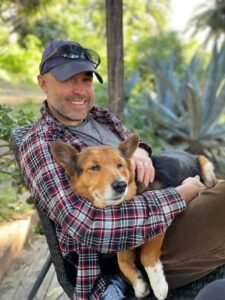 About the Author
Born and raised in Los Angeles, Mike Robinson is the award-winning author of multiple novels and dozens of short stories, most of them speculative fiction. His work has appeared in Clarkesworld, American Gothic Fantasy, Storyteller, Cirsova, ClonePod, December Tales II, Underland Arcana, Thirteen Podcast and many more, and has received honours from Writers of the Future, the Next Generation Indie Book Awards, Maxy Awards, The BookFest, Kindle Book Awards and others. His novel Walking the Dusk was a semifinalist in Publishers Weekly’s BookLife Prize.
As an editor, he has worked with hundreds of authors, including National Book Award finalists, and is the red pen behind J.P. Barnett’s bestselling “Lorestalker” series. A book coach and senior editor with Wordsmith Writing Coaches, he also co-created the New Author Plunge, a workshop for beginning writers, and is on the advisory board of GLAWS, the Greater LA Writers Society, He is also an illustrator, and the screenwriter of the film Blood Corral, which recently hit the international festival circuit.