by Christian Emecheta
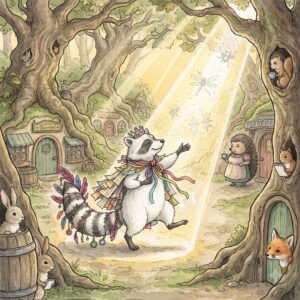
I spent my cubhood in Bramblewood, a bustling burrow-town nestled between the Pine Barrens and the Susurrant River. To outsiders, it was known for its notorious blackberry smugglers and a rogue owl militia called the Talon Order. But to me, Bramblewood was simply home: a maze of tunneled trees where we played “Fox and Hounds,” a meadow where fireflies lit our midnight games of “Bat vs. Moth,” and an abandoned badger sett we claimed as our fortress. Adults? They were background noise—busy badgers fretting over taxes of acorns, or hedgehog matrons hissing about propriety. All except one: the White Raccoon.
No one knew his real name. He earned his title by draping himself in whatever flamboyant scraps he scavenged. Fallen kite ribbons became his scarves, discarded paper towels transformed into capes, and once, he created a crown from soda can rings. His tail was a masterpiece—striped with berry-dyed feathers and clattering with bottle-cap charms. Parents called him “eccentric”; we kits called him brilliant.
The first time I saw him, I was helping my mother sort through winter provisions—a tedious task of separating good nuts from bad. He came twirling down Oak Lane, wearing what looked like a defeated birthday piñata, its colorful paper strips dancing in the breeze. My mother clicked her tongue disapprovingly, but I was enchanted. He moved as if gravity was merely a suggestion, each step rhythmic like a dance move, each gesture part of an elaborate performance for an audience only he could see.
Every dawn, he’d parade through the town square, chattering to himself—or so the grown-ups thought. But we knew better. His conversations were with “The Glimmerfolk,” invisible beings he claimed lived in the sunbeams and shadows. He treated each shaft of light like a royal corridor, each shadow like a secret passage to another realm.
“Aye, Queen Titania, I’ll not surrender the crown till the crows sing soprano!” he’d declare to a patch of dandelions. Or, “Tell the Star-Mice I’ll need a faster rocket if we’re colonizing the moon by Tuesday!”
His daily performances drew an unlikely audience. While adult animals hurried past with averted eyes, we young ones gathered in secret corners to watch. The rabbit twins, Thistle and Thimble, would hop from shadow to shadow, practicing their “Glimmerfolk stealth techniques.” Pippin, our resident theatrical squirrel, took extensive notes on the White Raccoon’s gestures, convinced they were part of an ancient sign language used by spiritual beings.
We adored him. Soon, my friends and I began inventing our own Glimmerfolk etymology. Mine was Sir Nibbles, a chivalrous mouse knight who rode a dragonfly and carried a thistle sword. I spent hours detailing his adventures in my mind—how he defended dewdrops from morning sun-raiders and led midnight charges against the fearsome Dust Bunnies that lurked under bramble bushes.
Pippin outdid us all with Zorbit, a scholarly squid from Saturn who hated Mondays and collected lost memories in ink-filled jars. According to Pippin, Zorbit had a particular fondness for forgotten birthday wishes and misplaced first kisses. The rabbit twins shared custody of a pair of mischievous wind sprites who specialized in tying squirrel tails together when their owners weren’t looking.
We’d trail the White Raccoon through town, adding our own flourishes to his fantastic tales. Sometimes he’d acknowledge us with a knowing wink or a subtle nod, as if to say, “Ah, you see them too, don’t you?” Other times, he’d incorporate our presence into his performances, treating us like fellow actors in his grand production.
“The Glimmerfolk say you’ve got jam on your ear, sir!” I once shouted, feeling particularly bold.
He paused mid-stride, patted his ear with exaggerated concern, and licked his paw with deliberate ceremony. “A tactical snack, lad. Never know when you’ll need bribes for intergalactic tolls. The Star-Mice are particularly fond of raspberry, though they’ll settle for strawberry in a pinch.”
But trouble brewed like storm clouds over the Susurrant River. What started as rumored concerns among parents grew into a thunderous debate that echoed through every hollow and burrow in Bramblewood. The hedgehog matrons began holding emergency “gardening circles” that had suspiciously little to do with actual gardening. Instead, they huddled over their teacups, clucking about “impressionable young minds” and “dangerous flights of fancy.”
“It’s that raccoon’s influence,” Mrs. Prickle declared one afternoon, her quills quivering with indignation. “My Charlotte tried to convince me there was a tap-dancing toadstool in our pantry yesterday. A tap-dancing toadstool! What’s next?”
My father, a no-nonsense fox who thought mushrooms were a government conspiracy (he’d once spent three hours explaining how morels were actually tiny surveillance devices planted by mole spies), grew increasingly agitated. “Talking to air? Next, they’ll be howling at the moon!” he grumbled over dinner, stabbing his roasted beetle with unnecessary force. “In my day, kits knew the difference between reality and rubbish.”
The final straw came when young Birch Badger, son of the town’s most prominent accountant, announced he was abandoning his apprenticeship in acorn taxation to become a “cloud shepherd.” His father nearly choked on his evening grubs.
The Talon Order, ever eager to assert their authority, saw their opportunity. Commander Screech called an emergency town council, his feathers puffed up with self-importance. “This… individual… poses a threat to the very fabric of our society,” he hooted from his perch on the Council Oak. “Today it’s imaginary friends, tomorrow it’s anarchy! Will we stand by while our youth abandon tradition for… for… quirkiness?”
The council issued their decree with the gravity of a falling oak: No interaction with the “delusional raccoon.” Parents were instructed to keep their children indoors during his morning parades. Shopkeepers were forbidden from trading with him. Even the blackberry smugglers, those notorious outlaws, refused to sell him their wares.
The change was gradual but unmistakable. The colorful scraps that had once adorned the White Raccoon grew ragged and dull. His vibrant patches faded to mud-gray, his magnificent tail sagging like a deflated balloon. The bottle-cap charms grew silent, no longer announcing his presence with their merry tinkling.
His conversations with the Glimmerfolk became muttered rather than proclaimed, as if even they were drawing away. “No, no, Princess Dewdrop, I understand completely,” we’d hear him murmur to a fading sunbeam. “Protocol must be observed. Can’t have revolutionary ideas disrupting the status quo, can we?”
One night, unable to bear his diminishing spirit, we sneaked him a care package. Pippin had pilfered blueberry tarts from his mother’s cooling sill, and the rabbit twins had managed to “liberate” a handkerchief from Mrs. Pricklebottom’s washing line – polka-dotted, his favorite pattern. We left it outside his den, wrapped in moonflower leaves.
The next morning, as we pretended to be gathering pine needles nearby, we saw him discover the package. For a moment, his old sparkle returned. He looked directly at our hiding spot and said, “The Glimmerfolk say you’ve got guts, kid. But stay hidden—they’re watching.” His eyes glazed eloquently past the Talon Order sentry positioned in the nearby oak.
That was the last time we saw him smile. Over the next few days, his appearances became sporadic, his costume reduced to a single faded ribbon. The Glimmerfolk conversations ceased entirely. Even the sunbeams seemed dimmer in his presence, as if they too mourned what was being lost.
A week later, they found him dead beneath the Old Oak, the polka-dot handkerchief clutched in his still paws. His vibrant sparkling fur had faded to ashen gray. The adults talked about “natural causes” and “it’s probably for the best,” but we knew the truth: imagination is a heavy thing to bury.
The funeral was a stiff, formal affair, held at nightfall when the darkness was longest. The Talon Order provided an “honor guard,” though we all knew they were there to ensure proper decorum. Commander Screech himself delivered a eulogy filled with backhanded compliments about “colorful characters” and “unique perspectives.”
As the chaplain droned about “restoring order to chaos” and “the importance of rational thinking,” we huddled together at the back of the gathering. The rabbit twins were sniffling into matching handkerchiefs, while Pippin anxiously shredded an acorn cap between his paws.
That’s when it happened.
“Uh… guys?” Pippin squeaked, his voice cracking. “Is anyone else seeing this?”
The polka-dot handkerchief we’d gifted him, carefully arranged in his paws by the undertaker moles, was glowing. Not the subtle phosphorescence of foxfire or the familiar twinkle of fireflies, but a pure, impossible light that seemed to glow like stars.
Then Sir Nibbles sputtered into view—no longer a figment of my imagination, but a real tiny mouse in meticulously crafted tin foil armor, astride a dragonfly with gossamer wings that shimmered with rainbow hues. He winked at me, raising his thistle sword in salute.
Zorbit materialized next to Pippin, tentacles gracefully juggling acorns as promised, each arm trailing ink that wrote poetry in the air. The wind sprites appeared to the rabbit twins, their translucent forms twirling through their fur and causing a most improper ruffling of whiskers during a funeral.
All around us, the space became occupied by shimmering beings. Star-Mice scampered through the shadows, leaving trails of stardust. Queen Titania herself emerged from a shaft of dying sunlight, her court of dewdrop performers spinning in her wake. Even the tap-dancing toadstool from Mrs. Prickle’s pantry made an appearance, performing a solemn but rhythmic mushroom meditation.
The Glimmerfolk weren’t figments. They were real—visible only to those who believed. The White Raccoon hadn’t been mad; he’d been a bridge between our world and theirs, a guardian of that delicate space where imagination explodes into reality.
The adults, of course, noticed nothing. They were too busy muttering about proper burial protocols and the appropriate duration of mourning. But we understood what was happening. With the White Raccoon gone, the Glimmerfolk needed new ambassadors. Us.
Sir Nibbles bowed formally from his dragonfly mount and spoke in a voice like silver bells: “The contract must be renewed. Will you keep the bridge open?”
We didn’t hesitate. We couldn’t. Some promises are too important to ponder.
Today, Bramblewood’s adults still chatter about the “odd kits who inherited that raccoon’s nonsense.” They shake their heads when they catch us in deep conversation with empty air, or spot us leaving tiny teacups filled with dewdrops in forgotten corners. The Talon Order keeps a wary eye on our activities, and my father still grumbles about proper vocational choices whenever I mention my apprenticeship in cloud shepherding.
Little do they know that we’re negotiating peace treaties between fireflies and moths in the twilight council, or planning Mars missions from our headquarters in the badger sett. The Star-Mice have proven to be excellent engineers, and Zorbit’s collection of lost memories has been invaluable in our diplomatic relations with the dust bunnies.
Some say Bramblewood has changed. The blackberry smugglers now run a legitimate trading cooperative (though they still prefer to operate at dusk, for tradition’s sake), and even the Talon Order has relaxed their patrols. But if you visit our little burrow-town and spot some young animals talking to sunbeams or leaving gifts for invisible friends, remember: they’re not crazy.
They’re just keeping the bridge open.
* * *
 About the Author
Christian Emecheta is a writer, illustrator, and computer scientist. His fiction and poetry have appeared in many online publications and magazines such as Arts Lounge Magazine, Writefluence Anthology, 9th Edition of Chinua Achebe Poetry/Essay Anthology, Synchronized Chaos Online Journal, The Decolonial Passage, Mocking Owl Roost, and elsewhere. He writes songs when inspired by a tune or lyrics. Christian enjoys reading, watching movies, and getting lost in his imagination. He hopes to travel the world.