by Anne Larsen
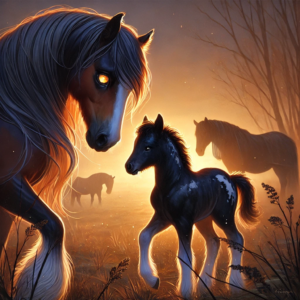
My dam remembered when Lore was a sorrel mare with a bad hock. By the time I was foaled, Lore was a dun mare faded by sun and salt water, her muzzle going grey and her eyes — well, Lore’s eyes are what they are: green and gold, like no other horse in our herd’s heritage.
“Can she really see the wind, mama?” my third foal asked.
“My dam said she could, but how can we know?”
“Did you ever talk to her?”
“Only the lead mares speak to her. Sometimes the old aunties graze by her and listen. She tells them the stories they must tell the weanlings.”
“What stories?”
“Soon enough, you’ll know, won’t you?”
He leaned into me then, lipped my udder enough to show that he appreciated my milk, though he didn’t drink much these days. His foal fuzz came away in patches revealing his bright bay coat, a gift from his sire. By late summer my colt would be off with the others of his year learning all the things a horse needs to know to live among his kind on this harsh place: how to see patches of sucking sands, how to brace side-by-side with cousins, rumps to the storm wind and heads low in the lee of their shoulders, how to run and spar in the bachelor band where friend and rival are the same thing because they both strengthen you. But for now he stayed close, bending his knees to graze in the shelter of my body when the wind off the water blew cold.
As my foal would soon do, I had learned Lore’s stories grazing among the senior mares who no longer bore foals but guarded and guided the weanlings into maturity. She remembered sweet grass in marshes far back before men, when only the wind’s hands had touched us and we carried no burdens. She remembered generations when ice locked the land and when it had weakened, she had led her people north to new pastures fed by the waters of its retreat. She remembered the hot, golden hills we had run before we came here, packed in the dark bellies of wooden ships that crossed the saltwater.
One evening, in the dusk after sunset, with the offshore wind fading and the herons settled on their high nests, Lore called us all to Gather. She had never called a Gather in this land before now, but we all recognized the summons as it lived in our bones and blood. The lead mares sent the bachelors up and down the island, leeward and windward, to bring every horse to hear her. Last to come were those on the far side of the fence that humans had stretched from inner sea to outer sea, nonsense dividing the sand. Those horses skirted it by swimming around the sunken end. Rumor said they had left a great pile of manure banked against the sun-warped planks.
By moonrise we were with her in our hundreds, mare and foal, weanling, bachelor, and herd sire. We surrounded her, the lead mares at the center and the rest of us around them, circle around circle, silent but for tail-swish and hoof-stomp when flies bit. The Gather Truce prevailed, so none of the young stallions challenged their elders or one another for mares. They knew the penalty for disturbance was exile, as good as death, for no horse can live alone.
Into our minds she came, silent as snowfall, showing us what we needed to know and what we had to do. “Far over the gray ocean in the direction of morning,” Lore said, “lies an island with a fiery heart. That heart swells and will soon break, shattering the island above it. Most of its body will fall into the sea, making a great wave rise and run. In less than a day it will travel from there to here. When it arrives, it will shrug the ocean over this island and roll far inland across the channels, washing everything before it, then drag the shattered mess back out to deep water. The flood will run faster than we can, so we must leave now to be far away and safe when it comes.
Lore’s plan was to take us across the channel to the smaller sister island, through the town there, across the second channel, then over fields and into a forest we had never seen. She knew some of that country from the times she had been caught in the high summer penning-day, when many of us were driven across the water and into the town to be looked over by humans, with some youngsters taken while the rest of us returned. Because they were her kindred, Lore could touch the minds of those horses carried away to new pastures, so she knew roads and open land none of us did. She selected our destination inland from what she had learned from these distant lives.
The vision of tall, dense trees startled us, for we were creatures of this windswept, watery place, living on seagrass between sand and sky. But for horses, the sense of home is the same as the sense of safe, not tied to a bit of ground, but to a feeling of peace, where a watchful eye is all we need to keep our foals and families from harm.
Lore sent urgency rippling through our spiraled herd, and the outermost bands peeled away, trotting toward the channel crossing. The senior mares led; their stallions took the rear guard, guiding the youngsters between them. As the great mass of us moved out, I felt the other lives of the island stirring. The white tips of fox tails flickered through the scrub, and I heard the light footfalls of deer shadowing us.
The wading birds, who have their own ways of knowing, lifted from the shore in skiffs and swirls, strangely silent. I had never seen herons leave their rookery so close together, one after another, long legs behind them and their wide wings scooping the night air, the lines of them long strands like a tail swept back in the wind. The egrets, large and small, were easier to see, their whiteness gathering the scant moonlight. By the time the first horses entered the channel, the air above was filled with birds, the differing rhythms of each kind’s flight blurring together into a whoosh like rushing water.
When I plunged into the channel my foal pressed close to my shoulders. He’d splashed in the ocean shallows with me before to escape the black flies but this was his first real swim. It was low tide, so there was little current in the narrow stretch of water. His brave muzzle never wavered as he swam, ears swiveling to listen to huffing breaths around him and the murmur of crossing wakes as our band pressed forward. The moment his hooves found the far shore he bounded onto the beach, soaked tail high with pride. He nuzzled his year-mates as they checked one another, affirming that all were here.
Whitetail and sika deer had blended into our great herd, but sifted themselves apart as soon as they landed, bounding away across the yards and gravel roads toward the leeward beach. Foxes and raccoons arrived in our wake, staggering on the trampled sand as they shook water from their pelts before disappearing with the deer.
Lore came in the middle group, but all the bands waited for her to take the lead in the next part of our journey. She led us past the wooden houses and yards of short, thin grass, sending her peace outward to soothe dogs startled awake by our footfalls. We walked so the foals and eldest could rest and so the muffled rumble of our hundreds passing would wake no human sleepers. The island’s captive horses heard us, though, and some called to Lore. She quieted them, but I believe she gave them the message because several of them ran their fence lines and rattled the gates that kept them from joining our numbers.
“Will they die here?” my foal asked.
“I don’t know. I think the humans will leave the island and take their animals with them in a few hours.”
Our great herd bunched together on the leeward shore as Lore assessed the condition of our weakest and then considered the best crossing. Marshy sand spits littered the inner channel, some of them standing proud at low tide and others merely clots of reeds trapping muck that gave no rest or purchase to a tired horse. Lore’s light touch in our minds asked us to attend her again.
“It will be a long swim, maybe hours to reach the far shore. Some will be lost to the water.” The lead mares nodded, their ears twisting with fret. “But there is another way. We take the narrow road above the water that goes straight across. We could trot and canter that distance, reaching the far shore with enough night left to hide us as we run inland.” The adults raised their heads to study the distant ribbon of stone and steel. Ever reckless, the bachelors nudged one another, their feet shifting in anticipation.
“We might meet with humans crossing. We would have to share the road with their machines as there is no way to leave it once we have begun. Are you willing?” Mares and herd sires pressed together, necks arched and muzzles close, seeking reassurance from one another. Shifting along the shore road, the herd shuddered as each family band made its choice. One by one the lead mares sighed their assent and the entire herd stood still, waiting.
“Together then,” Lore said. She led us up the island, the stallions keeping our long herd clustered on the road. Past houses and cars and buildings we walked through the silent town. Most of the adults had walked through the town on penning day, so the shapes were familiar. The waning moon was high now. Lore turned onto the wide, white road that ran over the water. Lead mares and stallions kept us bunched close on the shallow rise to the road. It was wide enough for us to travel several abreast, the mares with foals at heel. My colt and I trotted near the front. We could see Lore’s pale coat glint in the moonlight, her dark tail held half-high, signaling her concern. From the well of my heart through every muscle and sinew I knew she would keep us safe.
Lore kept our trot steady, a cadence to cover distance without exhausting our youngest and eldest. The bachelors longed to break and run, but lead mares pinned their ears and drove the males back into line with nips and glares. My colt’s boldness pleased me as he matched my pace. I raised him with that courage. In a different band I would be a lead mare, but my older sister guides us, the strength of her spirit rare and worthy, so I am content to follow. Perhaps one day she will leave our band to go with her chosen mate when he is displaced by a younger stallion, and I will step into her place. Until then I trust and obey her and insure all my foals do as well.
The road crossed reed beds that hissed in the sea breeze, the long stems rippling like water above the water. Now and then we heard deer splashing over the sand spits, traveling in pairs and severals with few fawns among them. I doubted that fawns could survive the long swim, so many does had not started this part of the journey. By now all the birds had vanished inland so the sky above us was deep and calm, though on the far shore lights from another town tainted the dark horizon and smothered the stars. The rhythm of our two-beat pace blurred into a low thunder on the hard road.
We had reached the place where the road crosses the deepest, widest water when the truck came, heading toward the island. I had seen one of these at rest in the town last penning day. It was huge, three times our height, and its face lights flashed as it roared toward us.
“Move over!” Lore commanded, and the whole herd flowed sideways to the upwind side of the road, crowding many horses against the low metal fence. The truck made so many different sounds that it seemed to be more than one creature. I heard thumps like a woodpecker on a hollow tree, though there never was so huge a bird. I pinned my ears against its mind-piercing squeal.
The horses in the front bunch balked and those behind them piled into one another, screaming. Some that were crushed against the low rail leapt off the bridge, and I heard their bodies hit the water below. A filly panicked, breaking out of the herd and running blind toward the beast, screaming for her dam. Lore spun and leapt, shoving her back into the stumbling mass of us. The filly found her dam but Lore could not escape the truck’s path. It hit her broadside, throwing her several lengths down the road.
She lay still.
The truck halted, its eye-lights glaring at the heap of her golden body.
The mass of plunging, panicked horses milled on the road. My colt squealed and the lead mares cried out, frantic to contain their bands and push them past the rumbling truck. It was not moving anymore, but clouds of smoke billowed around its feet, its eye-lights shattered our night vision, and a human had climbed down off of its side. He yelled at us and waved his hands but the horses at the front ignored him. Beside his deadly, reeking beast, he was no threat at all. The leading band had tangled in rage and fear, stomping on their own youngsters and not even the stallion could shift them by driving from the rear of the group.
“Lead them. They need you now. Get them across the water.” Lore’s voice steadied me, directed my attention away from the press of legs and the roiling sea of necks, manes, and haunches. “Go on. This is who you are. They are all, every one, yours to lead.”
“I am not a lead mare,” I answered. I could not keep my feet still. Terror had streaked my shoulders and flanks with foamy sweat.
“You are far more. Now you are Lore. Call your people together and they will follow you.”
“How can they hear me?”
“The same way you hear me now. Believe with your whole heart — know with your whole mind — that they are your people. Then speak.”
I turned away from the empty body on the road to look at the shuddering line of horses stretching far back toward the island we had fled. My night vision returned and I saw them, each one, knew their names, their lineages, their strengths and sorrows. White feet, blazes, stars, patches, and tails gleamed under the waning moon. Scents of fear-sweat and mare’s milk whipped past me on the landward wind. My colt found me, ducked under my neck and pressed himself against my chest, his voice quavering in time with his skittering feet. I bowed my neck over his back and laid my cheek against his face.
“Shall we leave, beloved?”
He bleated in answer.
“Follow me, stay close.”
I turned my mind inward, stroking the memory of every horse I knew here, discovering that somehow I knew them all, even the bands from the north whom I had never met.
“My people, my family, follow. We move forward now.”
I stepped around the dead mare and passed the hot body of the truck, pausing only to bare my teeth and strike at the human so he would step back. I arrived at the front of the line, nibbled my colt’s curly foal-mane to reassure him, and spoke again with my whole body, a strong trot ringing on the hard road as I stepped into the darkness beyond the horror.
“Follow, follow,” my two-beat gait sent a tempo through the herd. The confusion at the front dissolved into order, the simplicity of the trot, and with motion came clarity and calm.
All down the herd the lead mares matched my call, walking until the ripple of forward movement opened space for them to trot. I directed one of the old bachelors to keep the human pinned against his truck until we were all past that narrow place. I knew, somehow, when the last horse was on the open, empty road, and I pulled the whole herd into a canter.
On the road we crossed the main channel, then the marsh islands and the smaller channels. A knowing, rather like a scent, came to me that the horses who had leapt into the sea were making good time. All were strong adults who could smell the mainland.
“We will wait for you on shore,” I told them. “We will rest until you join us.” There was no lead mare in the water with them, so they could not answer me, but I felt them take heart and stroke onward.
I cantered above the last marsh island. The road was level with the land again and swung left a short way onto the shore. It lay beside the ocean’s edge for as far as I could see, short grass and white sand on either side. I saw a fence glint in the darkness, but there was enough space on our side of it for all of us to gather. I walked onto the grass, my colt walking beside me, his body trembling with exhaustion.
“We will rest here and wait for the swimmers,” I told the arriving bands. “The foals need to feed and sleep. Come close to the fence, away from the road. Our band, led by my sister, stayed near me. We claimed a space and I dropped to my knees, then to my side, rolling to rid myself of the sweat and distress of that crossing. I stood and shook, then invited my colt to nurse. He drank all I carried, and was asleep, flat on the grass but for his round belly. I felt the last of our herd, mud-caked and staggering, rise from the channels and marshland and rejoin us. They found their bands and lay down, their need to rest greater even than their desperate thirst. I also sensed does and fawns on the bridge, their hard, tiny hooves tapping as they followed our lead, foxes and other small animals scampering among them, pulled far from their home ranges by their terror of being left behind.
“Ask the aunties to watch for a time so you can sleep,” I told the lead mares. More tired than I had ever been in my life, I lay down beside my foal and slept.
In my dreams, Lore’s power and knowing flowed into me, blending my own life’s experience with that of all the generations of our people who came before, like a tributary stream joining a great river. I was still myself, a dark paint mare of six summers and three foals, but now I also carried in myself so much more. I wandered the memories of these horses, of their sires and dams going back to a place I had never seen. Hot, stony mountains and hard land, sparse grass, black cattle. Men on tall horses used long poles to drive us and the cattle to high meadows season on season. I dreamt of the wooden ships that bore us over the water, not to our island but to a place far to the south, hot and wet. We carried humans, pulled wagons and plows, walked beside sheep and cattle, and plunged into the noise and stink of battle, steel spurs sharp against our sides, urging us into the blood and hurt and press of angry, frightened bodies. Horses came north, dispersed across forest lands and grass lands. So many places, so many seasons, and yet we were one people under a clear and fair justice meted out by the lead mares. At the edge of my awareness, further than eye can see or ear can hear, bands of horses ran under the setting sun with their own Lore among them, as all horses across the broad face of the world, mountain to desert, grassland to island, have a Lore among them who keeps them safe.
I dreamed each member of this herd: the white-faced foal born deaf, the exiled stallion going blind, the fierce, wild minds of the young bachelors, the foals like marsh lights, faint glimmers at birth but burning bright and steady by weaning. The lead mares bound together all other mares connected by blood and friendship, the strands among them gleamed like a dew-touched spider web on a clear morning. Now I stood at the center of them all, promised to them and promising them, bearing in my body all we are and will be. This is how it has always been, Lore passing from one mare to another, shifted by deaths sudden or slow, always a shock to the anointed one. I would never be our band’s lead mare. I would not bear another foal. I no longer belonged only to myself, but to all of us, and I loved each quick-footed foal and senior stallion, each vigilant dam and cocky bachelor, and every one of the brave lead mares. I loved them all with a fierce, determined, sheltering understanding of who we had been and who we will be.
I woke, rose, and snatched at the short, tough grass, frantic and ravenous. While I grazed, I sought out the memories Lore had left to me of the way from here to safety. My awareness drifted inland, following the tendrils of memory from other island horses who had lived here for generations and guided by the minds of those who lived here still. The living horses showed me that fences closed off the most direct path to a forest. They also shared the knowledge of ponds and creeks where we could drink.
The light grew brighter long before the sun lifted above the water. My colt stirred, blinking and groggy. He rolled onto his belly, braced his forelegs wide and shoved himself up, shaking himself from nose to tail tip. I lipped his forelock and invited him to nurse. He looked up at me and scrambled backwards, legs splayed and the whites of his eyes bright against his dark face. He fell into a frightened heap, struggling to rise.
“Who are you?” he bleated.
“You know me, beloved,” I said, sending my breath to comfort him.
“My dam’s eyes do not glow. Why do you smell like her? Where is she?”
“My eyes glow? I did not know that. I am who I have always been for you, though now I am also more.”
He sorted his legs out, rose, and bolted toward our lead mare. My heart twisted in pain to see him so afraid. My sister met him, curling her piebald neck over his and nibbling his withers to calm him. When his trembling eased, she shouldered him back toward me.
“She is your dam, child, always,” my sister said. “Close your eyes, take in her scent, and you will recognize her.”
I closed my own eyes and held myself still, but I could hear the panic in his feet as he scrambled beside my sister.
“What happened?” he snuffled against her flank.
“On the bridge, Lore passed from the mare where she had been into your dam. She is now Lore, keeper of all the stories, guide and watcher, the wisdom of all horses living among us.”
My foal made a soft sound of fear and loss and only the steady presence of my sister kept him from bolting. Grief rose in me then, a stain in my tributary as it entered Lore’s ancient river. I knew now that every mare who has ever been Lore had felt this loss, though knowing I was not alone in this did not comfort me.
“I will look away so you can feed,” I said. But my colt would come no closer, and did not ask to nurse again. My sister released him to join the other weanlings in our band. She shared her breath with me, taking in some of my sorrow at this loss. We groomed one another for a time while my heart ached.
A few cars passed us on the road, going out to the island. They slowed or stopped to look at us before driving on. The ground beneath me felt wrong, not the way that sucking-sands do, but dangerous and unfamiliar. Refreshed by sleep and light grazing, my people’s thirst made them restless. I chose to follow this road to its end, then turn into the farmed fields and travel over them to the nearest woodland.
“Rise now,” I said to the herd, “I know you are hungry and thirsty, but we must move away from here. We are not yet safe.” The bands stirred, mares nosing foals up for a quick meal, stallions circling their charges to bunch them together.
“Follow me. We will go to water first, and then take shelter from what is coming.” Speaking to all of them this way disoriented me as I gathered glimpses through the eyes of each horse as my mind touched theirs. I shook off my confusion and set out in a slow trot that would carry us miles though we were still tired.
We stayed off the road when we could, trampling the grass alongside it rather than bruising our feet on that hard surface. Each time my hooves touched the earth, it felt wrong, as though the ground should not be trusted. I wanted to move us faster but forced myself to keep to this easier pace.
Not long after sunrise the earth moved. The tremor swept past us from seaward to landward, a shiver like flanks beset by biting flies. Horses squealed and bucked, scattering. Several foals went down hard and their dams stood over them to fend off the trampling, panicked hooves. Then, as suddenly as it shifted, the earth quieted. None of us trusted that stillness now. Inland and from the islands, we heard the wail of human alarms.
“Follow, follow,” I called and we set out again, the lead mares hard put to keep their bands from tangling in the confusion. The few cars on the road had stopped, their humans out and walking, gesturing to one another. They had had no warning. They stopped talking as we swept by them in our hundreds. The road turned away from the ocean and headed straight inland. I stepped into a canter. We had so little time before the humans would swarm. Now they knew what was coming and we must be out of the way of their rush.
I learned from the horses living nearby that the road went straight from here, and soon we would reach open land. An old gelding paced us along the fence of his pasture, telling me where to find the creek on the far side of the long field. The sun was well up and more cars appeared, so I was relieved when we arrived at the place where we could leave the road. I sent my sister and her band on toward the water and waited while the herd flowed past me. The bachelors, unfettered by mare rules, bolted into the wide field, their hooves flinging up clots of mud and small plants as they tore away, tails flagged high and eyes wild. I joined the last band to leave the road, stepping between them and a group of humans approaching on foot, yelling and waving their arms. We left them their road, and they did not follow us.
I joined my sister at the creek. My son clung to her flank and would not look at me even when I nickered at him. I turned away from the pain in my heart, keeping my attention on the stragglers far across the field. Horses arranged themselves along both banks, upstream and downstream. They dipped their muzzles into the chilly water and drank, lifting their heads in turn to keep watch while the water settled in their bellies. Then others paused and took the watch so the first could drink again. The foals pranced into the creek up to their knees so they did not have to strain past the length of their legs to reach the water. As horses soothed their thirst they stepped away, allowing the latecomers access. There was no grazing for us here, just scrub and a small patch of trees. But there were also no humans here, so sighs of relief rippled through the herd. No one relaxed, as we were in unknown territory, but we were not threatened. The earth beneath was still for now, but I thought it might move again. It was the coming shift in the ocean that threatened us, though, and we had to be further inland before that happened.
When I set out in the lead this time, I kept us at a walk. Even the younger horses kept this pace, as the terrors of the night and morning had drained them. Each band kept its members close, but the bands themselves drifted apart in this open space. It was bigger than any flat, empty ground these horses had ever seen, and it spoke to their blood and bone as good land for horses. We could see any danger coming from far away, and there was ample room for all of us to move if we had to flee.
It took much of the morning for all of us to cross that ground. It was all as flat as our island, which is why we had to go so far away from the shoreline to escape the coming water. We saw only one human far away, a man on a machine that stirred the sandy dirt. He stopped his machine and stood on it so he could watch us pass. I looked back and saw him turn his machine and leave the field.
At noon we reached a place with patchy scrub and some grazing, so we stripped it bare. The foals nursed and slept, and the elders lay down in the cool shade. I stood apart, listening to the minds of horses far from here. Those native to this place showed me that their humans hurried, moving their families and animals inland. I found some of the horses on the small island and saw through their eyes the fear and haste as they, too, prepared to leave with their humans. A filly in a trailer on the long bridge shared her eyes with me, and I saw there was no open road, only a stretch of cars and trucks creeping toward the far shore. I breathed gratitude into the afternoon breeze that Lore had Gathered us when she had.
Late in the afternoon I called, “Follow, follow me.” We left the scrubland and walked another long field, always heading inland. Human alarms blared in the distance. I pushed the herd through fine pastures though many wanted to stop and graze. Even so far from the ocean, I could feel the wrongness in the turning tide, though I could not convey this to my people. They trusted me when I moved them on at a brisk trot. We stopped just once for water.
That evening we reached the forest I recognized from Lore’s memory. She had meant for us to go among the trees, as they held this land fast with their bodies and no great wave or storm surge had ever shifted them. We needed only to spend a night and a day in their shelter; then we could return to open country. The herd bunched against the borders of the forest, unwilling to step into the dimness under the dense branches. Born and bred under wide sky and constant wind, the trees felt confining, and to us, that meant dangerous.
“Come in, my people, come under these trees,” I coaxed. “This is where we will wait. The water is coming, and in a day or two it will retreat. Then we graze under the sky again. In time, we can return home.” The lead mares coaxed their bands from the sunlight into the deep shadows. The bachelors were the last to enter, skittish and resistant to the lead mares’ instructions. I directed seven of the senior stallions to drive the reluctant young males, with teeth if necessary, into the forest. When the entire herd settled at last in this strange shelter, I spoke to the Gathering, my mind touching each of them.
“Come close around me,” I said. “I will tell you stories through this time we must spend far from our island.” The wind in the trees sounded like surf. “We will be safe here.” Away to the east, I sensed the ocean arrive and the world we had left snapped and splintered under the running wave. My breath caught as horses and humans trapped on the road, and those who had not yet left the island were swept under. Sweat formed on my flanks and neck and dripped off my shoulders while those around me stayed dry and calm. I took a deep breath and released a long sigh. I forced my attention back to the shuffling of hooves in leaf litter and the call notes of tiny birds astonished by our arrival. I decided to tell my herd about the golden mountains and the black cattle. “Long ago and far away,” I began, “we lived in a different land and ran with another people.” Even the bachelors stood still to listen.
* * *
 About the Author
Anne Larsen writes in a bio-diverse household that includes mammals, birds, and plants, in particular a gang of Venus flytraps that rule a dangerous neighbourhood on one windowsill. In addition to direct guidance from her animal family, Larsen draws on biology, history, mythology, and religious studies in her magical realism.
Stunning. I loved this story so much!
I felt present with the herds, and grateful for Lore and water and safety. Thank you.