by Andrea Giusto
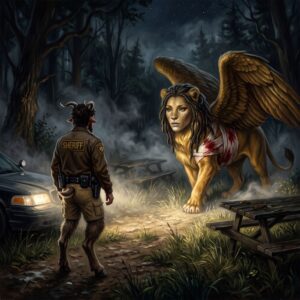
Stephen left the shadows of the pine forest behind. The Mediterranean sun blazed in the cloudless sky, warming his tan skin. The scent of brackish water was intoxicating, and the chirping of cicadas filled his pointed ears. He was vaguely aware of being completely naked, except for the brown fur that covered him from the waist down. His hooves left crescent-shaped footprints on the sand as he crossed the tall, thick vegetation growing on the dunes. He stopped and turned his head from side to side, shaking his curved horns. Beyond the distant crashing of waves, the breeze rustling the leaves brought a new sound: the melody of a flute.
The faun stood there, entranced, as the notes spoke of desire and belonging, of joy and pain, of life and death. The craving to find the source of the music overwhelmed him: if he could succeed, he would never seek anything else. He would be complete.
Stephen’s heart pounded in his chest as he quickened his pace. His furry arms brushed aside the sharp-edged branches, his hooves splashed in the now marshy ground. The music increased in intensity and rhythm, guiding him like an arrow to its target.
And then, suddenly, the branches opened onto the beach. Languid foamy waves lapped the sand, advancing and retreating to the rhythm of the music. Crouched in the shade of a thicket, a female faun turned to look at him: her eyes were as black as night, her curly hair cascaded between her horns, falling onto her tanned shoulders. Her full lips parted in a smile as she lowered the flute; she spread her arms, in a gesture that was both a greeting and an invitation.
With a cry of wild joy, he ran toward her.
* * *
Stephen woke up in his bed, staring at the bright numbers on the alarm clock. In a corner of the room, the embers burning in the stove gave their final breath of warmth. He ran a hand over his face, as if trying to shake off the dream, and reluctantly sat up between the sweat-soaked sheets. It was time to get up.
Still drowsy, Stephen went to the kitchen and prepared a breakfast of cigarettes and bitter coffee, which he consumed while staring at the mist outside the window, thinking about the melody he could no longer remember. After that, he took a quick shower, carefully drying the fur on his legs and arms, then put on the gray and brown county sheriff’s uniform. He let go of the wide-brimmed hat, which he couldn’t wear because of his horns and was collecting dust hanging on the hook, next to the empty holster of the standard-issue pistol. Finally, he put on rubber hoof covers, grabbed the pickup keys, and left the house.
The fog had cleared, revealing the oaks growing around the log cabin. On the horizon, the mountain peaks were already covered with a white blanket. November was approaching. Stephen shivered as he got into the car and started the engine.
The acacias had shed their leaves, creating a colorful carpet on the road leading to the town. After one last cluster of trees, a rusty sign welcomed him: some joker had replaced the word “population” with “humans” and deleted the number that hadn’t been updated for years, writing a resounding “zero” in capital letters. Probably one of the third-generation kids, he thought.
On the main road, some fluttering fairies were hanging the festoon lights and decorations for the Miracle Festival. Dragons, griffins and unicorns. Wooden market stalls were already in place, waiting for the first customers to buy pumpkin pies, scented candles and handmade scarves.
As the pickup moved along, the sheriff noticed several new faces on the sidewalks. Visitors with their children in strollers, hikers with large green and orange backpacks. In front of a dumpster, he saw Mother Alessia throwing away a huge number of fast-food bags and empty soda bottles. There must have been a parish event recently.
The radio transmitter beeped.
“Hey boss, where are you?”
Stephen pressed the receiver button. “Hi, Pat. I’m in the car. I’ll be there in a minute.”
“Don’t worry, no one’s dying. But it’s better if you go to the Van Deers. Remember that puma Albert says he shot last week?”
“The one going around killing chickens?”
“It seems they found it. Only, it’s not a puma.”
“Really? What is it then?” A young bear, maybe a wolf, he thought. A big stray dog, probably.
“Well… Tom and Maria are already there. With James’ guys. You better get the details from them.”
Stephen furrowed his brow. The coroner? “All right, Pat. I’ll head there now.”
He made a U-turn at the intersection, under a banner that read “Miracle Festival 2033.” It took a few minutes to climb the hill with the pickup struggling through the gears. First, he saw Tom’s car with the county police shield on the door. Then, it was the black van with “coroner” in yellow letters, parked in the clearing in front of the Van Deers’ house.
Tom met him as he got out of the car. He must have shaved before his night shift, but his beard was already growing lush on his wolfish face. He had a disgruntled look when he bent over and greeted him. “Hi, boss. You really need to see this.”
Stephen started to get nervous. “Can you explain why James’ guys are involved with an animal?”
“It’s not exactly an animal…”
“What do you mean, not exactly?”
“The Van Deers found it early this morning, and well, I think you’ll have to notify the state police.”
“Darn it!” exclaimed the faun. “City cops right before the festival. Who’s going to break the news to the mayor?”
As they talked, they had entered the woods. Now they had reached a clearing where a small crowd had gathered: Albert Van Deer, the sylvan elf who owned the property; the coroner’s guys, pale as usual; Maria, the junior officer, taking photos and telling everyone to stay away as she scurried back and forth on her gnomish legs.
Stephen greeted them as he passed and then he saw it. “You’re kidding!” he exclaimed, instinctively touching his horns.
The body was undeniably feline—the massive frame of a lion with golden fur—but a pair of large, feathered wings like those of a bird of prey rose from its shoulders, and where its muzzle should have been, there was an almost human face. The creature lay on his side, with yellow eyes obscured by a gray veil, the mouth wide open, revealing two ivory fangs. A purplish tongue seemed to lick the ground covered in lichen. A faint mane surrounded his head like the halo of a saint.
“He’s a male,” Maria said, lowering her camera. “And I think he was quite young, judging by the length of the mane and the fangs,” she added, clearly pleased by her own erudition. “Does anyone know the life cycle of a sphinx?”
No one answered.
“I didn’t know he was a person!” Van Deer exclaimed, approaching. “I challenge anyone to recognize that thing at night. Instead of presenting himself like a civilized creature, he smashed the chicken coop door, roaring like a fury… The kids started screaming! What was I supposed to do? I swear I didn’t know he was a person!” he repeated, red in the face.
Stephen had known Albert since school, and he knew he wasn’t a murderer. He could understand his distress: a sphinx was a sentient creature, so it was a homicide. Guilty or not, there would be an investigation involving him and his family.
“No one could have foreseen this,” he said, trying to sound reassuring. “I’ve never seen a sphinx around here… in fact, I’ve never seen one in my life.”
“He was way out of his place, for sure. Did you know…” the gnome began, eager to help, but Tom abruptly interrupted her.
“Please, Maria. It’s not time for a biology lesson…”
As they argued, Stephen knelt beside the body. The ants had already begun their grim work, marching in orderly lines across the pointed ears, much like those of a real lion. The lobes were pierced, as if he had once worn earrings. The tips of the wings had a strange shape: upon closer inspection, he realized they had been cut, but those scars were old. Apart from that, there didn’t seem to be anything strange, except for the absurdity of the situation.
“You said you shot him last week?” asked Stephen, getting up from his knees.
“Yes,” Van Deer replied. “I’m sure I hit him because I found blood on the ground. I thought he had gone to die somewhere.”
“Well, it doesn’t look like he’s been dead for a week.” The faun circled the sphinx. “And I don’t see any wounds on this side.” He sighed, then clapped his hands. “Okay, guys, we can’t leave him here. I don’t want an argument with Mother Alessia on the dignified way of treating corpses. Let’s finish the forensics and take him to James: maybe he can make sense of it.” He turned to his deputy. “Tom, you and I will take a look around to see if we can find any leads. This creature must have come from somewhere, and I don’t think he could fly with those clipped wings.”
“And me?” Albert asked. “What should I do?”
Stephen scratched his long ears. Certainly, the elf had never thought about running away. “Albert, please, go back home. Stop by in the afternoon for a statement. I suggest you call a lawyer.”
While the others prepared the body for transport—it would take at least six people to load it onto the van—Stephen and Tom began to walk the clearing in concentric circles, moving further away.
“We wouldn’t have to wait for sunset if we had another coroner,” his deputy began.
“Do we really need to have this discussion now?” the sheriff asked, exasperated. “Listen, James is qualified and has saved our bacon on more than one occasion. He knows his job and is a good kid.”
“He’s a seventy-year-old kid!” Tom burst out. “Do you know he sleeps in the morgue? He could contaminate the evidence! Not to mention his assistants, if that’s the right term. Those guys give me the creeps! I can’t understand why you like him so much.”
“I’m getting tired of your werewolf prejudices. What you do on full moon nights is just as strange, in fact, it’s a miracle you haven’t caught a silver bullet so far. Let’s try not to behave like characters from a teenage horror novel.”
“We all are by now,” his deputy replied, grumpily.
They continued in silence for a few minutes, scanning the ground, but the sphinx’s tracks vanished after twenty yards. They were about to turn back when a glimmer in the undergrowth caught Stephen’s attention. “Tom, come take a look! What the hell is this thing?”
* * *
“It’s a dart for an air rifle, the kind used to sedate wild animals,” James explained, pointing at the object on the metal cart beside the autopsy table.
“Albert said he fired at what he thought was a puma, a week ago, but with a hunting rifle,” the sheriff said, folding his arms. It was cold in the morgue, which suited James just fine. The faun, on the other hand, kept tapping his hooves on the tiles glowing under the neon lights.
“Maybe he really did shoot a puma, because this creature died less than twenty-four hours ago and has no gunshot wounds. Just three needle holes, in different spots.” The coroner pulled back the sheet covering the sphinx’s corpse. “Two on the hindquarters, one on the chest,” he added, brushing aside the golden fur with his fingers to reveal the entry wounds. “Hard to notice at first glance.”
“Someone tried to take him down, big hunt style.” Stephen scratched his horns. “Damn it, but who are they? And where are they coming from?”
“That’s what you’re supposed to tell me, Sheriff.”
The faun furrowed his brows. He stayed silent for a while, staring at the body on the table. It had been arranged properly while waiting for the state police to arrive. James wasn’t a funeral director, but he had tried to be respectful. “The sphinx probably came from the forest,” he finally said. “That’s why no one noticed he was around.”
“And his hunters?” the coroner asked, stepping away from the table to open a lab refrigerator.
“The Miracle Festival,” Stephen explained. “They must have slipped into town blended with the tourists. And they knew what and where to look for: no one carries those weapons around to shoot deer.”
“They definitely didn’t stay at Judith’s Lodge. I doubt they’re that foolish. The food is awful.”
“Very witty.”
James took two containers from the shelves inside the fridge. He placed them carefully on a cart. “Why did they leave him in the woods?”
“We found the darts in the underbrush. He shook them off and then slipped away from the hunters,” Stephen replied. “Only to die not far from Albert’s place. Maybe he was looking for help. Or maybe there were…”
“What?”
Stephen shook his head. “Nothing. Just a baseless hunch.”
James narrowed his scarlet eyes. “In any case, your reconstruction seems plausible.” He opened the first container and gestured for Stephen to come closer. Inside was an enormous, dark-red heart.
“Look. See the discolorations and the rigidity of the tissue? Blood tests are in progress, but it’s already clear he had a cardiac arrest, almost certainly caused by a reaction to the anesthetic. It happens rarely, but happen it can,” the coroner concluded, as if he had already dealt with such things.
For the umpteenth time, the faun scrutinized his friend’s face. Despite the gray hair, the vampire didn’t look older than eighteen, even though Stephen knew he must be at least seventy. He was a first-generation transfigured, one of those who still remembered the world before the Miracle. In contrast, Stephen was born a faun, and even at thirty, he felt like a child compared to him.
“I never asked why you came to us,” he said, changing the subject. “After the Miracle, all the vampires moved to big cities. But you chose a small town in the woods.”
James shrugged. “I don’t like cities. Too many people, too many problems.”
Stephen looked outside the window. In the moonlight, the coroner’s assistants were unloading bins of disinfectant liquid from the van. Those guys were his “donors.” No one could argue with him because they were all adults and consenting, even though old prejudices die hard, as Tom constantly reminded him.
“I love the simple life. That’s all.”
The sheriff didn’t buy his explanation, but chose to leave him his secrets. “Maybe our late guest thought the same. Perhaps he was tired of city life,” he said instead.
James fell silent for a moment. He covered the sphinx with the sheet and said, “What do you know about the Miracle? About what really happened?”
The faun raised his shoulders. “I know what they taught me in school, that there was a merger between realities. Something about a quantum collapse, or a resonance cascade. Things like that.”
“I bet they’ve left it to guesswork.”
“At Sunday school, the Church of the Miracle told us that mankind was on the brink of destruction, and the Dreamworld intervened to save us. We were transformed, our souls made manifest. Since then, wars stopped and everyone is free to follow their own dream.”
“Mother Alessia would be proud of you,” James commented with a slight smile.
“Don’t you believe it?” The sheriff was intrigued: it was rare for James to open up like that.
“I don’t know what really happened, but I’ve lived long enough to understand that this world is impervious to salvation. We only took on the form of the dream, but not the substance. We’re still destined to chase happiness without ever finding it.”
Stephen thought back to the dream from the previous night, to the music he couldn’t remember. He lowered his eyes to the sphinx and suddenly felt sad.
“There were many more of them at the beginning,” the vampire continued, following his gaze. “But in the chaos of the Miracle, it wasn’t easy to catch your own dreams without opposable thumbs. It may seem trivial, but I assure you it’s true. You have no idea how those days were. Half of the vampires died immediately, just because they were transformed in full daylight: fires were everywhere. Winged creatures were throwing themselves from burning skyscrapers, only to crash to the ground because they didn’t know how to fly. Tritons were drowning in the air…”
James stopped, as if he had said too much. “In the transformation lottery, the sphinxes drew the short straw, like many others,” he concluded.
Stephen shuddered, and not from the cold. Like all second generations, he had studied the immediate consequences of the Miracle in school, but hearing the firsthand account from a living witness struck him deeply. However, while waiting for his friend to wake up, he had done his research. “But the Miracle wasn’t just chaos,” he said. “It awakened new qualities in all of us. The sphinxes have a prodigious memory, superior intelligence, a commanding presence…”
“All very useful things in an ideal world. The fact is that the few remaining ones are almost all at the court of the Queen of Summer. Officially, they serve as crown advisors and tutors for the scions of nobility, but they are more like exotic animals in a zoo. They cut the tips of their wings, so they can no longer escape by flying. They’re prisoners in a gilded cage.”
“Do you mean he came from there? From the capital?”
“Maybe. Or maybe he just had a crazy craving for cheeseburgers.”
The faun shook his head, perplexed. “What are you talking about?”
“I’m talking about his stomach.” James opened the second container. An acrid, sweetish stench filled the air, as if someone had just vomited between them.
Stephen took a step back, covering his sensitive nose.
“He had eaten a dozen cheeseburgers and drunk a gallon of soda just before he died. Thanks to the Miracle, I haven’t had breakfast for fifty years, otherwise… hey! Where are you going?”
The sheriff had rushed to the door.
“Be careful, Stephen!” the vampire called after him. “These people don’t mess around!”
* * *
The fast-food joint was open until late at night. Stephen pulled the pickup to the far end of the parking lot, into a patch of darkness away from the streetlights, and turned off the engine. He waited. In less than an hour, a small car stopped in front of the entrance.
Mother Alessia got out of the vehicle, looking around with a worried expression. She was wearing lay clothes, a simple red jacket and knee-length pants, leaving her faun ankles and hooves exposed. Even under the parking lot’s lights, she looked beautiful with her long curly black hair, cascading over her shoulders between the ivory horns.
They had been in love as teenagers, the silent, thoughtful boy and the cheerful and selfless girl, but in the end, she had chosen to dedicate her life to the Miracle, pursuing her dream of helping others understand their own. One day, Alessia had left the city to study at the seminary in the capital, the same place from which Stephen had come and to which he had sworn he would never return. This marked the end of their romance. When she came back, she wore the golden robes of priesthood, and they both did their best to behave in a friendly and professional manner. Stephen hoped she was happy.
He waited for Alessia to exit the store with a cart filled to the brim, and continued to wait for her to load its content into the trunk. When she started the engine and left the parking lot, he began to follow her from a distance with his lights off.
The vehicle left the town and ventured into the forest. The asphalt was soon replaced by a dirt road, but it wasn’t difficult to follow her because he knew the surroundings like the back of his hand.
After a while, the car went a few yards into the trees and came to a complete stop, without turning off the lights. Stephen remembered that place: it was an old picnic area with benches and tables where as a teenager he had smoked his first cigarette and had his first beer with Alessia and Tom. But no one had come here for years, and the benches were rotting in the tall grass.
The sheriff parked by the roadside and waited for Alessia to begin unloading the bags. Then he got out of the pickup and walked toward her without attempting to hide.
“Hi,” he said when he was close enough. Alessia jumped, dropping a bag; a bottle of soda burst, spraying colorful liquid onto the leaf-covered ground. The smell of freshly prepared hamburgers even overpowered that of pine needles.
“Stephen!” she exclaimed, covering her lips with her hand. She sighed. “Please, Stephen, go away. I’m not doing anything wrong.”
“I know. But someone might harm you. Please tell me how I can help.”
“You can’t,” a deep female voice said. Something massive entered the range of the headlights.
Stephen had seen a dead sphinx, the sad remains of its past splendor. The creature he now faced couldn’t have been more alive: great, golden, she advanced gracefully on column-like legs, as if she had just emerged from a fantastic dream. The wings were partially spread, like a sumptuous cloak. The faun felt the urge to kneel before her majesty, but he forced himself to stand, not knowing what to say.
“My lady, don’t hurt him!” the priestess implored. “He’s a friend, a child of the Miracle. He wants to help us.”
The creature nodded with an inscrutable expression. Two wet streaks ran down her face, where tears had flowed copiously. “Is he dead?”
“I’m sorry,” Stephen said.
The sphinx shifted position: a rough bandage stained with blood covered her side, where Albert’s bullet had struck her a week before. She sighed. “It is my fault. I convinced him to flee the royal palace with me.”
“Why?” Stephen dared to ask, surprising even himself.
“Why,” the sphinx repeated, looking him in the eyes. “How can I explain it to you, so that you understand? Because I knew too much but not enough. Because I was not a slave, but I was not free. Because I was living in luxury but not truly living. That’s why.”
“You wanted to be free,” the faun said, looking at Alessia. “You wanted to pursue your dream.”
“We all do, don’t we?” the sphinx replied, with a hint of sadness in her voice. “Strange how we end up getting in each other’s way.”
Alessia lowered her gaze. “You arrived sooner than I was told. Forgive me for not acknowledging your presence right away. The thought that you had to steal chickens like a wild beast…”
“It was actually quite fun. They were delicious!” the sphinx said. Finally, a smile lit up her face: to Stephen, it felt like the sun had risen. He felt Alessia’s hand in his. In the distance, he began to hear the music of the flute.
Then there was a strange noise, like the one the soda bottle had made when it burst earlier. The faun felt something warm splash on his face. He quickly blinked. Alessia was lying on the ground. She must have fallen on the bottle because her head was submerged in a red puddle.
“No!” the sphinx roared. “No more death!”
The roar was unbearable. Stephen squeezed his eyes shut and covered his ears with his hands. He didn’t see the creature that lunged at him, throwing him to the ground like a puppet. He hit his head on the edge of a bench. The music stopped.
* * *
Stephen regained consciousness in a hospital bed. He didn’t know how much time had passed, but it was pitch dark outside the window. He felt fierce nausea, and a pulsating pain shook his head: touching the back of his neck, he felt a thick bandage.
The memory of what had happened hit him like a punch to the stomach. He curled up on his side and cried into the pillow to avoid making noise, feeling alone and unworthy, like when he was a child.
Just before dawn, a cold hand rested on his shoulder. A familiar voice whispered in his ear, “Stephen, please, sign those papers.” When he turned, he saw no one, but there was a dried rose in a tall, narrow vase next to the bed. The petals were still red, the color they had been when they were alive.
In the morning, he was visited by a doctor, and then Maria and Tom came to see him. The young gnome stood on a chair and hugged him. “Happy Miracle Day, boss,” she said, sniffing a bit.
Tom had taken off his hat and was clutching the brim with his hands, his face showing a mix of anxiety and anger. “Someone called James, so we found you,” he began. “Mother Alessia’s funeral will be in a week. Her family said that’s what she would have wanted, not to spoil the spirit of the holiday, and the Church has agreed. The new priest is on his way.”
Stephen nodded in silence.
“You shouldn’t have gone alone,” his deputy added, accusingly.
The faun lowered his gaze. “You’re right. I’ll resign to the mayor as soon as I’m out of here, after apologizing to Alessia’s parents. Then I’ll hand over the sheriff’s office to you and make myself available to the police.”
“Don’t be a fool. No one wants that!” the werewolf blurted out. “You could have at least brought your gun. Why don’t you ever carry it?”
“Who am I supposed to shoot? Albert and his chickens? Janeth’s cows?” he explained. “It wouldn’t have made a difference, anyway. They were professionals. I was caught off guard, like a rookie.”
Tom shook his head, as much as he would when trying to avoid an argument.
The faun changed the subject. “Have the city cops arrived?”
Tom’s expression turned serious, and Maria tensed.
“No,” the girl replied. “Someone else came. They went to James, seized the sphinx’s body and the coroner’s report. They also took the statements from Albert. The mayor told us to let them do their work. I’ve never seen him so scared. Actually, they’re outside now. They want to speak with you.”
The sheriff sighed. He had a vague idea of what was about to happen.
“Tell the others I’m okay and not to worry. I’ll be up and about in time for Mother Alessia’s funeral. Now, let them in,” he concluded, dismissing them.
After they left, two elves in black suits entered. Under their jackets, the bulge of the holster was visible. They closed the door to the room after ensuring the corridor was empty. They explained everything clearly and concisely, then handed him a folder and a pen. Stephen flipped through the document: he had the urge to spit in those murderers’ faces, but his gaze fell on the dried rose. He signed.
* * *
The doctors discharged him before lunch. His head still ached and he would have to take pills for a week, but being able to stand on his own was already a victory.
He wore the civilian clothes that Tom and Maria had brought him that morning and exited the hospital. Outside, a black limousine was waiting for him. Two elves were standing next to the open door, gesturing for him to get in. He sat down, and they took their seats, one on the right and the other on the left. There was no way out.
The car drove through the town, decorated for the festival. Behind the tinted windows, Stephen saw the wagons heading to the parade on the main street. Children of all kinds were running around wearing costumes of human beings, annoying their parents who lit barbecues in the courtyards. It was Miracle Day.
The journey lasted less than two hours, as they left behind the wooded hills and the landscape became increasingly urban. They were entering the capital.
The outskirts were a desolation of abandoned factories and warehouses, soon followed by blocks of apartment buildings overrun by vegetation. The sheriff had avoided the city since leaving it, twenty-five years earlier, and he was amazed at how few cars were on the road. Entire streets were closed to traffic, with trees and bushes sprouting from the asphalt as nature reclaimed what had been taken from it centuries ago.
In front of them, skyscrapers appeared, half of which were in ruins. Among the spires, Stephen glimpsed the winged shapes of fairies and other creatures he didn’t recognize. Harpies, perhaps, or maybe even dragons.
The limousine entered the downtown, passing between elegant buildings that had been recently built or extravagantly renovated, with doors too big or too small, on the top floor, or without windows at all. The city was changing, the whole world was changing, or rather, it had already changed into something unrecognizable.
We are not human anymore, the faun thought, and the banality of that statement scared him for the first time in his life. What kind of person would I have been without the Miracle? Would I exist at all? he asked himself, looking at his reflection in the window. What would things be like?
Thanks to the Miracle, the world had avoided nuclear war and who knows what else, but at what price? Fifty years had passed since that fateful autumn of 1983, but scientific progress was stagnating and the world population was plummeting. Entire nations had dissolved overnight, replaced by things that seemed to have stepped out of the fantasy books now gathering dust on the shelves of abandoned bookstores. But the Miracle wasn’t made of words, it was made of flesh and bones, and the only answers it had were the ones people could speak with their own mouths. We are the Miracle. What do we want to make of ourselves?
While he was reflecting, the car passed through a gate guarded by two towering minotaurs in golden uniforms, armed with automatic rifles, then proceeded into a huge green space, a forest in the middle of the city. Stephen began to feel hot, and the elf sitting next to the driver’s seat turned on the air conditioning. The Court of Summer, he thought.
In the distance, among tropical trees stood a crystal structure with multiple sparkling spires that captured and reflected the sunlight like a giant kaleidoscope. The car didn’t head for the main building, but stopped near a small side pavilion. One of the elves invited him to get out.
Stephen walked along a path of pink quartz, breathing the humid, sweet-scented air while the pebbles crunched under his hooves and the cry of exotic birds echoed in his ears. He reached an open door from which emanated a deep, feminine voice followed by a children’s chorus. He stopped at the threshold.
The sphinx was lying on a large Persian rug. In front of her, a dozen fairy children sat on the grass with folded wings, listening intently to her words.
Sensing his presence, she turned and said, “Very well. Today is a holiday, so you have the rest of the day off. Happy Miracle Day!”
Chirping among themselves, the little fairies closed their notebooks, spread their translucent wings, and took flight. The pavilion opened to the forest’s canopy, surrounded by the blue sky.
“It’s beautiful here,” the faun began.
“You’d start to hate it if it was the only thing you’d ever seen in your entire life,” the sphinx replied, getting to her feet and approaching. She kept her wings folded. The bandage on her side had been replaced, her golden fur had been cleaned of mud and dried blood. Pearl earrings adorned her leonine ears, and a golden diadem encircled her head. Around her neck, she wore a chain of the same metal from which royal emblems hung.
“I would like to ask for forgiveness from all those I’ve hurt, but I can’t. I’ve been granted permission to see only you,” she said, bowing on her front paws and lowering her head almost to the ground. “Because of my selfishness and recklessness, two people lost their lives and others were punished for helping me escape. I can only imagine the pain I’ve inflicted on you and so many others. I’ll never leave this garden again: this will be my punishment.”
Tears welled up in Stephen’s eyes. It wasn’t her who should be asking for forgiveness. Being children of the Miracle meant the right to seek freedom and happiness, as Alessia had explained to him many years ago. But perhaps James was right: the world hadn’t changed at all, and the powerful waved their tales in front of ordinary people to continue doing what they had done since the dawn of time. Now, however, the sphinx was before him in that humiliating position, and he couldn’t bear to see her in that state for another moment. He knelt and gently placed a hand on her head. “You have the forgiveness of a faun.”
They both stood up. Stephen had the impression that something important and necessary had just happened, like he had woken from a dream that had lasted his entire life. Alessia would not have come back to him, but somehow he knew she would have approved.
“Thank you,” said the sphinx. She let out a deep sigh. “Shall we take a walk?” she asked.
They left the pavilion, strolling along a path bordered by low flowering hedges.
“Your city was just a stop on the road to freedom, but they caught up with us too soon,” she began. “I am forbidden to speak of what I have seen and heard within these halls. That is why they wanted to take us back at any cost. To eliminate everyone we encountered.”
“But you managed to save my life.”
“I’m sorry you hit your head; I just wanted to push you out of the snipers’ line of fire. Otherwise, I traded my surrender for your existence. Please honor the pact you signed. I couldn’t bear to see you harmed again because of me.”
They continued along the quartz path, while the calls of tropical birds echoed through the branches of the trees.
“Give my regards to James,” she went on. “I hope I didn’t get him into too much trouble. I would have liked to see him again under better circumstances.”
To Stephen, those words were not entirely unexpected. He had always suspected that his friend was hiding more than he let on. “You know him?” he ventured to ask.
The sphinx did not reply. Of course, he thought. Hidden microphones.
As they walked, they had described a circle around the pavilion. The black limousine was still parked in front of the entrance, the engine running. The faun understood that the meeting was about to conclude.
“We will never see each other again,” said the sphinx, confirming his intuition. “Before you go, tell me your secret. Why did you decide to help us?”
He smiled, embarrassed. “I was left at the capital’s orphanage right after I was born. It happened to many, in those times. The first transfigured couldn’t accept that their children looked different from the image they still held of themselves,” he explained, touching his horns. “When my adoptive parents took me to the mountains, for the first time in my life I felt at home. That’s why I became sheriff: to protect those I love. To guard this little oasis of meaning in a world that has none. But I failed.”
“You are not the one who failed,” the sphinx replied, looking at the elves. “They are.”
Now they had reached the car. An elf had opened the door. But perhaps there was still room for one last question.
“After everything that happened, I still don’t know your name.”
She shook her head. “Promise me you’ll try to be happy, Stephen,” she replied instead. “And at every Miracle Day, think of me. It will be as if I were there, outside, with you.”
It was a difficult promise to keep, but he didn’t want to sadden her now that they were parting. “I won’t forget you,” he dared to say, and at least that was true.
Stephen got into the car. The elf closed the door. The limousine pulled away and drove down the entrance road. At the last moment, he turned: through the rear window, he saw the sphinx with her wings spread wide, like a farewell. She smiled, then her lips moved, forming a name. The faun returned her smile, among the puzzled elves. Now he knew the sphinx’s secret, and he knew she would never give up. Nor would he. And perhaps, one day, they might even find happiness. That would be a true miracle.
* * *
 About the Author
Andrea Giusto is an Italian writer of fantasy fiction. His works have been published by Il Lettore di Fantasia, All Worlds Wayfarer, and elsewhere. You can find him on Bluesky https://bsky.app/profile/