by F.I. Goldhaber
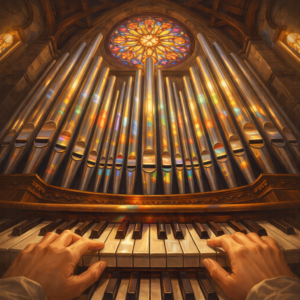
During Fisk’s forty-six years at Christ Episcopal Church in East Bay Harbor, Connecticut, organists came and went. While most played for several years, a few stayed only months. Fisk remembered them all by their hands. Matthew had short, pudgy fingers, yet he manipulated Fisk’s keys with a firm touch and coaxed out wondrous harmonies. Lenora fondled Fisk’s keys with thin, expressive fingers requiring him to stay alert lest he miss a note. Roger’s hands, like soft clouds, caressed Fisk’s keys towards new heights in sound.
Other than his well-worn bench — the varnish polished away by organists’ vestments to reveal the intricate grain of fine oak — Fisk showed remarkably few signs of age. Two of his stops, stuck in the Off position, resisted all attempts to use them. A few of his keys had chips or gouges. But Fisk still impressed worshipers with his music. Although he didn’t agree with every organist’s style and some didn’t value his abilities, Fisk had always respected their individual gifts. He concentrated on delivering the highest quality performance, within their limitations and his, that honored the artistry of his creators.
But, Ms. Dagger Nails demolished his opinion that every organist had something worthy to offer. She had appeared as a last-minute substitute and Fisk only expected her to play for one or two services until the Rector found a permanent organist. Instead, the tiny woman had abused his keys and ignored his pedals for the past dozen Sundays. Fisk didn’t think he could abide her ineptitude any longer, but he despaired of the church ever removing her.
Some musicians trod on Fisk’s pedal keyboard with the heavy feet of clog dancers; others two-stepped agilely, skipping among the long wooden keys. But, Ms. Dagger Nails played with her heels perched on the rail of his bench where competent organists merely rested their feet for a moment between hymns. Without the weight of the bass tones from the pedal pipes, Ms. Dagger Nails’ attempts at making music screamed annoyingly throughout the church. She found no use for Fisk’s third manual; she missed at least one note for every five she hit; and she chose atrocious registrations, selecting the least pleasant sounds from the hundreds of timbres offered by Fisk’s palette.
When his power switch flipped on to wake him two weeks before Palm Sunday, Fisk soon realized he must endure Ms. Dagger Nails’ torture through yet another service. I’ve been filling this church with inspired music every week for decades. I deserve more respect! He pondered his predicament while Ms. Dagger Nails fiddled with her sheets of music. I can no longer accept mistreatment without protest. I am a work of art and I should sound like one. He resolved to rid himself of his tormentor by Easter, his favorite service.
At that moment, Ms. Dagger Nails pressed a key in her tentative manner as if requesting permission to torment Fisk’s manuals. He refused to open the pipe fully, choking off the airflow. The expected musical note became a distorted squeak that reflected off the wooden rafters of the vast sanctuary and echoed eerily between the lofty granite walls.
Ms. Dagger Nails gasped, but she pressed again. Fisk resisted her touch, stopping the key halfway down to truncate the note. Despite the cacophony, Ms. Dagger Nails continued. Although Fisk grudgingly admired her fortitude, he maintained his rebellion throughout her entire prelude. J.S. Bach sounded as arrhythmic and atonal as Edgar Varèse.
Let the Rector ignore her atrocious playing now! Fisk added an extra discordant note just for good measure.
He could hear murmurs from the congregants who shifted on the dozens of stark wooden pews below him. The choir, standing in three rows on either side of his console, sang louder than usual, trying to drown out the awful noise. Lately, since they had no one to work with them, only half of them sang in true key. When Fisk helped them harmonize, they didn’t sound too bad. But, today, the rustle of their worn, blue polyester robes produced better harmony. Rector Bob ended the service early, before Ms. Dagger Nails could mangle the Recessional hymn.
The following Sunday, Ms. Dagger Nails returned. Fisk groaned in frustration when he sensed her diminutive presence on his bench. He refused to respond when the lacquered points of her fingernails scraped at the imitation ivory of his keys. She jabbed harder, pinching the key between her nail and the action, forcing Fisk to relent because he could not tolerate the pain. But he stopped the airflow to his pneumatic motors and every note screeched dissonantly. Fisk cringed, ashamed that his beautiful pipes could produce such ululations.
A few days later, a technician subjected Fisk to a rigorous physical exam. The man removed and replaced several of Fisk’s two thousand, four hundred forty-four pipes. He adjusted all fifty-six of Fisk’s stops — fixing the two that were jammed in the Off position, much to Fisk’s relief. The technician inspected a number of the thin, aluminum rods connecting keys to pipe valves. He tested every Swell manual shutter control and depressed each of the one hundred seventy-eight keys on Fisk’s three manuals as well as all thirty-two pedals.
Fisk enjoyed the gentle reverence of the man’s inspection. The technician obviously valued a quality instrument, and Fisk appreciated the fine tuning. He made sure that every note spoke with the proper tone, filling the old stone church with a divinely mystical sound. The inspection complete, he overheard the technician explaining to the Rector that Fisk was in good condition for an organ his age.
“I didn’t find anything that could cause Carole the problems you mentioned. Still, all the salt in the air here isn’t good for any instrument. You probably need to consider refurbishing or replacing this organ in the near future. If organists are having trouble with it now, you may want to do that sooner, rather than later.”
Fisk knew the church did not have funds to spare for a refurbishing. He wondered where the Rector found the money to pay the technician. The past few years, pleas for funds from the pulpit had grown increasingly impassioned. Never before had he heard a Rector constantly badger parishioners for support. Until recently, a need mentioned one Sunday resulted in accolades by the next for the donor who had stepped forward to meet it.
“Do you think it could be the fault of the musician rather than the instrument?” the Rector asked. “Carole’s a pianist, she hasn’t had much experience playing organ.”
Fisk suppressed the urge to allow a smug chord to escape through his pipes.
“I appreciate good church music as much as anyone, and I know there’s a vast range in abilities from one player to the next,” the technician said. “But you can’t blame sticky keys and squeaky pipes on the organist.”
Fisk’s bellows sagged.
Rector Bob sighed. “What kind of money are we talking about?”
“A proper refurbishment’s gonna run you fifty to sixty thousand.”
Fisk heard the Rector whistle. “That much?”
The technician cleared his throat. “Yeah. Takes expensive materials — leather and exotic woods — and some’re hard to find. I’ll need several weeks, if not months. Once you replace all the leather, you have to go in and adjust the tension on thousands of hinges connecting the valve mechanisms to the keyboards.”
The technician scratched his beard. “You know, you could buy a used electronic organ for maybe fifteen to twenty thousand. Not going to give you the same quality of sound as this beauty,” he patted Fisk’s oak cabinet, “but you could take out this console and fit an electronic organ in its place and leave those gorgeous pipes in for looks.”
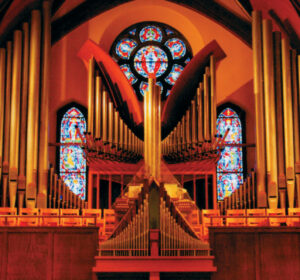
Fisk’s burnished zinc display pipes soared from above his console toward the ceiling. They embraced the round frame of the large rose window over the church’s main entrance. The tall, narrow arches of the lancet stained-glass panels were flanked by additional pipes on either side. All together he made an impressive display that he always tried to honor with his music.
“I’ll bet,” the technician continued, “most people won’t know the difference.”
Fisk closed every pallet to prevent a moan from escaping. He had never considered the possibility that his rebellion could cost him his position at the church.
“Well, I disagree with you on that note.” Rector Bob tapped out a C major scale. Although he had never tried to play Fisk, the pastor could coax a simple hymn out of the grand piano in the chapel. “I think my parishioners appreciate the beauty of this old guy’s tone. Music is still one of the best ways for a church to attract and keep members.”
Fisk had noticed fewer people attending each additional week that the interim organist played. He had expected the Rector to take action sooner, if only to stop the exodus.
“Still, if we keep having problems…”
Fisk held his wind.
“We certainly don’t have the funds for a restoration. I can’t imagine trying to raise that much money — not right now with attendance down and the economy costing so many of our parishioners their jobs and homes.” Rector Bob sighed again. “I suppose we would have to consider an electronic replacement. Do the more expensive ones sound anything like a real pipe organ?”
The technician laughed. “Well, I guess that depends on who’s listening. Look, Reverend, this instrument set the church back what, a quarter mil? You’re not going to get anything like it for ten or twenty grand. But you’ll get something that won’t need as much maintenance. With a nice set of speakers, a decent organist can give you an acceptable musical program. Given the acoustics you have in here, I’ll bet any instrument’ll sound pretty good.” The technician snapped his fingers and the two men stood next to Fisk, listening to the sound reverberate through the stately old church.
“What would we do with this console?” The rector’s voice cracked a little. Fisk had been installed almost a quarter of a century before Rector Bob joined the church. In his first sermon, the pastor had said that his love of good music had influenced his decision to accept the appointment.
“You could stash it somewhere in case things turn around and you can raise restoration money. Best bet, though, is sell it for parts — not that you’ll get much unless you throw in the pipes. Then you have to pay for reconstruction. Doubt if you’d get enough for the whole organ to cover that.”
The rest of the conversation did not register with Fisk, their words blurred by the torment of his choice: accept Ms. Dagger Nails’ abuse and allow her to play without interference or get replaced, gutted for parts, and dumped on a trash heap somewhere.
The artisans who had created him had designed him for a life that, with proper care, could span centuries. How could the Rector consider destroying Fisk after less than half of one?
The technician forgot to turn off his power, leaving Fisk alone with his memories. His music had accompanied four thousand, seven hundred ninety-six Sunday morning Eucharists, two thousand, three hundred ninety-eight Thursday evening choir rehearsals, eight hundred fifty-two weddings, seven hundred twenty-seven funerals, and one hundred ninety-two recitals. He thought of the many brides who had gushed about how they had always dreamed of a wedding in Christ Church with Fisk’s sublime accompaniment for their walk down the aisle. He remembered somber widows discussing their husbands’ favorite hymns and how only Fisk could play them right. And how many people had joined the church after attending a recital or concert and recognizing what Fisk could add to their spiritual experience?
Fisk allowed himself a snort from his windchest. No! He would not compromise, even if the church did not replace Ms. Dagger Nails with a real organist. Better to die an ignoble death than have anyone regard him as a second-rate instrument. Let the church try to replace him with one of those electronic fandangles. How could anyone even call such a contrivance an organ? Some of the congregants would protest, even if they could not raise the money to save him. At least they would remember him for the artistry of music he had produced for decades rather than the few months of horrible sounds Ms. Dagger Nails forced out of him.
Fisk let out his wind and strengthened his resolve. He knew the church had served East Bay Harbor for more than a hundred years. At one time, it had attracted many of the community’s movers and shakers. The parishioners had worked long and hard to raise the money required to purchase and install him in 1965. They had even built the gallery in the back of the sanctuary just to accommodate him and his pipes. Fisk would not lower Christ Church’s musical standards or his own!
On Palm Sunday, Ms. Dagger Nails returned, but Fisk had devised a new plan. When she pressed a key, he sent air through the wrong pipe. For every note she tried to play, Fisk chose something different. Middle C became B, two octaves higher. When she selected a flute sound, Fisk supplied trumpet instead.
Flustered, Ms. Dagger Nails knocked a page of music to the floor. When she bent down to pick it up, Fisk let out a low E-flat on the bassoon stop. The organist pushed herself off his bench and ran from the choir loft in tears. She had not even finished her prelude. The choir sang a cappella for the rest of the service — dreadfully off key. The deacons gathered the Offertory in silence, except for the tap, tap, tap of envelopes dropping onto collection plates. During Communion, footsteps echoed forlornly throughout the church while everyone walked down the candlelit center aisle to the granite altar. No one sang; no one played, and Fisk awaited his inevitable fate, his expression pedal drooping.
Once again, Fisk found himself alone. No one turned off his power after Ms. Dagger Nails’ abrupt exit. Hours passed before Rector Bob ventured into the choir loft above the sanctuary. He brought a tape measure and several sheets of paper with him. Fisk sat silent while the pastor pulled the tape across his console’s width, depth, and height, and scribbled numbers down on the sheets of paper. Fisk cringed when he heard the Rector muttering about fit, costs, and sound.
The Rector’s hand rested on the power switch and Fisk prepared to go to sleep, perhaps forever. Without warning, Rector Bob’s fingers dropped to one of Fisk’s manuals and he again tapped out a C major scale. He muttered words Fisk could not make out.
He loves my music; I have to make him understand. Fisk opened his pipes in sequence to play a verse of “Amazing Grace.” He didn’t move his keys, but he put his heart and soul into each note, making sure they all rang true.
Fisk had not thought about how the Rector would react to an organ generating its own music. Rector Bob dropped onto Fisk’s bench with a thud and his feet pressed several pedals at once. Surprised by the sudden weight on the bass keys, Fisk could not stop the notes and the discordant combination brayed through the church. Before Fisk could recover, Rector Bob pressed the power switch.
* * *
Power coursed through Fisk’s circuits awakening him once more, to his great surprise and delight. Colored light from the stained-glass windows danced across the silver verticals of his pipes. Fisk sensed the unfamiliar weight of someone new on his bench. He let a little air hiss in his windchest, just to show he knew someone expected him to make music, and raised his bellows in anticipation. Long elegant fingers, with nails appropriately trimmed short and filed smooth, ran an arpeggio across his Great manual. Feet encased in proper organ shoes stroked the pedal keyboard. With new hope, Fisk let the notes ring out fully in response, reveling in a firm but gentle touch.
Rector Bob stepped into the choir loft. “I really appreciate your agreeing to play for Easter services on such short notice, Stephanie. We haven’t been able to fill the organist’s position and our interim volunteer isn’t able to make it. Please take all the time you need to practice. Also, the choir hoped you’d consider working with them a bit during their rehearsal tomorrow evening.”
“I’ve always wanted an opportunity to play a Fisk organ.” Stephanie spoke in melodious tones and Fisk wanted to hear her sing. “I didn’t know the position here was vacant until the secretary called me about playing for Easter.”
Fisk waited for Rector Bob to warn the newcomer about his problems, but the priest left the loft without saying anything else.
Stephanie reset several of Fisk’s combination pistons in sensible registrations, then played “Bach’s Toccata and Fugue in D Minor.” Her weight shifted easily on the bench with the movement of her hands across all three manuals, while her feet danced on the pedals. Fisk delighted in the touch of an organist who could play, who knew how to coax the proper tone from his pipes. After the hell of the last several months, Fisk had found heaven at last.
For the first time in weeks, Fisk looked forward to Easter Sunday. Maybe if he performed his very best, Stephanie would consider staying on. Fisk gave Stephanie everything he had, responding to the organist’s light touch with smooth action and true, clear notes. Their music filled the church and pride filled Fisk’s heart again.
When the last notes drifted away, Rector Bob stepped back into the loft. “You certainly know how to bring out the best in the old boy.” He patted Fisk’s console. “Why don’t you stop by the parsonage when you’re done here, Stephanie, and we can talk about the organist’s position.”
“Absolutely,” the organist responded.
Fisk wanted to sing and make his pipes dance, but he feared startling the Rector again. Instead he waited eagerly for Stephanie’s next piece.
* * *
Originally published in Rebellion: Two Short Stories
 About the Author
F.I. Goldhaber’s words capture people, places, and politics with a photographer’s eye and a poet’s soul. As a reporter, editor, business writer, and marketing communications consultant, they produced news stories, feature articles, editorial columns, and reviews for newspapers, corporations, governments, and non-profits in five states. Now paper, plastic, electronic, and audio magazines, books, newspapers, calendars, broadsides, and street signs display their poetry, fiction, and essays. http://www.goldhaber.net/