by Lynn Gazis
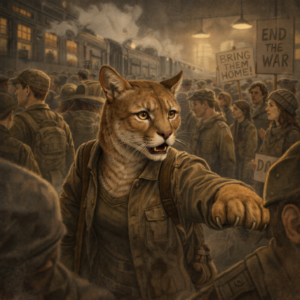
The door stood ajar, as if Annan had just stepped outside to get the mail. But we knew, the moment we stepped inside, that something had gone terribly wrong. The large cardboard boxes where we lounge comfortably between calls had been torn. A possum, from one of yesterday’s calls, lay half-eaten on the floor. Annan loved possum meat. He would not willingly have left it unfinished. And the whole room smelled of human.
My daughter and I dropped our dead raccoons on the floor and ran down the stairs. I sniffed the ground, searching for where the mingled smells of Annan and human might be strongest. My daughter ran to question our nearest human neighbor. I call her Cookies, because she often bakes cookies, and because I can’t be bothered to remember human names.
Cookies limped out, leaning on her cane, and quickly cleared up the mystery. Soldiers, she said, had come and taken Annan.
Soldiers! They should have known better. Cats don’t belong in the army. Never have and never will.
Humans bred us to be good soldiers. Their mistake. You’ve seen, perhaps the old posters, hanging in museums and covered with glass, announcing the arrival of “Tiger-Men.” We’re more like mountain lion people, but “tiger” somehow sounded fiercer. You’ve watched, perhaps, the old video, of the interview with Zachariah Kim, head of the lab where we were designed. They thought their genetic engineering would give the combined strengths of humans and the larger cats: the claws and jaws of a cat, the deft hands of a human, able to speak in human sign language and wield human guns.
But they missed one thing. We have the spirits of cats, not humans. I’m not a hero, nor a coward. I’m a cat. Heroism and cowardice are human ideas. Humans gather in large groups to fight other large groups of humans. Humans do many things, good and bad, in large, organized groups. Our groups are smaller. A friend or a sister. My cubs. For these, or for myself, I will fight. Why would I want to be a soldier and fight someone far away, for some leader I don’t know?
They could have let us go wild and hunt for ourselves, and we’d have been happy. But humans had spent money to make us, and so humans needed to find us work. We found our niche in animal control. Do you have a raccoon or a snake or some bats you need removed? Who are you going to call? Cat people, that’s who.
I’m an animal control officer, the daughter and granddaughter of animal control officers. I always thought I’d also be the mother of animal control officers. I didn’t count on the Great War. I didn’t count on a land so desperate for soldiers that it came to draft cats.
That morning, we had gotten a call – raccoons in the basement. And another call – bats in the attic. My cubs and I split the calls, two of them for the bats, while I took one with me for the raccoons, and left the fourth behind to answer the phone. We had left the fourth, my youngest, the sensitive one, behind to tend to the phone. Now soldiers had dragged him away. The last place Annan belonged was the army.
I set off at once for the intake station. We all know the station, an ugly brick building surrounded by the most delicious rats’ nests in town. Something about that terrain draws rats as soon as we’ve hunted the old ones. Mostly we care more about rats than soldiers. That day, I had no time for rats.
At once was already too late. My cub, I learned, had been taken away by train. No one would tell me where he’s been taken.
“He’s in the army now,” I was told. It’s a done deal.
That is how my journey began. No one takes my cub to be a soldier. I left the other three to mind our business and set out to retrieve the missing one.
I had never been to the train station. Why would I want to? We were happy where we were. Animal control workers have no need for trains. But I didn’t need to ask the way or take a chance that I’d be lied to or misdirected. I simply followed my cub’s scent. I knew he’d take extra care to leave a trail.
In the old days, when I was young, green bushes and bright flowers stood on either side of the road to the train station. A brook trickled along one side of the road. If a week passed when animal control calls were too few to feed us, we’d head for the brook, to catch fish, and follow them up with squirrels from nearby trees.
These days, the brook is long dry. Someone planted hydrangeas at spots along the side of the road, to replace the less drought tolerant flowers of my youth, but mostly you just walk in a cloud of dust. Between the drought and the passage of so many soldiers, not much grows next to the road.
Some say that humans fight over water, now that there is less than there was before. Others say that humans fight over land. What cat knows or understands the causes of human wars? They march in lines to the sound of music, headed for some distant place where they will need to hide like cats to pounce upon their enemies.
At first, my cub’s scent mingled with the scent of humans, many humans. But as I walked further, an odd thing happened. I caught the scent of others of us, mingled with the humans. I wasn’t the only mother to lose a cub to the army. Why would they do this? How could they not know that cat people belong nowhere near an army?
When I reached the train station, my hair stood on end. I saw crowds of people as I had never seen crowds of people. But somewhere in that crowd I hoped to find my cub, so I steeled myself and pushed forward.
Young humans in uniform, human families with baggage perhaps heading off on vacation, solitary humans glancing at phones. My nose told me that my kind had passed through this station, but I couldn’t see any cat people now. If I asked one of the humans with uniforms where they might have taken my cub, would I get an answer? Perhaps not. I remembered how brusque the humans had been at the intake station.
Then I saw them, a small group of humans holding signs. “Peace.” “War” in a red circle with a red line through it. “Hell no, don’t go.” I walked over to them.
“The army took my cub,” I said to a woman who held one end of a “Quakers for Peace” banner. The lines on her forehead and gray streaks in her hair suggested she might be old enough to have a cub of her own of army age.
“Tell me about it,” she said.
“We’re supposed to be off limits,” I said.
“Not since last week,” said her companion at the other end of the banner.
“Where did they take him?” I asked.
“Wait,” said Gray Streaks, “Are you going after him alone?”
“Of course!” I said, “He’s my cub.”
“You can’t fight the army alone,” said Gray Streaks.
“Just watch me!” I said.
“I’ll give you the address,” said Gray Streaks, “But we need to talk. Let me buy you coffee – I mean milk.”
Soon we sat on cushions at a table at a local coffeehouse. Flat pictures of humans and wild plants, the motionless kind that humans like and that bore us cats, adorned the walls. The waiter gave Gray Streaks a cup of that dark, bitter liquid that humans like, while I got a saucer of milk. A human strummed an instrument and sang, “I’ll take you to the war, my love,” while another human sang her refusal to join her love in the army.
“Do you have a way to tell your cub when you’re coming?” asked Gray Streaks.
“No. How would I? We don’t each carry our own phone the way you humans do. There’s one phone in the office, and two phones are enough to share between us when we’re out on a call.”
“That’s where you need help,” said Gray Streaks, “Someone who can talk to one of the recruits at the training center can find out their schedule, how long your cub might be there before he’s sent to the front, and how you might get your cub a message. Do you know how many other cubs were taken?”
“I didn’t know any others were taken.”
“There are other cubs there,” said Gray Streaks, “And many mothers coming for their cubs can make more trouble than one.”
“We’re cats,” I said, “we don’t form large groups like you humans. That’s why we don’t belong in the army. That’s why they should leave us alone. Why do they want my cub off killing people far from his family? Just point me where he is and I’ll tear their faces, till they give him back.”
We argued through two cups of coffee for Gray Streaks and two saucers of milk for me. Humans and cats will never see things the same way. My new Quaker helper, Gray Streaks, could no more be convinced that I could rescue my cub by going to the army camp myself and fighting till they gave him back than I could be convinced that trying to organize a band of cats to come to the rescue would help.
Finally, without agreeing, we settled on a deal. I would answer all the questions that she thought would help her find other cats whose cubs had been taken, and she would point me to the army office. She could also, she said, help me get a message to my cub to be ready. Human recruits, unlike my cub, took their phones with them and stayed in touch with their parents, at least while they were in the training center. On the front, contact might be spottier.
“Then I need to bring him home before they take him to the front,” I said.
The next day, I returned to the train station. I looked for the people holding signs. I didn’t find Gray Streaks. But I found someone else, talking to the young human with the “Hell no, don’t go” sign. She stood taller and longer than I, and had striking large paws, six toes on each. The twitch of her ears and flicking of her tail told me that she was as ill at ease in a crowded train station as I was, and, after all, what cat wouldn’t be? When I had my cub, I would not be able to get back fast enough to my own cardboard box, in my own home.
Her voice rose with the words “my cub!”
“Have they taken yours, too?” I asked.
We cats are not like you humans. We don’t form bands or organize. We would never form an army, and we’d never gather in groups with signs to protest an army. But cat mothers will help each other one on one. The two of us headed to the coffeehouse to plot over saucers of milk. I told her about Gray Streaks.
“She thinks she can organize cats,” I said, “Fat chance! But she can get us the address, and a human with a phone who can get a message to our cubs.”
“She may be right,” said Six Toes, “That going straight at them with our claws isn’t the best approach. The army has a lot of humans, and they have guns. But if we had a distraction, perhaps our cubs could escape in the ruckus. What about skunks?”
Many of us cats work in animal control for the obvious reason. A lot of the animals that humans want to get rid of are tasty. That possum, those rats – there’s good eating in human pest control. If humans are willing to supply us with good hunting and pay us for it, why not take the job? But once in the animal control business we’ve had to learn to handle animals that we might have found more trouble than they were worth, if we were just looking for a meal, like skunks and porcupines. We even handle animals that we’d give a hard pass for dinner, like rattlesnakes or swarms of bees or hornets. Whatever you want to get rid of, we’ll take off your hands.
Why not become the cats who could take off animal control’s hands the animals that were trouble rather than good eating?
I told Gray Streaks that Six Toes and I had an idea for a company that could gum up the works at the training center, and could we find a human to handle the paperwork to make the company legal? Humans are good at paperwork. Then, confident that we’d get a human to file papers for us and set up our office, Six Toes and I set about the fun part of the task, figuring out how to wrangle all the bees and snakes. We talked with other cats in the animal control business, who were happy to give us their skunks and porcupines and bees and hornets and snakes, at least the poisonous and not so edible snakes. We even persuaded some to pay us in bats for taking wasps off their hands. We cats, always current on our rabies shots, consider bats a prime taste treat, but humans, who fecklessly wait till they’re exposed to get shots for rabies, fear bats even more than they fear bees. And to rescue our cubs, we could sacrifice the opportunity to eat bats.
Gray Streaks sent us not just one human but two, to help us set up the office. They filed papers to set up the company, found office space, and got us a new phone. And sent us more cats. Soon there were eight of us cats, and two humans, and we told the humans to stop sending us cats, because a group of ten, between humans and cats, is as much as a cat can manage, even if we were all mothers looking to get our cubs back. Any other mothers would have to manage on their own.
We had to rely on our humans, with their phone contact inside the training site. How long would it take for a human inside to get word to all our cubs? Not long, as cubs stood out among the humans. How long did we have before our cubs were moved? Weeks, easily enough time to round up wasps and snakes, but not enough time to dawdle.
On the day of the event, we arrived shortly before dawn, with our menagerie. The grounds smelled strongly of humans, but also of cats. How many cubs were trapped there? We scattered with our animals, as we judged they’d make more distraction for the humans if they came from more quarters. Skunks, porcupines, bees, hornets, wasps, bats, and snakes both poisonous and not poisonous but scary looking to humans all had their planned locations for release. My job was scattering all the stinging insects.
As I drew closer to the training base, I saw another band of cats, digging.
“What are you doing here?” I asked, and got the reply, “Taking back our cubs!”
Closer to the base, I met still another band of cats. I could tell by their accents that these cats were big city cats, and they had, it turned out, big city plans. This band of techno-cats busied themselves jamming the radio signals that, they said, the soldiers used.
Humans, I realized, had found ways of their own to wrangle cats. We cats work in small groups, but humans, one or two to a band of cats, have no trouble communicating with each other about what each band is doing, and arranging for the bands to show up at the same place at the same time. I hoped the army would not learn from our example. Was it possible, after all, that cats could be made into soldiers?
Surely not! All of us, mostly mothers but also some fathers and aunts and grandparents, had come to rescue our own cubs. No one would make us fight for anything larger than our families. I didn’t raise my cub to be a soldier. My cub would come home with me.
I turned a corner and two human soldiers pounced on me. I fell, biting and scratching, but as I did, I dropped and let loose the last swarm of hornets.
I was, you may understand, dressed in full beekeeper clothing. All my band of cats were, as were our two humans. Despite all of that, I got stung once, and yowled.
The humans, though, had nothing of the kind. Hornets swarmed them. They shrieked and swatted, and I ran.
Other human soldiers rounded the bend and shot at me. I ran. They say to zig zag when someone is shooting. I did nothing of the kind. I can’t keep zigzagging straight in my head when bullets are flying, and when running straight I run fast. I did get hit, once, on my left back leg, but kept running through the pain.
I reached a wood some distance from the base, and there I stopped and lay down, having outdistanced the shooters. Time to inspect and clean my leg. Time to feel the pain more keenly. And time to wonder, had I failed my cub? I could only hope that I and the others had provided enough distraction for him to escape. After all, I had no more pests left to release.
I lay for long minutes, but I could not rest. Not without my cub. I rose and limped, scanning the land from the trees in search of my companions. The sun had nearly set by now, and human eyes must be dimming. But my spot in the forest lay uphill from the training camp, and I had, from my vantage point, a better view of the actions of all the bands of cats. Many of the soldiers still struggled with our beasts. The various stinging insects proved especially effective. Some of the cats, in defiance of the wishes of humans like the Quaker Gray Streaks, had chosen to charge the soldiers and fight. The signal jamming techno-cats used puffs of smoke to send messages to each other.
Far across the field, I caught sight of Six Toes, letting loose some bats. We had planned to save the bats for last, to give them the advantage of the coming darkness. I limped my way to her.
“Are these the last?” I asked.
“Yes,” she said, “Time to find our cubs.”
“The tunnel digging cats?”
“Probably.”
We collected the rest of our band and found that we had lost our humans, and thus, our phone. Possibly its signal in any case had been jammed by the techno-cats. I hoped the soldiers hadn’t taken our humans captive.
I wouldn’t have thought we could ever forget where we’d seen the tunnel digging cats, but it turned out that, though we were all sure we remembered the location of the end of the tunnel, we remembered three different locations. All we could do was try them all. By the time we reached the third place and found no tunnel, my leg ached as it had never ached before. Besides this, we had to keep pausing to hide in the underbrush from soldiers.
Six Toes sniffed and announced that she had the trail. The rest of us followed. Soon I caught the scent of my cub. I almost forgot my injured leg in my haste to follow the scent.
At last, we reached a small clearing full of cubs. My cub, the cubs of Six Toes and three others of our small band, and other cubs that none of us knew. Cats from other bands – mothers, fathers, aunts, grandmothers – arrived to take their cubs. If we hadn’t feared attracting soldiers searching for the missing cubs, we would have cheered. Victory!
Victory, at least, for me and Six Toes. Some of us have our cubs. The others remain to try again.
We cats are not like you humans. We don’t organize for causes. We work together to care for our own families. The other cats, who were our fast friends when all of us worked together to free our cubs, will take over the business. Six Toes and I, and the others who have our cubs, have agreed to send the business all the nasty, useless, inedible critters that come our way, in our animal control work. We leave it to you, their new human comrades, to handle the paperwork, and to find out what happened to the humans we lost at the training camp.
As for me, I am bringing my cub home.
* * *
 About the Author
Lynn Gazis (she/they), being one of nine children, grew up in a small town in New York surrounded by cats, dogs, mice, gerbils, turtles, snakes, and an invisible goldfish. As a child, she played “For All the Saints” on the piano at a funeral for a mouse. She now lives in Southern California with her husband and cats. She works in IT and is active in her Quaker meeting. She has stories published by Cathedral Canyon Review, Air and Nothingness Press, JayHenge Publishing, Persimmon Tree Magazine, and Friends Journal. The cats, though, want you to know that her most important function is scratching them right where they want it and placing items on the table for them to knock down.