by Spencer Orey
Moonlight swept closer across the high desert, and this time, Ty wasn’t alone.
Around the campfire, everyone in his pack was coughing or worse. Ty too had hardly been able to eat for a week, stomach throbbing with all-too-familiar cancerous rot. He’d still insisted on carrying more than his share of firewood. He wanted the others to see by his chores that he really did belong.
All their sicknesses would vanish in a moment. The desert was harsh, made even harsher by radiation, but when they transformed under the full moon, they healed. And then they ran.
The sharp scent of burning piñon wood grew stronger in Ty’s changing nose. Moonlight flung him snarling onto his hands. It hurt to become the wolf, but this time, he hoped it would be a shared pain, part of a pack howling into the night.
* * *
Warm fire. Sharp smoke. Beyond, night scents. Sagebrush. A river nearby. Cowering prey. A hare.
He ran. The pack ran with him. He hunted the hare. They watched. He caught it. They snarled, took the hare. Betrayal. Bites. A rip of claws.
They pushed him tumbling down the riverbank. Then, cold water all around. And fear. Darkness and fear. Fear.
* * *
The arroyo was mostly dry. Ty was not drowning. But the wolf remembered danger and water, so Ty still felt afraid. Wolf memories were like that, resonant in fragments, stronger in feeling than coherency. At least his stomach no longer ached. For a week, maybe more if he was lucky this time, he’d remain healthy in body, if not in heart.
He was alone again, no longer part of a pack, unable to ask why they’d separated. He’d never catch up. His pack had planned to scout up into the mountain forests, hoping it’d be easier to hunt and find water. Ty was lucky to have even this last trickle of monsoon rain in the arroyo.
Coyotes barked mockingly in the distance. More than any other creature, coyotes knew about wolves.
In truth, Ty didn’t trust the mountains. Too cold, especially with winter approaching. Here, the sky swept open into cloudless blue. On the banks of the arroyo he found golden chamisa blooms, still glowing despite the late season. An old dirt road beckoned toward a stretch of shivering elms that promised a string of abandoned houses, maybe a safe house or at least a hint of fruit trees. The high desert had always been difficult, but people found ways to thrive.
Life still scurried across the sand. Lizards, birds, hares. His previous pack had joked that eventually, thanks to radiation, a hare would mutate with antlers into a true jackalope. Other myths would surely follow. Ty had joked about a werewolf-La Llorona out scaring wolf cubs, but he’d been scolded and dismissed. Somehow, he’d never done enough to win their approval. Now they were gone.
It took him a week chasing campfire smoke on the horizon to find a new pack. By then, his skin was peeling, and his mouth and throat burned. The pack inhabited a crumbling adobe ranch house that’d been converted into a safe house. Piles of blankets. A closet of canned food. Everyone to find such a place was meant to leave it better than they’d found it, building a shared society back slowly, one moon at a time.
The pack shared food and bandages. In turn, Ty proved his worthiness. He followed their orders. When they scavenged through ruined ranch houses, he obediently rushed in first. When one of their packmates died, overcome by a wet cough that turned bloody, Ty made sure to mourn harder than the others.
For moonrise, they climbed a mesa. On the flat top, coughing again, they lit a juniper fire. Ty held close to his packmates, hoping the wolf would too. He needed a pack, and he hoped he’d done enough that this one would need him.
* * *
Always, fires. Harsher smoke, a pop of burnt berries. A pack, but unfriendly. Already they growled. A packmate bared teeth.
He did not want to fight but would not show his belly, would not submit. A snap. Reluctantly, he fought back. He lost. The other wolf was stronger.
Unsubmitting, he fled down dangerous steep sand, away into the night. Alone again. Afraid again.
* * *
No arroyo this time. No water. On a long stretch of open desert, Ty moved from shrub to shrub. The air was cold and dry, though the ground still lay mercifully unfrozen. There was still time enough to find shelter. If he’d still been with the pack, he’d probably be back at the safe house. Instead, Ty had a wolf memory of a fight. Before the moon, his mouth had grown bloody from sores. He’d healed, but through his wolf memory, the taste of another’s blood lingered.
Now he had no illusions of forgiveness, no more excuses for the wolf. To survive out here, he needed other people, but the wolf was selfish, a reject. Was the wolf the part of him who’d always failed, who deserved to be alone, manifesting every moon to ruin him anew? Always, Ty tried to be worthy of a pack; always, the wolf ruined it. A pathetic lone wolf.
Ty wouldn’t dare rejoin that pack now. They’d have wolf memories too. He’d been judged and found wanting.
At his thirstiest, he sucked on pebbles to pull forth saliva, an old desert dweller trick. At the harshest hours of day, he took shade in a low hollow beneath a juniper, though even that couldn’t protect him from the wind. Parched, dusty, drawn forward by thirst, he waited for gentler afternoon light, then set out searching for campfires and anyone who might want to survive together.
Near sunset, against the long sweep of red sky across the desert, he found a handful of people cowering around a pump well. A bitter pack.
Ty found them cans of food, and they complained about how much better they’d eaten before the bombs, when they’d had chefs to serve them warm sopapillas with honey. In a distant spring, maybe wolves could rebuild some of what they’d all lost, could plant and harvest and cook. But not now, with winter’s approach. Ty scavenged blankets and warm heavy clothes for them. In turn, they called him names like pathetic and sycophant. They joked about how he must be the only one who was happier in the wasteland, and that he must have truly been a loner and a loser before the bombs fell. It was better to take their abuse than be alone. Anything was better than being alone.
Snow dusted the mountains. Ty’s bitter pack trekked southward. The desert froze beneath their feet. They clustered in frosty adobe ruins and burned branches from elms, pines, even shrubs, anything they could find.
Then came the first snows. The others clustered together for warmth, but Ty was unwelcome. Shivering and unwanted, he remembered other winters.
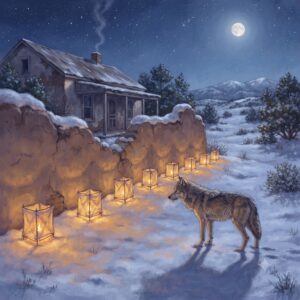
Mostly, he remembered luminarias, candles burning in sand-weighted paper bags, arranged in lines on snowy adobe wall tops. Some people called them farolitos instead. Back before the bombs fell, they’d all argued over the most beautiful things in the most pointless of ways. And now that joyful warmth was gone forever, one more thing to mourn. No more factories made bags. Candles and matches were scarce. All lighter fuel had expired. No more luminarias.
Ty remembered holidays, so he foraged presents for his packmates even though his foot was swelling.
His presents were all rejected, left behind in the snow.
Two of the pack died. Not elders, not young. They’d been healthy enough in smell and body until suddenly they very much were not. Likely, they’d passed too close to a city early after the moon and received a higher dose of radiation. Somehow, the pack blamed Ty because he’d gifted them trifles, not medicine, not real care. After that, they hated him openly.
Through their hate, Ty knew something was wrong with him, something beyond radiation.
He lost the will to forage or eat. He sat alone, trying to remember the glow of the luminarias. But he only remembered older shame, feeling unwelcomed and unneeded. Before the bombs, people had always told him he wasn’t truly from there, that he didn’t belong. His family didn’t want him either. Even his words were wrong, luminarias instead of farolitos. After the bombs fell, only the dead belonged, but the wolves survived. When he’d received his bite, he’d believed it would fix his problems and earn him acceptance. Neither was true. Maybe neither would ever be true.
The winter moon rose, and he limped away from the campfire, unnoticed and unwanted, coughing into the dark, wishing for luminarias, unsure whether his life was worthwhile.
* * *
Other wolves nearby. Unworthy, greedy wolves. He loped into open night, running with a memory of lights.
Searching. He hunted ground squirrels near bone-white trees. He stalked an elk but would not bring it down without a pack.
Scents of wolves and people. A glow. Cloth on wire. No scents to warn him away. Warmth.
* * *
Ty awoke covered by scratchy blankets near an open door. He saw an adobe wall outside. Burning on that wall were luminarias. Not the small paper bags of his childhood, but what else could they be, these boxy wire sculptures wrapped in thin fabric, glowing atop the wall like beacons to rising sunlight?
He had a wolf memory of a hunt for light and deep satisfaction at finding it. The wolf had found luminarias.
A ristra of dried chiles hung from a nail by the doorway. Three other people snored near a low-burning fire. Ty’s sense of smell was fading, but there was no mistaking piñon. He put a log on the fire and waited for the others to awaken.
None of them had made the luminarias. That was another wolf’s legacy, someone who’d left the safe house better through art and light before they left to roam elsewhere.
Their shelter was a good find in winter, with a door that could be shut. On cold nights, they told stories about people they missed. On colder nights, they remembered balloon fiestas and tall burning Zozobras. The constant smoke aggravated Ty’s throat, but everything was cancerous now anyway.
He found a cache of buried nuts and shared what he could. The others sometimes shared with him too. One of them shared a can of refried beans, and they ate together in silence. When they chose not to share, it was impersonal. None of them made demands on each other. It wasn’t quite lonely; it was almost enough.
The moon rose over a cold expanse of snow. Ty was still inside the shelter when he began to transform. He wondered if the wolf would want to settle here, then realized he didn’t want to. The wolf had found them luminarias. The wolf liked to roam. As moonlight bent him forward, he felt a wild hope that the wolf would find them somewhere better.
* * *
Together, without belonging. Not enemies, not a pack.
Paws crunched into snow. Crisp air carried to fresh tracks. Others ran with him for a time but hunted apart. They were nothing to each other.
He roamed the snow alone. Patient. Better to find the right pack, not just anyone. More than a tolerance.
* * *
Inside a shelter, alone beneath a pile of old clothes. No fire burned. Ty found only his own pawprints, no tracks of others. He was alone in the coldest month, and it felt like a relief. Better to dream of warm togetherness than be trapped in frigid companionship. Better to live resonating in possibility than settle for being stuck. The wolf had taught him that.
Snow fell more often than usual. He worried about starving but discovered the wolf had provided. Kills lay frozen outside.
He’d thought himself alone, but before, when he’d felt despair, the wolf had found luminarias to warm their shared spirit. This time, the wolf had stockpiled meat to help them survive until the next moon. They were already a pack of two, sharing one body.
The final week before moonrise almost killed him. He could melt snow for water, but the frozen ground made foraging impossible. His stomach ached from hunger, but even then, he did not pine for others. He wasn’t truly alone, not with the moon and the wolf. He wished he could do something for the wolf, leave some token of appreciation. But memory and feeling would have to be enough until spring.
The day of the full moon, the snow melted and so did the ground.
Ty sat with eyes closed, wishing for the wolf to find them somewhere better, somewhere happier, to try again.
* * *
Loping through bright moonlight. Paws sinking soft in gentle earth. Fresh tracks everywhere, scent and more. Distant coyotes barked joyfully.
A night full of wolves. He met two others by a long stretch of shrubby hills. They circled him out of sight, warily sharing scents, then followed him, desperate for leadership or company or just desperate. He did not need them. When they caught the scent of a larger wolf, they left to follow that trail instead.
An arroyo ran with snowmelt. Another wolf. They played, running downslope, upslope. A third wolf played too. A start of something more, or a small happiness.
They stalked an elk, pulled it down, dragged it to shelter. Howling victory together.
* * *
A safe house with only one crumbling wall. Ty was first up, so he lit the fire. Dry pine wood, burning fast. When the other two awoke, they shared their wolf memories. Playful laughs. They remembered the elk outside and dressed it together, preserving all they could.
It didn’t last, but Ty didn’t need it to. The third wolf drifted off first, and they wished him well. The second wolf stayed until the moon. They agreed to transform together, then part, friendly into the night.
* * *
Full moon. Warm spring night. He was enough, and so was the world. Out there, more wolves, some in want of a pack, some not. No need for desperation. In moonlight, the world restored itself and so did he, and all that lived was joyous.
* * *
 About the Author
Spencer Orey (he/him) is a Copenhagen-based anthropologist and graduate of Taos Toolbox and the Odyssey Writing Workshop. You can find him and more of his stories online at spencerorey.com and @spencerorey on Bluesky.