by Lara Hussain

Jot knew exactly what had happened to Iota: Flowerwerks had eaten him alive. Or rather, he had worked himself to death. Mice were prone to it: working to grinding exhaustion, from those who squeaked commands all day to the lowliest directors of fertilizer distribution, and even the earthworm and bee wranglers. But it was unlike Iota to disappear. He had a quiet intensity, certainly, but he would never leave something unfinished, or depart without saying goodbye.
Jot’s best friend, Dottie, was wringing her paws. They were raw and pink from all the kneading, which started when she realized her partner was missing. Iota wasn’t the first mouse of Subporchia to go missing. Jot put her own paws on top of Dottie’s and looked up at her. Dottie was taller and had a lovely coat of fine winter grass-colored fur, with a single spot of white spread across her chest.
“When did ya last see him, Dottie?” Jot asked. Her voice had a thick New York accent, lyrical and caring, but with a no-nonsense tone.
Dottie found Jot’s self-assured voice comforting.
“Oh, oh. I saw him when he left for work yesterday,” Dottie panted in her high-pitched breathless waver. “He left early… said he’s working on some big project ,and they’re behind on deadline with a second planting. That they’re expecting rain. As if anyone could predict the weather. Well, you know, the big mice think they can. But you know what I think? I don’t think they have a clue! They’re just working everyone to death, all so they can get fatter! It’s not fair, Jot!” Dottie squeaked angrily. This wasn’t the first time they had discussed the unjustness of Flowerwerks.
Dottie pulled her paws back and began wringing them again. “To be honest,” Dottie continued, “He’s been working long hours for a while now. Flowerwerks just isn’t producing like it used to. There are fewer flowers than ever. But he’s working his tail off. I’ve never seen him so thin…” A sob snuck up on her. “Jot, do you think he’s okay?” she squeaked.
Tears were wet on Dottie’s sweet face. Jot offered open arms to embrace her.
“We’ll find him,” Jot said as she squeezed Dottie. “I start that new job today, you know, at the Flowerwerks entrance. I’ll nose around and see what I can find out.”
Jot was a carver, a talented artist who worked with roots and wood. After the success of her community roots projects — a tangle of wondrous flowers that she delicately carved in the thickest roots that ran through common areas in the burrow — she had been commissioned by Flowerwerks to carve the tall redwood columns at the entrance to the company. The thick square columns sprang from the ground and held up the canopy that covered all of Subporchia, from the burrow to Flowerwerks. No one had considered carving the columns before, not even Jot. But she thought it was a very good idea. The carved wood would bring beauty — and she hoped joy — to the start and end of the work day. And so she had agreed.
The early summer sun was already peeking through the narrow slits in the canopy by the time Dottie left. Tiddle, Jot’s partner, offered to accompany Jot on her first day to her new job, before he continued on to his work at the Scout Corps headquarters, the security outpost for Subporchia. It was also time for Flowerwerks’ town hall, something everyone listened in on, even if they didn’t work there. That’s because Flowerwerks ran the garden, of course, the whole east side of Subporchia, and beyond.
Jot and Tiddle nimbly crossed the long stretch of rocky flats outside the burrow and joined the commute of other mice, embarking on their work day. As the throngs neared the Flowerwerks entrance, the rocks gave way to soft soil. A large crowd had already gathered there, eager to hear from the leaders of Flowerwerks.
“This is the dawning of the earth’s fertility!” Mr. Cheeseman said, the bulge of his expansive furry belly bouncing with his enthusiasm.
Tiddle rolled his eyes. “I’m pretty sure the earth was growing plants just fine before Flowerwerks,” he whispered to Jot. “The real question is if anyone there has figured out that you can’t take from the Earth forever, that you have to give back and care for it, too?”
Jot, ever the optimist, squeaked back, “Well, maybe investing in public art is a good start. I mean, maybe it’ll help them see things differently.”
Tiddle sighed. “It’s the same thing every time. Big words and no real change. If they just gave the soil a break and put more earthworms to work, the flowers would come back… it’s simple…”
“Shhhh! Jot hissed. “Listen!”
“More flowers means more cheese bonuses. We’re expecting great things from you. Now get back out there!”
There was a smattering of applause and small cheers that could be construed as quiet groaning, and the crowd quickly dispersed. Jot and Tiddle scurried to the first set of columns at Flowerwerks’ entrance.
“Who needs more cheese?” Tiddle huffed as he patted the side of a column. “Honestly, at some point, Mr. Cheeseman is going to explode from all the cheese.”
Jot elbowed him. “Well, this job is helping pay for our cheese for now. It’s worth a try, ya know, to put some good in the world. It just might change things,” she said. Jot looked thoughtful, and then added more as a pep talk for herself, “I haveta at least try!”
“Oh, Ms. Jot! You’re here!” It was Mr. Cheeseman’s assistant. He was all nervous energy and jiggly in his rotundness, though he wasn’t nearly as large as Mr. Cheeseman himself.
Tiddle gave Jot a kiss on her cheek. “Be the change you want to see, darling,” he whispered in her ear, and whisked away toward the Scout Corps.
After Jot’s first day, her fingers were covered in chalk and ached from sketching. She would sketch for a few days still, outlining her plan for the carving. Then, Mr. Cheeseman himself would review the plan before she cut away at the wood.
“So, how did it go?” Tiddle asked.
“Oh fine. Everyone was very nice. They even provided lunch. Can you believe it? I haven’t even done anything yet!”
“Oh, that’s not true!” Tiddle replied. “You’ve been preparing for this for weeks, before you even got started. I bet you already had ideas before you put chalk to wood.”
Tiddle was correct, of course, even if Jot didn’t admit it. She returned to Flowerwerks the next day and the day after that. After two weeks, she noticed a new plumpness in her belly and roundness in her cheeks from all the free food.
“Oh, it will be very fine to have this extra fat in the winter, don’t you think, Tiddle?” Jot asked, pinching her own cheeks.
Tiddle harrumphed. “We’ve always been fine without it. The burrow is plenty warm with all the grass we harvest in the fall.” Tiddle cocked his head, as if a thought had occurred to him.
“How is Dottie?” he asked. “Let’s have her over, love. I don’t think we’ve seen her but once since you started your project at Flowerwerks.”
Jot looked down at her toes and nodded. She had been so busy at Flowerwerks that she hadn’t made time to help her distraught friend. Iota still hadn’t turned up, and she knew Dottie was frantic. The possibility that Iota might return was less likely with each passing day. Jot had nosed around, stealthily, as she promised, but hadn’t turned up any clues on his whereabouts.
Tiddle, a leader in the Scout Corps, which alerted all of Subporchia to any approaching danger — of the cat or weather ilk — was baffled. His team had investigated Iota’s disappearance.
“I just don’t understand,” Tiddle said, for what must’ve been the hundred and first time. “There were no cats in the area the day he went missing, nor the day after. And there were no signs of struggle. We just don’t know where he went!”
Tears brimmed in Jot’s eyes. She realized with heavy sadness that no one knew what had happened to Iota, and it was possible they never would.
The next day, back at Flowerwerks, Mr. Cheeseman stopped by and surveyed Jot’s sketches.
“This is masterful,” he said, and Jot blushed beneath her calico fur. In the same breath, he continued, “But don’t you think there should be more flowers and less soil? I mean, that’s what we all want, isn’t it?” he chuckled, and his belly bobbed ominously with the exertion.
“Yes, but we need soil. And it’s so lovely, too,” she said, fingering the swirls she had outlined for the soil portions of the carving. “Flowers cannot grow without it!”
“Not true!” Mr. Cheeseman replied with a nasty grin. “We’ve come up with a new way. Soil’s not needed. Heck, neither are the pollinators. Just don’t tell the worms and bees I said so,” he said and laughed.
He stepped closer to Jot and scraped his fingernail across the soil pattern. “More flowers, less soil. Get it done,” he hissed quietly. Then he stepped back and announced loudly, “This is going to be beautiful. A real testament to the power of Flowerwerks. Everyone will want to work here!”
Back in the burrow, Jot cried when Tiddle asked her about her day.
“He’s a horrible mouse. How can anyone be so blind and greedy?” Jot wailed, still upset that he had asked her to change the design, the true message of her work.
Tiddle frowned. “I think his greediness makes him blind,” he said. “And I’m sorry he doesn’t see the beauty of what you shared.”
Tiddle wiped at the tears on her furry, tri-colored cheeks and sniffed.
“Do you plan to finish it?” Tiddle asked tentatively.
Jot sat up straight, and her eyes cleared. She inhaled deeply, considering the question. She nodded, slowly at first, and then confidently. “Yeah. Yeah, I’ll finish, so long as I can!”
The next day, after early morning cups of warm honeysuckle with Dottie, Jot returned to Flowerwerks and began carving. She changed the design, embellishing it with bees and winding worms deeper in the wood, intent on showing all the essential elements that worked together to create a healthy garden. Flowerwerks employees stopped to watch her work, awed by her skill and intensity. They marveled over the emerging images and left paw imprints in the discarded dust and woodchips as they walked past.
That night, Jot’s teeth were sore from the many hours she had been carving, long after everyone else had gone home. She was still there when blinking fireflies and slivers of moon were the only light to work by. Tiddle retrieved her, and they talked on the slow scurry back to the burrow.
“Don’t let what happened to Iota happen to you,” he pleaded. “You need to take care of yourself, so you can continue this work. I don’t want to lose you, too, Jot! It’s not worth it. Nothing is.”
Jot started to disagree. The carvings could change minds, she was sure of it! But Tiddle was right. If she wasn’t well, it wouldn’t matter, because she wouldn’t be able to finish.
Jot took a refreshing spit bath, rubbing away dust and splinters of wood from her work. Then she sat down for dinner with Tiddle, berries and sunflower seeds drizzled in honeysuckle. Jot slept deeply that night and awoke, feeling more like herself.
When she showed up at Flowerwerks in the morning, Jot had to wade through a crowd to get to the column she had been working on the day before. Dottie was in the center, touching the curved backside of one of the carved bees.
“Oh my,” Dottie breathed. “This is beautiful. This is how I always imagined Flowerwerks would be. Should be,” she said. There were bobbing ears all around, and the crowd murmured in agreement.
“Jot, may I help you?” Dottie asked. “Please. I just think it would be…healing. Just tell me what to do.”
Jot startled. She had never considered such a thing. But partnering with Dottie would make the work easier, especially for such a big project. The wood was so dense, and she hadn’t even started on the second column. Plus her teeth were still sore from all the carving the day before. Dottie, a burrow architect, would bring her own skills and flair to the work. Best of all, it would be time they could spend together.
“I’m sorry I didn’t even think to ask ya, Dottie! And yeah, I would love to have your help. Here, I’ll show you how to follow the outline. Carving is the easy part, once you get the hang of it.”
And so, Jot trained Dottie, and while Dottie carved, Jot began sketching out a new design on the second column.
The next day, the crowd was even bigger. There were more volunteers, some were even Flowerwerks employees, willing to use their meager vacation time to help with the endeavor. Jot welcomed them all, trained them, and set them loose.
Mr. Cheeseman was not happy. Jot had not precisely followed his instructions. Mr. Cheeseman expected nothing but unquestioning, faithful followers, just as he was a loyal, compliant follower of his leader. But seeing how enthusiastic employees were about the carvings, he knew he could not change what had been done, not now.
Instead, Mr. Cheeseman turned his attention to the business of business. Employees were expected to work longer hours. The pressure to grow more flowers intensified. Purple and white buds unfurled and covered the lands surrounding Subporchia like a thick carpet. Though they were in greater quantity, Jot noticed they were smaller, with withered leaves and weak roots. Quietly, more mice went missing. The cat alarm was sounded more frequently.
One evening, Tiddle returned home upset. “Mr. Cheeseman called the outpost and actually asked us to stop sounding the alarm so much. Can you believe it? He said it was causing unnecessary panic. As if getting eaten is not something to panic about,” Tiddle said. “The fact is, that cat is coming around more often. How can Mr. Cheeseman not be worried about that?”
“What did you tell him?” Jot asked, her heart beating with fear.
“I told him we’re going to do whatever it takes to protect the burrow. Every life is worth saving,” he said. “Mr. Cheeseman actually laughed and told me I was a ‘ridiculous idealist’.”
Something clicked in Jot, then. She realized that Mr. Cheeseman did not seem to think that every life was worth saving, except his own. He wasn’t looking out for his employees. He was only looking out for himself. He’d destroy every mouse and the whole garden in pursuit of more cheese, more cheese than he would ever need.
“Oh, Jot. I know that look,” Tiddle said, watching Jot’s changing expression. “What are you cooking up?”
She smiled, a small fire in her eyes. “Well, it’s time we did something about it. Something big.” She shared her plan with Tiddle who nervously squeaked his support. If anyone could pull it off, he knew Jot could.
The next day, Jot bravely confronted Mr. Cheeseman.
“Mr. Cheeseman. We’ll finish the second column today. You’ve seen how the mice have reacted. Everyone is so excited. It was truly your brilliant idea to beautify the columns that brought everyone together. I imagine productivity is up…”
“Indeed it is,” Mr. Cheeseman boasted, inflated by Jot’s compliment.
“What if… what if we had a day of service where everyone came together and carved the columns deep within Flowerwerks. Imagine what it would be like if everyone collaborated, across the organization, to carve designs into more columns. It could transform Flowerwerks, inside and out! I mean, this is your idea after all.”
Mr. Cheeseman nodded and sat up a little straighter. His fur puffed out a bit with pride. “Ah, yes. Happy employees means more flowers. I will call a day of service. But the design MUST be within my specifications.”
“Oh sure. More flowers, less soil, yeah?”
“Yes, and giant flowers, too, please.”
“No problem, Mr. Cheeseman. No problem at all.”
It was settled. The day of service was announced, with plenty of time to prepare. Jot worked with Dottie on plans, leaning heavily on Dottie’s architectural expertise. Then, Jot turned to sketching new designs on columns deep within Flowerwerks, the whole far east side of Subporchia.
On the day of service, Jot gathered all the volunteers. Her eyes went misty over their joy and eagerness. Nearly all of Subporchia was there, it seemed, even a couple of Flowerwerks’ leaders. Mr. Cheeseman, of course, was absent, as Jot presumed he would be.
“I’m verklempt!” Jot said, overcome, and she waved at the hot tears of relief and joy that wet her face. “Thank you all for coming for this special day!”
Jot never imagined mice would turn up in such numbers for anything but cheese. But here they were, eager to work together for something better. Jot took a deep breath and began with carefully explaining her vision and purpose for the project. Those who disagreed were given an opportunity to leave. There was respectful silence and stillness, as everyone considered her plan. Jot nervously tapped her foot. Some mice closed their eyes. Others folded their arms, resolute. In the end, not one mouse put a paw in another direction. All were ready to chew.
In a single, very long day, the mice carved more than any had imagined possible. All were covered in sawdust. Splinters and wood chips were piled at their feet. Every designated column was given new life. They marveled over the power of their collective work, sure that they had made change, for now and for the future. Just after the first slivers of moon shone down, they scurried home to their burrows, their teeth sore, their hearts big.
That night, after a cat alarm sounded, when all were safe in their underground homes, there was a large crack. Followed by another crack. And then there was a splitting, a splintering and the ground shook as weight heaved to the earth. The mice heard the cat screaming then. They waited in their burrow, fearful and excited. They waited for the sun.
By the time the mice emerged the next morning, the cat cries had stopped. When all had gathered at the entrance of what used to be Flowerwerks, it was easy to see that Jot’s and Dottie’s careful planning had worked. The canopy over Flowerwerks headquarters had collapsed. The entire east side of Subporchia was rubble on the ground. The mice stood at the new edge of Subporchia, admiring the sunlight and splintered wood, awed by what they had achieved.
The mice’s strategic carving, a whittling away of the support structures deep within the company, had weakened the columns just enough to cause the entire roof to collapse. It was the collective power of the mice and their vision for a better future, for all of the garden and its many creatures, that brought down all of Flowerwerks overnight.
Far under the rubble, the mice heard a faint, desperate squeak. They raced after the sound and cleared surrounding debris, frantic to save any souls who had somehow been in Flowerwerks when the canopy caved in. It was Mr. Cheeseman. He was trapped next to the cat. And the cat was dead.
“It was the cat’s idea,” Mr. Cheeseman confessed, after he was rescued. He shook dirt out of his filthy coat and continued. “He was the one who wanted to control the garden. We did whatever he wanted because he gave us the cheese. All the cheese we could eat and more.”
“Waita minute,” Jot said, her hand on her hip. “Are you tellin’ us that the CAT was in charge of Flowerwerks? ALL this time, we were working for the CAT? Tell me I’m wrong.”
Mr. Cheeseman hung his head and shook it. The mice collectively gasped and squeaked with disbelief.
“But WHY?” Jot screamed above the cacophony.
“The cat wanted control,” Mr. Cheeseman said, still looking down at his ample belly. “The cat wanted to run the garden so it could grow as much catnip as possible.”
All at once, the mice erupted into shouts and shook their tiny paws at Mr. Cheeseman. Instinctively, the Scouts gathered around the large mouse, to make sure he didn’t try to escape.
There was a long, pitiful wail then. Jot ran toward it. Deep in the splinters of what was once Flowerwerks and what appeared to be the cat’s lair, Dottie was holding a mouse tail.
“Oh no, no!” she said. “It was the cat all along. He ate Iota and the others. Jot, there are so many tails here.” Dottie hugged the tail to the white fur of her chest and rocked back and forth. “Iota, my poor, poor Iota. You deserved so much better.”
Mr. Cheeseman was marched out of Subporchia and banned from the garden after that. No one ever saw or spoke of him again. The tails of the cat’s victims were delicately buried and marked in a corner of the garden where the lavender grew the thickest.
In time, the mice returned to doing what they always did best: working together in harmony with the garden and all of its inhabitants. The next spring, the garden never looked so beautiful. The flowers grew larger, the honeysuckle tasted sweeter, and there was always enough to share.
* * *
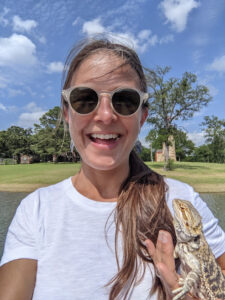 About the Author
Lara Hussain is a former environmental journalist who spent many years in the corporate arena, making good trouble. Today, she teaches literacy and writes fiction in Denver, Colorado, where she lives with a menagerie of human, furry, and scaly family members. In her youth, she spent summers creating Lego villages for pet mice until the mice learned to chew through the windows to escape. Her stories of the underdog rising up have appeared in The Literary Hatchet, Scapegoat Review, and The Last Girls Club, among others.