by Joy Kennedy-O’Neill
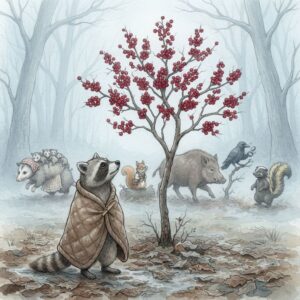
The last of the Greybacks was gone. It was hard to believe. William’s uncle on his mother’s side had finally slept his last great sleep.
William rubbed his raccoon’s paws together and tried to get a grip on his emotions. He and his friends had finished a simple farewell ceremony, and they now walked the river’s west path back toward home, at Belle’s Landing. He looked up at the sky. The Sky-Bearers would soon come – black vultures with red, bald heads. Their dark wings would open like vestment robes, and their soft hisses would sound like extinguishing candles. William scanned the winter’s grey and drizzly sky for the first sign of them.
“I’m sorry for your loss.” Petunia put her hand on his shoulder. Her soft possum’s fur ended at her pink fingers, and he could feel the warmth in her touch. “Would you like some tea with us when you get back?”
“No.” William thought of Petunia’s many possum babies at home with their father Paddy. They would want their mother’s full attention when she returned. “Thank you though.”
Dr. Sass, a small fox squirrel, wiped raindrops from her tiny spectacles. “Your uncle had a good life. Very long-lived.”
A mottled squirrel beside her who held a white rain lily frowned. “Oh cousin. No matter how long his uncle lived, it’s still death.”
“But it is a part of life,” Dr. Sass replied, flicking her tail. “Perfectly natural. I am merely stating the facts, I dare say.”
William wondered how two relations could be so opposite. Dr. Sass spoke as if she bit on a crisp dictionary while her cousin, Nutty Nuthatch, was airy and breathless, floating on her imagination.
Nutty sighed. “Just let him grieve. It lets the vapors out and then his aura can re-energize. Right?”
“I never said he could not grieve. And don’t be ridiculous.”
“I’m fine,” William told the squabbling squirrels. “Really.”
But in truth, he wasn’t so sure. He felt empty and off-kilter. Sad. From the corner of his eye, he saw the first wingtip of a Sky-Bearer gliding silently, as was their way.
Nutty Nuthatch saw it too. “Oh, look. They’re coming. Did you know an old tale says that vultures once had beautiful voices, like songbirds? But they gave up their songs as a price to pay so they could bear the bones of our beloved. It’s so sad, right? They clean the bones and send our flesh back to the earth. Then they carry our spirits Beyond.”
“Yes.” Petunia nodded. She pulled a handkerchief from her possum’s pouch and wiped her eyes. “They bear our souls to the Great Oak, just beyond dawn.”
Everyone stopped respectfully to watch the flight. The vultures soared high above in the gloomy drizzle of winter, unfathomable and remote. Then they descended beyond the tree line, into the clearing from where the animals had come.
Petunia put her paw on William’s shoulder again. “Well. They are with him now. Don’t dwell on it too much.”
As they resumed their walk, Nutty Nuthatch said, “William, when we get back to the landing I can play a dirge on my hickory drum. You’d like that, right? Oh, and then we could light some scented beeswax for protection from restless spirits.”
“Um, maybe later?” William caught Dr. Sass rolling her eyes.
The sound of December leaves under his paws was rustling and dry, like pages in a forgotten book. Here and there cursive snail tracks patterned the mud. He wondered what they said. His uncle had been a fine writer and told him exciting tales when William was a kit. Tales about colder winters and harder times.
“I wish I had visited him more,” he said with regret.
“His den was rather out of the way. Why didn’t he come and visit the landing?” Petunia asked him.
“He preferred wild-side. A good tree den and night walks. None of the Greybacks really understood why my grandfather, a Ring-tail, built the landing with its houses and general store. They called it soft living. Too human-like.” William shook his head. “And I guess I felt that maybe he didn’t understand me because of that. But I should have visited him more. He never had kits, and now I guess there are no Greybacks left. Except for half of me.”
It was then that a terrible feeling swept over him. Ominous and cold. As if a line of animals before him had been pushed off a high limb, and he was next for a fatal fall.
Nutty Nuthatch felt something too. “Sad bugs! Don’t let them go in your ears. They’ll settle in your mind!”
Her cousin, the educated doctor, rolled her eyes again. “Oh, for heaven’s sake.”
* * *
Later that week William discovered that, real or not, sad bugs certainly had settled into his body. He couldn’t concentrate. He read the same paragraphs twice. Even his favorite books, like those from the hedgehog Horace the Elder or The History of the Brazos by the esteemed egret Clarence Long-knees, couldn’t capture his attention. He couldn’t write in his journals. Words dried up inside him like a dusty spring.
Then food lost its taste. He might as well have been eating sawdust. The sky lost its colors. He stopped going to work. He no longer sat at his general store’s counter, greeting everyone who entered under the door’s happily jingling bell. He let deliveries pile up on the dock until Paddy and Petunia took it upon themselves to restock the inventory.
Then he was sleeping all the time – a dreamless slumber full of a haze of sadness. He didn’t look forward to spring. He couldn’t daydream about summer. Every grey, gloomy day of the week was just like the other, and above all else he heard a drumbeat of, “You will die too.”
He slept and dreamed and tossed, going under waves of rest and restlessness, only opening his eyes to see that shadows had moved as a clock’s hand. Day and night turned like tides over him, as if he was at the bottom of a deep, deep sea.
Dr. Sass was the first to ignore his many “go away”s and burst into his bedroom.
“I’m perfectly fine,” he told her.
“You are most certainly not fine,” the squirrel declared.
He was unwashed and his fur matted, but he didn’t care. “Lots of my kind hibernate in the winter,” he explained.
“Hibernation? Nonsense,” the squirrel countered. “Raccoons go into torpor in cold weather. It is not the same thing. Besides, it is merely chilly outside. Not enough to warrant sleeping in bed all day and night.”
“But I’m hibernating,” he insisted.
“Well then,” she said with suspicion, “did you eat a great deal last month to pack on weight for the season?”
“No,” he admitted.
“I see. And did you clean your den for sleeping through the winter?” She sniffed and looked around at his usually tidy bedroom. It was clear she already knew the answer. “I think not. No, you are decidedly not in torpor nor in hibernation.”
She unclasped her medical case and took out several instruments. She listened to his heart, looked in his ears, and thumped on his chest. She had him extend his tongue and then poked around his middle. “Hmm. I can find no symptom of illness.”
The little squirrel fastened her case. “Let me think on this, and I shall be back with some things that might help. In the meantime, you must get outside. Walk, exercise, stimulate your brain! Ah, I have a charming game of leaf-match I shall bring to help you pass the time. And wash yourself, for heaven’s sake.”
William didn’t know how to tell her that simply tying his apron strings was too much for him now. And washing? The well’s pump was downstairs, outside in the garden, and many steps away. Then there would be all the steps coming back while carrying a heavy pail of water. Then, if he wanted a hot bath, he’d have to put some logs in the fire and . . . it was just too much! How did I ever manage it before? he wondered.
After Dr. Sass left, Petunia visited. She brought butternut soup and pretended he was sick with a cold, for which he was grateful. His undiagnosed desperation and helplessness felt so strange. Everything seemed dark.
Shadows mean something is blocking the light, he thought. They are a sort of illusion. The light is still there. Somewhere. But they feel as real as death breathing down the scruff of my neck!
The next to visit him was the wild hog Willowmena. He heard her “oofing” and “uffing” as she pressed her great bulk up his staircase, her hooves hitting like tap hammers on the floor. He groaned. Willowmena had been born as a litter of one (already a sad beginning), under a willow tree, and her birth season (as she dramatically told everyone) was in low-winter. All three were very poor portents, if one believed in that sort of thing. And she and Nutty Nuthatch certainly did. Willowmena was a great worrier and often a hypochondriac, despite Dr. Sass trying to knock those traits out of her head.
However, the wild hog was also a kind friend with worried, piggy eyes. “I see that you’re resting, so I won’t be long,” she whispered. “I just want you to know that it’s okay.”
William pretended to be asleep, but his ears perked up as he listened.
“What you’re feeling is melancholia, and it’s perfectly normal. Don’t let them – especially Dr. Sass – tell you such sadness is abnormal. Why, it’s the most logical thing in the world! How anyone gets up to face the day is beyond me, knowing there is tooth and claw out there waiting in such an unfair world.”
He kept his eyes closed. Willowmena made sense though. He was grateful for her perspective.
“Now you just rest,” she whispered. “And don’t let anyone tell you that you’re unbalanced.” He heard her squeeze her way back down his stairway.
Am I unbalanced? he wondered. Is that what everyone is thinking of me now? Am I strange, like . . .
And then she came in herself: Nutty Nuthatch. She wore a moss headdress that covered her ears and declared breathlessly, “Wake up! I brought traps for the sad bugs.”
He forced himself to turn over and watched her drape spider webs around his room. They seemed to be coated in honey. Then she burned some herbs that gave off purple smoke. He sneezed. She told him to ask the wood fairies for protection and declared, “You’ll know the sad bugs’ power is starting to wane when you notice colors again.”
Thankfully, her visit was short. Bertie the crow bumped into her as she left the room. “Wood fairies and sad bugs?” he muttered as he flew up to William’s writing desk, perching near the pens. He waited until he heard the squirrel leave downstairs then cawed, “That squirrel is as nutty as her name!”
“Hi, Bertie.” William was relieved to see his old friend. He knew the crow had suffered from his own melancholia once, during the dark days of winter.
“I know what you’re feeling. Exactly what you’re feeling!” Bertie said. “Remember when the sun disappeared for weeks, and I could barely get off my roost? Then that fast hare Finn Fleetwood made a cut-out shadow of me and strapped it to his back. Took off running at full speed through the flatland as I flew over him, just so I could pretend the sun was shining on me again. Turns out I had to see my wing-shadow under me again before I felt better!”
William nodded. “I remember. But I don’t have wings.”
“But maybe you need some light! Gloomy winter days can get anyone down!” Bertie flew around the room, cawing in disgust as he ran into Nutty’s sticky cobwebs. He pulled back William’s curtains. Then he lit several oil lamps which crackled softly. The warm yellow light was comforting, but William burrowed deeper under the covers and shoved his pillow over his eyes.
“Just give it a chance! I’ll come back later with some tin and a mirror to reflect it more. Brighter is always better! Just ask any crow.”
William slept again, too tired to care. Eventually Dr. Sass returned. She pulled the pillow off his face then leapt to his nightstand, where she put her little paw under her chin. She flicked her bushy tail.
“Still in bed, I see. We must dig down to the nut of the problem! I’ve given it some thought. Have you had all your nutrients? What about calcium?” She took out what looked like a bone and waved it.
“Ew!” William exclaimed.
“It’s just part of an antler. Deer drop them quite naturally.” She chewed it herself loudly with her sharp squirrel teeth clicking and grinding. “I find that I always think better with a chewing stick. Now, this all came over you after your uncle’s death-day. Correct?”
“Yes.”
“Mmm. Matters of the mind. I daresay that is not exactly my field. In olden times some animals believed there were four humors in the body: leaf, root, water, and sun. If one was prone to panic and over-activity, they had too much spring-green leaf. If they were lethargic, they were water-deprived.”
The squirrel picked up his nightstand pitcher with both paws and poured him a glass. “Modern science has moved past such theories, but there may still be a seed of truth in them. Dehydration is a real problem,” she said, pushing the glass toward him, “but the idea of the four humors is rather outdated.”
“What about sad bugs?”
“Oh, such rubbish! There is nothing wrong with keeping an open mind, but my cousin’s mind is so far open that her brain will likely fall out!”
“Willowmena says it’s melancholia.”
The squirrel looked both aggravated and pleased that one of her patients had hit the nail on the head. “Well, yes. Of course it is melancholia. And Willowmena was once my physician’s assistant so she’s had my training, you know.”
William rose to sip some water then lay back down heavily. “I need some more sleep. I’m just not strong enough to deal with things right now. I’m sorry.”
“Strong, you say?” Dr. Sass picked up her chewing stick and gnawed loudly again, thinking. “Strong. Hmm. We both know someone quite strong. Perhaps he shall have some advice.”
William sat up in bed again, alarmed. “Oh no you don’t. I know what you’re thinking. You don’t need to call him!”
“Hmm. We shall see.” The squirrel picked up her case and clicked it shut. “In the meantime, drink some more water, eat something, and you must get up and bathe. It is becoming rather odiferous in here. Very much like you-know-who, speaking of that rascal.”
She winked, and William dreaded what might come next.
* * *
William heard him before he saw him. Bounding up the stairs. Singing a sea shanty. Knocking on the wood with his knuckles. Then there he was in the doorway: Skunk.
He wore a belt with a dagger. One paw held an empty tin can of beans. The other was sticky from caramels. Skunk smelled like molasses and tobacco, plus his own brand of pungent earthiness.
“Look who the bobcat dragged in!” he shouted gleefully at William.
William didn’t know if he was talking about him or about himself. Skunk did always look half-chewed on: he had a torn ear (from an actual bobcat fight), battle scars on his muzzle, and one crooked tooth. His white stripes were yellowed from sleeping on tobacco leaves.
William smelled the molasses on him. “Have you been stealing from my store again?”
“Who’s to catch me?” Skunk grinned. “You’re up here lollygagging in bed.”
“I’m just resting. I’ve been tired.” William was embarrassed for Skunk to see him like this. “Um, Dr. Sass says it smells in here. Sorry.”
“Smells fine to me!” Skunk sat down heavily in William’s desk chair and burped. He gave William the once-over. “So what’s up, Buttercup?”
William sighed. “Nothing. Everything. Oh, I don’t know what it is. Everyone has come by with different ideas. Dr. Sass says I’m not sick, but I might need nutrients. Willowmena says it’s melancholia. Petunia is pretending I have a cold. Bertie – well, he sort-of understands – but I can’t fly over my shadow to feel better. Nutty Nuthatch thinks it’s invisible bugs or fairies or something.”
Skunk chuckled.
“All I know,” William continued, “is that I feel dead inside. I have no hope for anything. And I feel . . . I feel–” He took a big breath. “I feel like I’m going to die. Maybe not right at this minute, but it’s hanging over my head like a rotten tree branch that just won’t go away.”
There, it’s out, he thought, both relieved and ashamed. I’ve said it. Now Skunk can make fun of me as he pleases.
But Skunk didn’t ridicule. His dark eyes gleamed as he thought. He spat a stream of black liquid into his bean can, then said, “Your uncle died, didn’t he?”
“Yes, the last of the Greybacks.”
“Mmm.” Skunk nodded.
“But we weren’t really that close. I don’t know why it would affect me like this. And I’ve come close to death before. You know that. So many times on our adventures. All those times you nearly got me killed!”
Skunk chuckled again.
“It’s not funny! Those times were scary and horrible, and they always made me stop and reflect on life. But not like this.”
Skunk grew more serious. “A death of your own kin, of your own fambly, ain’t the same as escapin’ it on an adventure. Famblies is different.”
William listened to Skunk’s accent rolling around his muzzle. He watched him spit into his bean can again and listened as he said, “Even if you ain’t related by blood, even if’n you made your own fambly and kinship with friends and the like, when they leave, it sure makes a hurt.”
William knew Skunk had lost a beloved captain, and the grief ran so deep he rarely spoke of it, neither sober nor drunk.
Skunk continued. “Two ol’ bachelors like us don’t have no kits either, and sometimes that can play with your mind. Not leavin’ any bit of yourself behind.”
“Well, in your case, that may be a good thing.”
Skunk chuckled again. “The whole landin’ would probably agree with you.”
They listened to the silence of winter and watched the bedroom window turn gauzy. Humidity from the coast brought with it a thick, chilly sea fog to the river’s bottomlands. The snowless woods outside misted over into a ghostly pale.
Finally, Skunk slapped his knees. “You got to either stan’ up and live, or roll o’er and die.”
“Die?”
“Sure!” Skunk fingered the dagger in his belt. “I’ve got a lot of what-for to give death when it’s ready for me, and I’m pert near looking forward to it. Now you just sit back and rest.”
There was a gleam again in his eye. “Yep, just close your eyes and rest. I’m going to leave you for a spell. Ain’t nothin’ goin’ to happen.”
Skunk’s smirk was worrisome.
After he left, William heard the water pump creaking as someone worked its handle. He heard wood thrown into the fireplace downstairs. Then, before he knew it, Skunk had grabbed him around his middle and thrown him over his shoulder like a sack of potatoes. Downstairs they went, with William’s head knocking against the walls with each step. He yelled and protested to no use.
Downstairs, a tub of hot water waited with blankets hung around it to keep in the steam. Skunk dunked him roughly, and the raccoon came up sputtering.
“Let’s warsh behind your ears too,” Skunk said, lathering him with soap and stinging his eyes.
William yelled, “Stop! I can bathe myself!”
Skunk then stood in a corner and drank from a flask. “None of this for you, by the way. Liquor will only make things worse.” He burped again noisily.
William reluctantly scrubbed himself. Water on his paws usually made him feel better, but now he seemed somewhat numb. When he had finished washing, Skunk rubbed him so hard with towels that he thought he was being flayed alive. His fur puffed, and his ringed tail looked like a bottle brush.
Skunk laughed. “You look like a wooly worm.”
Just when William thought the worst was over, Skunk wrapped a blanket around him, tied it with a clothespin, and marched him outside. “One, two. One, two! Get your legs movin’!” Around the possumhaw tree in the center of the landing. Out to the gardens. Back again. Around and around. One, two. One two!
The next day, Skunk came again. Although there wasn’t another bath, there was more marching.
Every day Skunk burst into his room. When William shoved his desk across the door to block him, Skunk crawled in through the window. When William put a lock on the door, Skunk picked it. When he hid under the bed, Skunk grabbed him by his ankles and yanked him out so hard that William thought his legs would dislocate. When he tried to hide in his armoire, Skunk tumped the whole thing over.
Skunk looked at the spillage on the floor and picked up two socks Petunia had knitted for William’s long, back paws. “Hey, you want some foot-bags to keep your paws warm?”
“No.” William crawled out from under the shelves’ contents. “There’s a left and right one. I’m too tired, and it’s too complicated.”
“You got a fifty-fifty chance.”
William shook his head. “It’s too hard.”
“What? Too hard? You got book learning, you read all the time, you’ve figured out maps, managed a general store, learned to sail with me, and yet you cain’t put two foot-bags rightly on your paws?”
“No, Skunk, I cannot. Not these days.”
“Well, there’s a pickle!” Skunk said in disbelief. “Come on!”
Again, Skunk rough-handled him down the stairs. Out the front door and off the porch, like it was a ship’s gangplank ready to push him off to his doom.
More marching. One, two. One, two! If William resisted, Skunk pinched his tail or flicked his ears. It was maddening.
“Think like a sailor!” Skunk instructed. “When you hit rough waves, there are things to do! Sheet the sail. Bail the boat. Watch the wind. Grab the tiller. You can’t just stop and do nothin’. You got to move! Ride it out!”
By now everyone at the landing had heard the daily commotions. And they had started to join in as well. “One, two! One, two!” Petunia marched with her possum babies hanging on to her back with their little fingers and long, pink tails. They blinked bright, shoe-button eyes.
“One, two! One two!” Nutty Nuthatch came waving a willow stick that resembled a wand. Bertie rapped on a bottle cap with his beak, keeping time, and Willowmena the wild hog made everyone laugh at her mincing little hoof-steps – at odds with her great bulk.
It occurred to William that the others felt the gloom of winter too, or had experienced similar sinking feelings in their lives. He felt selfish for not noticing before.
That evening, amid the contents of the tipped-over armoire, he found a story his uncle had written him years ago. He unrolled the palmetto-frond paper and re-read it, a true story about the terrible freeze of 1895:
“White flakes came from the sky. They were strange. Not cottonwood seeds. It fell one paw deep. Then two paws. Then up to my chest and then above my head. The woods became white as far as any animal could see. Scents disappeared. Water turned hard and slippery. I discovered stunned fish were underneath so I broke the surface with a log and I was able to catch them. I shared my catch with many animals. Days became dire as the cold bit like teeth we couldn’t see.”
The acorn tannin ink still seemed fresh, as if it had been written yesterday. William found himself weeping, then smiling. Maybe we still leave parts of ourselves behind, he thought. Even if we don’t have kits or become great heroes of yore.
The next day, he read the story to everyone. They laughed in all the right places, such as when his uncle said:
“The eastbend squirrels had always feuded with their possum neighbors. One night it was so cold that even the toughest hawk fighter grew desperate. He climbed down from his squirrel drey and slipped inside a possum den. It didn’t matter that it was the home of his worst enemy. He was too cold. He curled up tight against that warm fur. Long-snout Ben thought it was his mate. He said Oh Minerva! and rolled over for a cuddle. He had a shock.”
As the laughter died down, it was as if old Greyback was still there.
Soon, William noticed a color – the deep red of the winter berries in the possumhaw tree. The next day he noticed when the sun sent a golden shaft through the pecan trees.
A few days later, he tasted soup’s rich creaminess. He savored the salty crunch of a piece of toast. He went into his kitchen and cooked up turnip stew and baked sugar-seed cakes. He brought it all to the possumhaw tree to share, like his uncle had shared his fish. Everyone still gathered at the tree doing little marches and dances in the afternoon.
It was good.
Nutty Nuthatch declared all his sad bugs were dead, and the fairies wished him good fortune.
Dr. Sass rolled her eyes. “It was the vitamins!”
Bertie said, “It was the lights!”
Petunia said, “It was my soup.”
Willowmena said, “It was my good worrying.”
Skunk didn’t say anything, but stood at a distance and spat into his bean can with a grin.
William shrugged. “Well, I wouldn’t mind more of your soup, Petunia.”
That evening, the sun set orange and brilliant. The silhouettes of the bottomland’s pecan and oak trees looked like paper cut-outs against the eastern purple sky, studded with the pinpricks of stars. William sat at his desk with a new sense of peace. He reached for a pen and paper, savoring the soft nub of a fresh page under his paw.
He began to write.
* * *
Author’s Note: The animals you’ve read about live on the banks of the Brazos River, about twenty miles from the Texas coast. They’d be delighted to tell you more about themselves – that is, if you had the gift of whisker-whisper. Many people find it far-fetched to imagine an animal world co-existing with our own, such as a raccoon operating a general store. Humans can be quite oblivious. It was true in the 1890s, when these events take place, and is still true today. For those who enjoy a softer, more paw-wise world, we invite you to come join us!
 About the Author
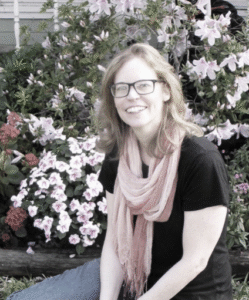
Joy Kennedy-O’Neill lives on the Texas Gulf Coast, where she teaches English for a small college. Her fiction has been published in the Cimarron Review, Strange Horizons, Nature, Galaxy’s Edge, and elsewhere. She lives with her math professor/writer husband and their two rescued brother-cats, Calvin and Hobbes. Her website is JoyKennedyOneill.com