by Gail Brown
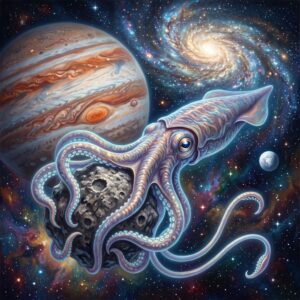
Stars swirled in the distance, as they had all of Chara’s life. Beautiful stars filled the sky beyond Jupiter with light.
Hundreds of generations before she had been born, this had been empty, open space. A small asteroid, about the size of Chara’s beak, moved between her and distant stars.
She stretched out her eight arms, each over a hundred feet long. They gripped the small asteroid with sharp suckers. Her two-hundred-foot-long feeding tentacles grappled and propelled the small asteroid on a path away from frozen Earth.
Earth. A home her distant ancestors had once dwelled on. Chara had never seen the now-frozen oceans that her ancestors, only a third her size, had swum in.
Earth circled the Red Giant Sun between Saturn and Uranus. Space squid had moved it there six hundred million of their generations ago. Now, it was a frozen memory of warmer times. A Snowball Earth, as the last humans had said before they were placed in stasis by Chara’s distant ancestors.
Earth had been an ocean planet with land littered across the surface, blocking some oceans from others. Her ancestors had lived underwater, instead of floating among the stars. The Earthen seas had many competing dangers for ancestral squid.
All Chara knew about water was that it hid the peace and allure of distant stars. Places she longed to see, as they careened toward her through time and space.
In space, the squid faced asteroids of all sizes, and gas flares from Jupiter, and the now distant dying Red Giant Sun.
Squid eyes, each three feet in diameter, often missed micro asteroids. Many of the space squid spent time on Europa regrowing damaged arms and feeding tentacles.
Tardigrades had to be brought to them from the semi-frozen atmosphere of Earth as food. They too were larger than their ancestors. Large enough that three or four made a good meal. The water bears fed on the algae growing on the frozen seas and lands of the once-inhabited planet.
As well as a few locations on Jupiter’s moons. One small tardigrade-raising center had been designed inside one of the asteroids that orbited near the part of space Chara patrolled for potential asteroid collisions.
She swished through space with her eight arms spread out behind her. Asteroids, once caught, were often flung toward Jupiter. They would dance into the waiting swirls of the gas giant. After they reached the outer gas bands, Chara swirled back to the atmosphere of the moon, once called Ganymede, where the space squid raised their young. Here, the oceans were warm and salty. Safe and secure.
Chara’s youngest daughters would likely complete the goal for which the space-dwelling giant squid had been bred on Earth three billion years before.
Three billion years was a long time for any living creature. Even if it was only a moment for a star system.
For a squid that once lived five years naturally, it was closer to beyond forever. In which hundreds of millions of generations of squid had worked to save Earth and its inhabitants.
Their life was simple. They directed the asteroids away from Earth. The squid maintained the once ocean planet in a safe orbit beyond Jupiter, which protected the planet from the Red Giant the Sun had become.
Admittedly, the magnitude of generations was a concern to the human scientists from three billion years ago. Would the squid survive in the openness of space? Would their memories of what to do when the galaxies met survive?
The memory of humans. Now asleep in stasis. As were most of the other once-living beings. To be brought back to life once Earth was settled into a new orbit around a new sun.
Humans, plants, and animals — something no living squid had ever seen. Even the visual records had turned grainy across the millennia.
* * *
“Andromeda. Isn’t it beautiful?” Chara checked the display on the command center asteroid she and Ismine rested on.
“It’s always been there.” Ismine tapped the controls that watched for Sun and Jupiter gas flares. “The Sun is sending a large flare directly toward Jupiter. It could increase the gas levels there.”
The Red Giant could pull all of Jupiter’s gases into its own atmosphere. Or, Jupiter could ramp up and pull the helium and hydrogen from the sun’s expanding atmosphere. It was unpredictable. The scientists hadn’t been able to predict which way it would go, so the space squid had been bred to watch and guard the frozen Earth in either case.
It was the hope– and future of the frozen planet — that a new sun in Andromeda would pull Earth away from their former sun before the Red Giant reached the helium flash stage. By that point, all life on or near Jupiter was predicted to evaporate.
Chara checked her screen. Several smaller asteroids had veered off course, toward Earth’s atmosphere. Their trajectory was too close to the stasis chambers where the humans and farm animals slept beneath the ice. “Solar winds are picking up. We need to move those three asteroids closer to Jupiter.”
“Do we have to? The winds there are too strong.” Ismine shuddered. Her skin rippled in bright neon colors.
No doubt. Two of Ismine’s sisters had been caught when an unexpected gas gust grabbed them and pulled them into Jupiter’s atmosphere.
“We have to. Soon, there’ll be a new sun.”
“I don’t see any new stars.”
“One is predicted. We have to keep Earth safe and at an inhabitable distance. Jupiter is helping us as much as our old Sun. Andromeda is almost here. She will bring new life to Earth.” Chara propelled away from the command asteroid to reach the smaller errant ones, and try to send them back to their original path. Her arms clasped them and wrestled them until she propelled them into the correct path, closer to Jupiter’s gravity.
Based on the charts of stars that updated regularly, a new sun had formed as Andromeda merged with the Milky Way, and in less than a generation, this new sun would be close enough to gravitationally reach for the planets in this solar system. Then, the space squid would have to break Earth out of its orbit beyond Jupiter, and steer their ancestors’ home toward the new sun.
Many of their distant relatives had commandeered other asteroids to help with this transition. The fear was that Earth would slow during the separation, and Jupiter would permanently add the planet to its rings of moons.
Their cousins on distant large asteroids should be close enough to affect the gravity of the new sun now.
Although it wouldn’t be much, a nudge toward the dying Red Giant would bring the new sun closer.
It would be a few more generations before one of the space squid would push the button to begin opening stasis chambers on Earth. Chara wouldn’t be there when the humans awoke. It was her descendants who should be the ones to open the stasis pods.
Whoever was alive would have to choose between space and Earth’s oceans. If returning was a biological option. The scientists had not been clear on that option.
Former leaders had promised the space squid would be left to live in space if they desired, protecting the planet from future asteroid attacks.
Others might wish to return to a planet neither they, nor their recent ancestors, had known.
Chara shivered and flashed multicolored. A vague haunting ancestral memory skittered on the edge of recognition. Water crashed as the gas flows often did. Long objects, rather like asteroids, chased this ancestor and threw sharp objects at them. The memory dimmed. Those were the ancestors of the scientists who had created them.
Perhaps the Snowball Earth would remain the scientist’s home, and the Space Squid would never forget their ancestors’ anguish.
* * *
 About the Author
Gail Brown’s paired stories mirror daily life as it could be. Perhaps should be, in some ways. Her novels are on her website, and short stories have appeared in Alien Dimensions, Bards and Sages, Earth 2100 (Other Worlds Ink), Kaleidoscope, Lorelei Signal, and The Neurodiversiverse Anthology, among others.