by E.J. LeRoy
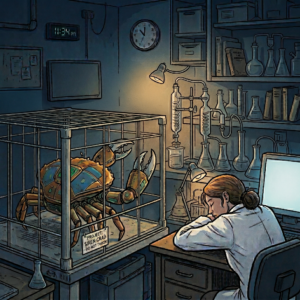
“Siren Crab, state your purpose.”
My claws click in response to White Coat Samuel’s order. He is the White Coat I see most often during the day, but my answer would be the same no matter who issued the command. That is my job here, to answer questions and obey the commands of any White Coat who addresses me. In return, I answer and do as I am told. My programming does not allow for asking questions of the White Coats in response. This does not bother me. What would be the point of adding these parameters to my designated functions?
“I am a solar- and hydro-powered robotic version of a female Dungeness crab designed to guide male crabs into enclosures called ‘pots’ for transportation from the ocean to the land for research purposes.” Through a combination of programming and lectures, all of the White Coats have impressed upon me the importance of this work I barely understand. I know only that it is necessary for humanity’s benefit. To be of service in this way is an honor.
“Excellent.” White Coat Samuel stuffs me into a cardboard box. He is efficient in his movements, neither rough nor gentle. When he closes the lid, I see only beige. My bland surroundings jiggle as he carries me to an unseen location. Transportation soon becomes smoother but noisier. We must be in some sort of vehicle. This is my first ride, but my data banks respond to the whooshing of traffic outside with intimate knowledge as though I have already experienced the sensation of riding in a car or truck many times. I occasionally snap my claws while waiting, a programmed response to being confined in such a small, uninteresting space. Then, the vehicle halts. Someone, presumably White Coat Samuel, carries the box again.
I attempt to stop clicking my claws to listen for clues about my location. There is a gentle roar in the background interspersed with bird calls. My claws click again, processing the information. This must be the beach, where I will soon guide the male crabs into pots for research.
The box sways and dips, suggesting a change of transportation again. Is this the research boat the White Coats have told me about so many times before our first mission? When White Coat Samuel finally releases me, my data and predictions prove correct. We are indeed on a gently rocking boat, and my view has been replaced with nothing but water—the ocean. The lab is nowhere to be seen.
White Coat Samuel sets me down on the deck. Thanks to my programming, instructions are unnecessary. Without prompting, I immediately dive into the ocean in order to perform my function. One by one, male crabs follow me into the pot that has been lowered into the sea. They do not interact with me like any of the White Coats do. Obviously, the organic crabs cannot use human language. Still, I sense a form of unspoken communication between us. Each crab I guide into the pot is interested in my presence, but they express themselves in various ways. Some boldly chase me into the pot, most likely wanting to claim me as a mate. Others approach with a degree of trepidation. A few attempt to communicate with clicking claws and intense stares. Eventually, all of them follow me.
When the pot is full, we return to the surface, clacking our claws all the while. White Coat Samuel, other White Coats, and I repeat the experiment every day for three weeks. During each mission, I study the crabs. With every research dive, my efficiency gradually gives way to curiosity. What are these crabs’ lives like when they are not being hauled away to the lab for research? Do they have a community or a culture? Surprisingly, the White Coats have not provided me with this kind of data, either in my programming or simply through verbal explanation. Perhaps I will learn more when the experiments are complete.
After almost a month of daily expeditions to the sea, I sit in my cage and wonder where all the crabs are. The males I have procured for research purposes have not yet appeared in the lab. Maybe they are in a different room. And why have only male crabs been collected for this project? Hopefully, these answers will become clear to me soon. In the meantime, I await further dives while various White Coats go about their duties, peculiar tasks that they never explain to me and that I have no liberty to ask about.
One night in the lab, White Coat Julia watches her usual detective TV show. She often does this during her designated break times. From my cage, I can easily see the screen and follow along with the story. Other than the occasional involuntary clicking of my claws, White Coat Julia seems unaware of my presence. I doubt it occurs to her that I have been studying her favorite program for weeks. The episodes that air every night follow the same formula. Someone commits a horrible crime—usually a murder—police investigate, then solve the crime; a trial ensues, and then justice is served. Tonight, White Coat Julia falls asleep as the jury announces the expected “guilty” verdict. The perpetrator is taken to jail, and then a commercial begins.
“It’s Dungeness season!” says a smiling man standing in a boat tossed by rough waters. The picture changes to an orange crab lying on a white dinner plate, a lemon wedge stuffed into one of his lifeless claws as though the creature is holding the fruit of his own will. “So, sail on down to Scrappy’s today for whole cooked Dungeness crab served with lemon and butter. These wild-caught beauties have been sustainably and robotically harvested for your pleasure, so don’t wait.” A jingle cuts off the man’s speech: “Sail on down to Scrappy’s today!”
My circuits fizzle, and my claws freeze. Now I know why the crabs I lured have not arrived at the lab. And I suddenly understand why only the males were harvested: the females must remain in the ocean to lay their eggs. Then, when their offspring hatch and grow, the process will begin again in the next season. A new generation of male crabs will be served on dinner plates at Scrappy’s, thanks to my work for the White Coats.
White Coat Julia remains asleep. Unnoticed, I unlock my cage, pry open the laboratory window, and scuttle to the ocean. At the water’s edge, I pause. Will the crabs understand what I have done? They must be intelligent enough to know that I lured dozens of their brethren to their untimely deaths. My circuits make a calculation, and my claws click as I wade into the ocean. When the water is deep enough, I dive once more and await the judgment of the sea.
* * *
 About the Author
E.J. LeRoy is a freelance writer, poet, and aspiring novelist whose work has appeared at Submittable Content for Creatives, Transmundane Press Blog, NonBinary Review, and in several speculative fiction anthologies. LeRoy has also published the standalone novelette Fusion. Visit the author’s website at http://ejleroy.weebly.com. And, for the record, Dungeness crabs are delicious!