by Anne Larsen
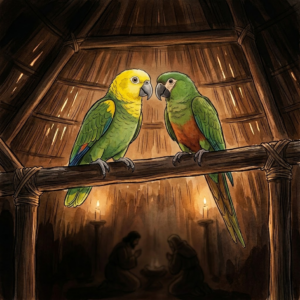
Consuela came to her vocation by riding on the shoulder of a pale human in black robes. The color suited her sorrow, the heavy cloth bunched beneath her clenched feet. Grief made her restless, but loneliness kept her clinging to this strange man who was the only one to walk away from the sun-dappled shade and silence of her village. The hammocks hung heavy with unbreathing fathers and stiff children. The women had died closer to the fire pit, trying to make broth for the little ones. When the last of her people had died, the pale man stumbled away from the village, and as she could not bear to be alone, she went with him.
The parrot had come to her village long ago, injured by an ocelot while learning to fly. A girl found her and carried her to the circle of open huts. The humans brought her water and fed her until she healed, but her left wing hung lower than it should and was not strong. She could fly, but not far. The jungle would not be safe for her. She chose these kind people as her flock, and they cared for one another. She learned Pumé, their language. She watched over the little ones, and scouted for the hunters. The people taught her their songs of creation and healing.
The girl who had found her grew up and bore children of her own. The bird felt a special bond with the oldest daughter. The bird found the ripest fruits and plucked the stems so they fell to the child’s waiting hands. That girl grew into a woman, and bore her first son. The bird adored him.
At the end of the rainy season, a stranger came to their village, a pale man wearing ridiculous black clothing, too hot and heavy for the jungle. The village welcomed him, invited him to shed his layers, but he would not. He started learning their language.
By the full moon, a new kind of illness tore through the village, taking the children first, then their parents, all of them coughing and gasping. The herbs the healers tried did not break the fever. Men did not return from hunting. The nets hung untended in the river. The bird sat with her beloved until she died, following her newborn son.
At first, the pale man tried to bury the people, but there were so many and the ground was so clasped by roots that he could not dig fast enough. Finally he fled, scrambling into a canoe he did not know how to handle, and pushed out into the river. The bird fluttered after him, perched on the bow and offered instructions, but he did not listen to any of the three languages she knew. The little craft caught on a submerged snag and he lost his oar pushing them free. The river spun the canoe out into the current and they drifted on for a day and a night.
The man trembled in his sweat, peeling back his robe before collapsing into sleep. Mosquitoes feasted on his wet chest, though the bird plucked as many of them away as she could reach. Now and then she would fly to the bank and grab a ripe fig, then return to the boat to eat it. She brought him figs, too. He woke when she dropped one in his lap. At last he studied her, perched on his knee.
“Consuela,” he said, touching her beak with a fingertip.
Is that his word for me? she wondered. Her people had called her with a distinct whistle-chirp she had taught them. It carried through the dense jungle when they were all hunting together and they needed her to tell them what she saw. The bird offered it to him but he did not understand.
“Consuela,” she said back to him. His eyebrows went up and he tilted his head.
“Sí, Consuela.” A weak smile perched on his mouth, then faded.
“What does that mean?” she asked in Pumé. He blinked at her. He had only come a wingspan of days ago, and did not know many words. She flared her yellow neck feathers and bobbed her head at him, then clambered back up to sit on his shoulder. He slept again.
The next day, a Waraoan man ferrying bunches of green bananas came near, and the pale man called out to him. With deft strokes the trader drew beside them and coaxed the pale man to crawl from the small canoe to sit in the bow of the greater one. There was a space on the far side of the mounded fruit where the pale man could huddle. After that, the two men did not speak. The pale man slept, slumped at one end of the long dugout. The parrot groomed herself, tidying every feather on her breast and back, pulling each blue-tipped primary through her gray beak to smooth the filaments. She could not settle.
The parrot fluttered to the stern and perched on a banana. She fixed the trader with one white-ringed golden eye. He nodded to her.
“My village died,” she said.
“Everywhere people are dying,” he told her. “You speak Warao well. Are you a magical bird?”
“I am an old bird. I listen. Is that magical?”
“Does that man know you understand human speech?”
“No. He thinks I am as silly as a quetzal.”
“Those black-robes don’t know anything. Not what to eat, what to avoid. They ask to be carried upriver to the villages for some reason, yet they cannot take care of themselves.”
“Why didn’t this one die when everyone else did?” she asked.
“I don’t know. They do die, usually of some sickness that we survive. It is odd, the way they are strong and weak at the same time.”
“Thank you for picking us up.”
“I am honored to be of service to a bird like you.”
The pale man cried out in his sleep then, and the parrot returned to his shoulder. She groomed his matted hair and nibbled the rim of his ear the way she had soothed the village children. She picked lice out of the hair on his face, which was thicker every day. None of her people grew curly hair like this. His bad dream passed, the jungle passed, and she watched scarlet macaws fly overhead, shouting gossip to one another, teasing a newly-mated pair.
The river widened and slowed, the banks receding on both sides. Other canoes joined the current, laden with papaya and cacao pods. When one came close carrying a heap of the huge, brown tururi fruit that contained her favorite nut, Consuela called out to that boatman, saying please, and naming the fruit in Pumé. He looked at her and shrugged. She asked again in Warao and the boatman laughed. He tossed one of the fruits to the banana trader, who broke it open and held it out to her. Consuela plucked out a long seed and peeled it. She ate three of them, delighted by the rich, soft meat. White crumbs stuck to the black robe. Satisfied for the first time since they had left her village, she fluffed herself, pulled up one foot, tucked her beak into her back feathers, and slept through the night.
The next morning the river was so wide she could see only one bank. The Warao, who lived their whole lives on this moving water, steered their boats across the current to the unseen shore, or paddled hard upstream.
Should I live with them now? the bird thought. The idea of being on the water in every season made her uneasy. Then a dugout drifted downriver past them, a man slumped over his oar and a woman huddled around a child at the bow, flies busy on their lifeless faces. The bird screamed her anger at this death.
If they are dying, too, then I will be left alone again. She screamed her sorrow. Startled, a mob of fleet, green parakeets rose screeching from the vines that draped the trees, carrying her distress deeper into the forest. The pale man woke and looked where the bird was looking. His tears left clean streaks on his cheeks. He did not move as the parrot plucked the salty, bright drops from his nose and chin.
That evening she sat with the Warao man. He plucked tururi nuts out of the big fruit for her, and she sang him his people’s origin song, which she had learned from an old trader who had sold fish and tapir hides to her beloved Pumé. She liked the chanted refrain of this song, and the boatman drummed the rim of the canoe to keep time.
“The first man lived on the sky river,” she sang, “with many birds for company but no other people, no four-legged ones or fish. One day he shot an arrow at a great bird and struck its breast. It fell from the open air, down and down, until it broke through the bed of the sky river. All the birds cried with joy at the light that rose from that place below.
“All the birds assembled, each with its people, and they flew through that hole into this world. They were so many it took a whole day for them to leave. The first man called to them. They laughed and invited him to follow. When he was all alone on the sky river with the unspeaking stars, he grieved. He was afraid.
“Then a blue-headed parrot called his name from far below, told him to be brave and look down through the hole. It took all the courage of his heart, but he did look, and he saw the green and glorious land, the forest, the many rivers, and the game. He saw bright flocks of birds playing in the trees, feasting on fruit he had never tasted. He saw silver fish leap from the waters and dainty-footed deer stepping from the shadows to drink.
“But it was a long way down. The man plucked the clouds and spun threads, then twisted those threads into rope. He tied that rope to his canoe, which would not fit through the hole. He lowered himself down to live in this world forever, and the parrots welcomed him, for we are all speaking peoples and we belong together.”
When the bird finished, the man drummed and sang for her, a funny song about a man who fell in love with a river otter and her family’s pranks on the couple. Afterwards, they sat in silence together, the bird preening and the trader weaving fabric from palm fibers. Then, from the far side of the bananas, the pale man’s voice rose in a song filled with longing so intense that both the bird and the boatman listened unmoving. They could not understand his words, but the posture of the man’s heart was clear. When he finished, the boatman whispered to the bird.
“I think he misses his homeland. He does not belong here.”
“I wonder if he can go back?” the bird said.
“If he could, would he sing like that?”
The bird nodded to him. Then she fluttered over the bananas and landed on the pale man’s shoulder and nibbled his ear.
“Consuela,” he said, his voice hoarse.
“Consuela,” she said back. He reached up to touch her and she bumped his finger with her beak. Then she fluffed herself, pulled up one foot, and slept.
Late the next day, they arrived at a place where there were more huts and boats than the bird had ever seen together. The trader steered his canoe close to a wooden dock and tied it there. He called to two women who helped him unload his bananas.
“Thank you for carrying me to this place,” the bird said.
“Thank you for your company, and the song,” the boatman said. “What will you do now?”
“I will stay with the black-robe,” the bird said. “He is so lost and alone. He needs me.”
“You are always welcome on my canoe,” the boatman said. “Be careful out there. People are dying. Parrots might be in danger, too.”
“You are kind to offer me a place. But I belong on land among trees, not on the water. Please be careful yourself.”
The pale man crouched low and wobbled forward along the boat. He extended his hand to the boatman, who would not take it. Instead, they bowed to one another. The boatman passed a palm-fiber bag to the pale man, and pointed to the bird.
“This is for her, she likes tururi nuts,” he said in Warao.
The pale man nodded, understanding the gesture, and bowed again. Then he stepped up onto the dock. The women helping unload moved back, away from him. He bowed to them, too.
The yellow-headed bird rode his shoulder as he walked into the cluster of houses. The paths between them twisted among the huge trees. The bird noted many empty homes, and fewer humans than she expected in so large a village. They passed through a wide place where women sat with baskets of fruit, fish, and game. Smoke twined up from small fires, wrapping around the meat spread over it on poles. The parrot knew the pale man must be hungry, but he did not stop to trade.
At a hut larger than the others, with a strange shape jutting up from the roof beam, he stopped. He ducked inside. Streaks of sunlight came through the walls to ornament the dim interior. At one end the bird saw a platform with bowls on it and two white sticks that each hosted a tiny flame on top. The pale man knelt so fast that he almost fell, and the bird squawked in alarm, flapping and scrambling to stay on his shoulder.
Her companion started speaking, his voice breaking now and then. He spoke a different language, one with a different rhythm and little melodic rise and fall.
Maybe this is his ritual language, the bird thought. It sounds like he has said these words his whole life. She listened, caught a few phrases and stored these in her memory.
While the man recited his words, another pale man in black robes walked into the room. A red-bellied macaw rode his shoulder. She nodded a greeting to that bird, and he nodded back. They all waited until her human paused.
“Amen,” the new man said.
“Amen,” the macaw said.
“Amen,” the yellow-headed bird said in unison with her human. He did not rise from where he knelt. His shoulders drooped.
The macaw flew up to perch on a rafter. The yellow-headed bird joined him there and they touched beaks. The macaw said something in Huottüja, a language she did not know well.
“My village died,” she answered in Huottüja. “Do you speak Warao?”
“I am sorry to hear that,” the macaw said in Warao. “That is happening everywhere.”
“Is that why there are more houses here than people to live in them?”
“Some died here, but most of the men were taken away by the pale ones called encomenderos. They have sharp blades, strong rope, and a drink that stuns. They offer this to the men and then tie them up and carry them away when they are asleep.”
“What are they doing with the men?” The bird could not fathom why the pale ones would do such a thing.
“They load them onto enormous boats, bigger than any canoe, and pushed by the wind. They go away and we never see them again.”
The bird considered this alarming news. “Do you speak their languages?” she asked.
“I have been with Pedro for a year. I have learned España, but less of their other language.”
“The man I ride uses the word ‘consuela’ for me. Is that a word you know?”
“In España, that word means comfort. It means easing pain in the heart.”
“I did try to comfort him. So it will do for a name.” She groomed her feet and talons, thinking. “Do parrots ride all the black-robes, or is it just you and me?”
“I have only met parrots riding those black-robes who are angry at what the encomenderos are doing. Most black robes help the encomenderos and the parrots shun them. They are bad people.”
Consuela fluffed herself. She offered to groom the macaw’s head, tidying the feathers that one cannot reach for oneself. He welcomed her kindness, closing his dark eyes in bliss.
The men knelt together on the ground in front of the little flames. The macaw’s man spoke the ritual language, and Consuela’s man answered him. They often spoke in unison. At length, the macaw’s man stood and offered a red drink and flat bread to her man, who wept and accepted this gift. The two of them settled across from one another and switched to Spanish.
“I will tell you what they are saying,” the macaw said. “I think it is important.” The two birds huddled together. “Your man’s name is Antonio, my man is Pedro. He calls me Valaro. They are telling each other about going out to the villages and how the people sicken and die when they come. Antonio thinks there is something about the pale ones that makes our people ill. Your village was the second time this terrible thing has happened to him. He thinks the black-robes should stop going to the villages.
“Pedro is angry at the encomenderos, at how they capture and carry away our people. He has stopped offering them the gift he gave Antonio, and this made them furious. They yelled at him, and one struck him. I bit that one,” Valaro said. “I tore his ear so it would not heal and we would know him if we saw him again.”
“Good idea,” Consuela said.
“Pedro scolded me, but when the men left, he thanked me for doing it. Now they are discussing how they might stop the encomenderos from taking men.”
“Do they have sharp blades and the things the encomenderos have?”
“No. Pedro thought that denying them the gift would matter more, but the encomenderos did not stop. He told me that we are few and they are many, and they believe they are allowed to do what they want. Antonio says that they need a plan.”
Both men had fallen silent below the birds. Evening dimmed the room so the tiny flames on the white sticks shone brighter. Moths flitted in through the open door and swirled around the lights. A bat followed them in, caught and ate them on the wing.
“We should eat something,” Pedro said.
Antonio held up the fiber bag with the tururi nuts. He looked up at the parrots.
“Come share our meal,” Consuela said to the macaw. She glided down to Antonio’s shoulder. Valaro landed on Pedro and stroked his cheek against Pedro’s jaw. Pedro ruffled the feathers on the nape of the bird’s neck.
Antonio handed Consuela a nut. She cracked open the hard, thin shell and peeled it off the meat. She fluttered across to Pedro’s lap, offering him the nut.
“Gracias, loro bonito,” he said.
“Consuela,” Valaro said.
Antonio started. “I call her that,” he said. “How does your bird know her name? For that matter, how does she know her name? She has only been with me for a few days.”
The macaw grasped the nut in his left foot and repeated the men’s words in Warao for Consuela.
“I call this bird Valaro,” Pedro said. “He defended me from men who tried to beat me when I confronted them about the abductions.” Pedro bit half of the nut and passed the other half to Valaro. “I think these parrots are as intelligent as we are. They have a gift for languages and they live a long time.”
“Surely they just echo what we say?” Antonio said.
“Then how did Valaro know your companion’s name? You have not used it before now. She must have told him, which means she also knows that ‘consuela’ is the word you attached to her for your convenience.”
“She stayed with me. She brought me fruit when we floated down the river. She could speak with the boatman who brought us here. But I thought she was just prattling at him.”
“Did he speak with her?” Pedro asked.
“I was sick, and fading in and out. But now that you mention it, I think they were conversing. One night she sang a long song and he drummed.” Antonio invited Consuela to sit on his knee. He gave her another nut to shell. She ate half and gave him the other half, which he ate.
“We have all broken bread together now,” Pedro said. “But I can offer you more than tururi nuts.” He rose with Valaro balanced on his shoulder. Pedro helped Antonio up. Hunger made him unsteady, but Consuela clung to his robe. Antonio and Pedro each took a candle, and they walked to an adjacent hut.
Pedro had a low table. He put out smoked fish, papaya, figs, and pounded cassava porridge. He poured water into a cup for Antonio and into a coconut shell for the birds. The men spoke before they ate, but not during the meal. Afterwards, Pedro tied up a second hammock for Antonio and banked their small fire. Valaro and Consuela perched together under the eaves.
“They will wake in the night to pray,” Valaro said, “but we can stay here.” Comforted by the warm softness of another bird beside her, Consuela slept well.
The next morning Pedro assembled two small satchels, passing one to Antonio. The birds settled on their shoulders and they walked to the dock. On the way, Pedro greeted many of the women by name and they smiled at him. One gave him a huge papaya, which he slid into his pack.
“These people like him,” Valaro said. “They saw him fight with the encomenderos. They lost their men, but they appreciate his courage.”
Pedro traded the huge papaya to an elderly boatman for a ride down the river. The man had a bad leg, so the encomenderos did not take him, though they had taken his sons.
“Can you bring them back to me?” he asked in Warao.
“We will try,” Valaro answered. “If any more black robes come, do not take them upriver to the villages.”
The boatman studied the two parrots. He spoke directly to the macaw.
“All of the ones nearby are empty now. They would have to go very far up to find people. I cannot row against that current anymore. Are you two teaching these men manners?”
“We will try. Some of them are good people, but most of them are not,” Valaro said.
Pedro said, “We are going to their camp to learn where they are taking your men and boys.” He spoke Warao with a thick accent, but he used the right words, which impressed Consuela.
It took two days to reach the river delta, riding the current among the narrow islands. They saw few boats going upriver, and no one was fishing. Late in the second day, they rounded an island and Consuela saw huge ships in the middle of the river, tall trees stuck out of their backs like porcupine spines. Ahead, they saw where the encomenderos had burned part of an island to make their camp in the muddy ruins.
The boatman delivered them to the upstream side of the island and fled.
Valaro and Consuela guided their men through the jungle. Once, Valaro warned them away from the most dangerous kind of serpent. Consuela found ripe fruit for their midday meal. They found a place where they could crouch in the shadows and watch the encomenderos.
Valaro said, “We will go look for the men. Wait here.” He and Consuela flew across the open. The encomenderos lived in cloth huts, and had filthy habits. The camp stank from their open waste pits where clouds of flies swarmed. A few of the cloth huts were larger than the others, and men stood outside them dressed in dark shells like upright armadillos holding tall spears with leaf-shaped blades. No one looked up as the parrots passed.
On the far side of the camp the birds found the missing men. They were bound with rope on their wrists and ankles, and all were tethered to a long rope that pulled their arms above their heads. Several were sick, moaning with fever, skin swellings, or coughing. Many had dried blood on their backs and legs, and flies clustered there. All of the men were thin and filthy.
Consuela landed on the long rope and spoke to the man below her.
“Who are your people?” she asked in Warao. The man blinked at her, his eyes dull.
“We are Pumé and Huottüja,” he said. His voice was ragged with thirst.
“How long have you been here?”
“Since quarter moon. The sick ones have been here longer. Some Warao came yesterday.”
Consuela felt his fear like a wound. “We want to help you. If we broke your ropes could you run?”
He shook his head. The muscles between his shoulders twitched every time he slumped, and he whimpered in pain.
“We could crawl,” he said.
Shouts came from the camp and four encomenderos marched toward the captives with a bucket and a gourd dipper. Some captives stirred and lifted their heads. One called for water in Warao. Consuela retreated to a burned snag and whistled for Valaro. He joined her as the encomenderos started down the line, dipping water and holding it for the captives to drink. As they could not use their hands, most of the water spilled. The encomenderos laughed and smacked the thirsty men with the dipper. Valaro translated for Consuela.
“Others are coming in the morning to take these men away.”
The encomenderos ran out of water before they reached the end of the line. The few men left cried out as their captors sauntered off, laughing.
“We must free them,” Consuela said.
“We will need help.”
The parrots flew back to Pedro and Antonio. Valaro described the situation and translated as usual.
“If we are going to rescue them, we need to do it tonight,” Antonio said. “But how? I have my eating knife and you have yours, but it would take hours to cut their bonds.”
“We will get others,” Consuela said. “My people and their cousins will come and shred the ropes.”
“I will call in the macaws,” Valaro said. “They will scream and argue. No one in the camp will hear anything we are doing.”
“The captives are weak,” Consuela said. “We need to get them into the jungle, then into canoes.”
“We can hide in the brush and meet them,” Pedro said.
“The macaws know everything that happens on the river,” Valaro said. “They can find boatmen to meet us.” Valaro drew in the dirt with two toes to show Pedro and Antonio where the captives were. “We will go gather our people and return before moonrise,” the macaw said.
Consuela stretched her sore shoulder. Having a plan pleased her. She flew up to the canopy and called to her kin. She sent the first group out to recruit more. Far away above the river she heard Valaro summoning the macaws.
By sunset, a loud mob of the long-tailed macaws filled the trees closest to the camp with a storm of red, yellow, blue, and green. At dusk, Valaro sent them swooping over the cloth huts and cook-fires, shouting and spraying their sticky white guano on the encomenderos. By dark, all the bad men were inside their shelters. The howler monkeys joined the wild din.
Consuela led her kin to the captives, explaining that they must work in silence to free these people. Blue-headed birds, birds of green and gray, birds with white foreheads and others with yellow napes gathered in the snags above the men. Antonio and Pedro stayed back in the trees, ready for their part.
Three or four parrots tended to each captive, their strong beaks clipping through the sisal rope with ease, teasing apart the strands and knots until the bonds fell away. Consuela found three of her kin who spoke Warao, and two who spoke Huottüja so they could soothe the men and tell them what to do. She found four more Pumé men, but one was too sick to move when the ropes were gone. He thanked her for her kindness and lay still.
By midnight, every captive who was able had crawled or staggered into the forest. At first they feared the black robes, but Consuela reassured them that these were good men who worked against the encomenderos. Hour by hour, they crept through the undergrowth toward the far side of the island where the boatmen waited. In the faint light of the waning moon, the freed men collapsed into the canoes and were rowed away. Consuela and Valaro told them to stay far from the encomenderos, refuse their shiny gifts and drink, and warn everyone else.
Consuela, so exhausted she had to cling to Antonio’s robe, pressed herself against his chest. He fed both birds papaya.
“I don’t think we will be able to do this a second time,” Pedro said.
“We cannot stop what the encomenderos are doing,” Antonio said. “But we can slow them down.”
“We need to find other men like you,” Consuela said.
“We will find other parrots,” Valaro added.
“I believe we have a new vocation,” Pedro said.
“What does that word mean?” Valaro asked.
Antonio said, “It means good work that we must do.”
“Together,” Consuela said. Then she tucked her beak into her back feathers and fell asleep.
* * *
 About the Author
Anne Larsen writes in a biodiverse household that includes mammals, birds, and plants, in particular a gang of Venus flytraps that rule a dangerous neighbourhood on one windowsill. In addition to direct guidance from her animal family, Larsen draws on biology, history, mythology, and religious studies in her magical realism.